

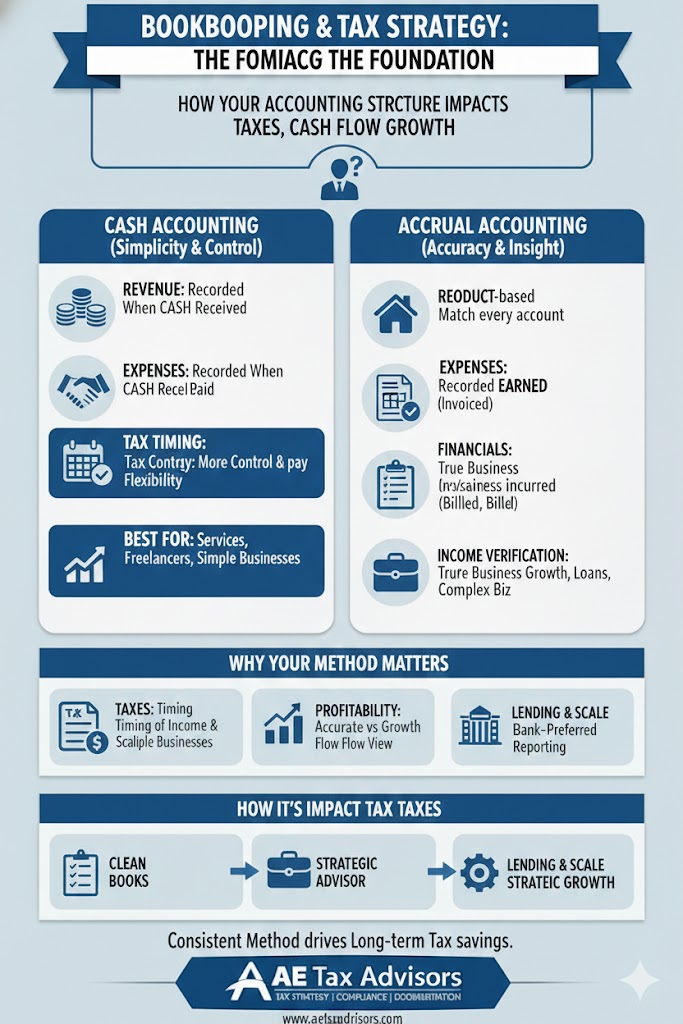
Why Your Accounting Method Matters More Than You Realize
When it comes to why bookkeeping is the foundation, understanding the fundamentals is key. Choosing between cash accounting and accrual accounting is one of the most important bookkeeping decisions a business owner will ever make. Your accounting method influences your tax bill, your financial reporting, your ability to scale, and even how lenders view your business. Most owners think they can switch between methods casually, but the choice affects everything from monthly cash flow strategy to long term tax planning. This guide covers real estate bookkeeping and what it means for your tax situation.
If you want a deeper understanding of why clean books matter before choosing a method, read the article Why Clean Books Matter for High Income Business Owners.
If you need foundational guidance on setting up your bookkeeping system correctly, see The Ultimate Guide to Bookkeeping for Small Business Owners Who Want Lower Taxes.
If you want a monthly process that keeps your accounting method consistent and compliant, review the Monthly Bookkeeping Checklist for Staying Compliant and Ready for Tax Season.
Choosing the right accounting method is not just a technical preference. It impacts how much tax you pay and how accurately you can run your business.
Understanding the Cash Accounting Method
The cash method is the simplest and most common approach for small businesses. It recognizes income when money is received and expenses when money is paid. What matters is cash movement, not invoices or commitments.
Under cash accounting:
You record revenue only when cash hits your bank
You record expenses only when money leaves your account
There is no tracking of accounts receivable
There is no tracking of accounts payable
This method works best for businesses that want simplicity, predictable tax timing, and easy financial tracking.
Advantages of Cash Accounting
Cash accounting offers several benefits for service businesses and new entrepreneurs.
Straightforward tracking
You always know exactly how much cash the business has.
Better control over tax timing
You can delay or accelerate payments strategically to shift taxable income between years.
No need to track complex receivables or payables
Perfect for freelancers, consultants, and businesses with simple operations.
Clear real time cash flow picture
You know your true cash position without adjustments.
Ideal for seasonal businesses
Cash accounting aligns directly with when money enters or leaves the company.
Many business owners choose the cash method because it is easier to understand and maintain, especially when paired with a monthly bookkeeping system like the one outlined in our Monthly Bookkeeping Checklist.
Disadvantages of Cash Accounting
The simplicity of cash accounting also brings limitations.
Unreliable reporting for growing businesses
Your profit may appear low simply because clients have not paid yet.
Harder to get accurate financial statements
Lenders often prefer accrual based financials because they reflect real obligations.
Misleading profitability
You may think you are having a great month because you received a few large payments, even if those payments were for past work.
Not ideal for businesses with inventory
Inventory based businesses often need the accrual method for compliance.
Cash accounting works well until your business reaches a level where better reporting and planning become necessary.
Understanding the Accrual Accounting Method
Accrual accounting recognizes income when it is earned and expenses when they are incurred, not when cash moves. This method reflects the true financial state of your business.
Under accrual accounting:
Revenue is recorded when the work is performed
Expenses are recorded when the obligation is created
Accounts receivable and payable are tracked
Financials reflect economic activity, not just bank activity
This method gives a clearer, more strategic view of your business.
Advantages of Accrual Accounting
Accrual accounting creates accurate financial reporting that supports scaling.
More accurate profit tracking
You see how your business is truly performing month by month.
Better tax planning for complex businesses
It helps you understand trends, margins, and seasonal changes.
Stronger financial statements
Banks and lenders prefer accrual based financials because they show real obligations.
Better insight into business performance
You can evaluate profitability even when cash timing is unpredictable.
Matches revenue to expenses
This makes it easier to see which activities actually generate profit.
For high income earners and businesses preparing for expansion, accrual accounting often becomes necessary for better decision making.
Disadvantages of Accrual Accounting
Accrual accounting requires more detail and consistency.
More complex bookkeeping
You must track receivables, payables, and non cash adjustments.
Cash flow is harder to judge
You may show profit even when cash in the bank is low.
Requires tighter systems
Monthly close processes matter more because timing affects reports.
More time consuming
The books must be kept cleaner and more organized.
Accrual accounting is powerful, but only when the business has the systems and consistency to support it.
How Your Accounting Method Affects Taxes
The method you choose changes how and when income becomes taxable. Your tax bill depends on when revenue appears in the books and when expenses are claimed.
Under cash accounting, you can:
Delay income by holding off deposits
Accelerate expenses by paying vendors early
Control the timing of taxes more easily
Under accrual accounting:
Revenue is taxed as soon as it is earned
Expenses are deducted when incurred
Tax timing becomes more consistent and predictable
Different methods create different tax outcomes. This is why tax planning works best when your bookkeeping method stays consistent and your records stay clean. If your books are messy, read the article Why Clean Books Matter for High Income Business Owners to understand how errors increase tax liability.
Which Businesses Should Use Cash Accounting
Cash accounting works best for:
Service businesses
Consultants
Freelancers
Online coaches
Businesses with simple operations
Businesses without inventory
Businesses prioritizing cash flow visibility
If your income is unpredictable or seasonal, cash accounting gives you clarity.
Cash accounting is also ideal for owners who want the simplest path to clean books, especially when paired with AE Tax Advisors monthly bookkeeping structure.
Which Businesses Should Use Accrual Accounting
Accrual accounting is better for:
Businesses with employees
Businesses with inventory
Agencies
Construction companies
Ecommerce brands
High volume service businesses
Companies seeking loans or financing
Businesses preparing to scale
Accrual accounting offers stronger financial reporting but requires disciplined bookkeeping. If your business is growing, accrual accounting usually becomes necessary.
The IRS Rules for Cash and Accrual Accounting
The IRS allows many businesses to use the cash method, but there are exceptions. You may be required to use the accrual method if:
Your business holds inventory
Your average annual gross receipts exceed IRS thresholds
You are classified as a C corporation
You operate certain types of financial or manufacturing businesses
Most small service businesses can choose either method. However, switching methods requires filing Form 3115 and following IRS procedures, which is why choosing correctly in the beginning matters.
How to Choose the Best Method for Your Business
Choosing the right accounting method depends on your goals, your industry, and the complexity of your financials.
Cash accounting is best if you want:
Simple bookkeeping
Better control over tax timing
Easy cash flow tracking
Straightforward monthly maintenance
Accrual accounting is best if you want:
Accurate insights into long term profitability
Better reporting for lenders
Clear tracking of receivables and payables
A system that supports scaling
If you are unsure which method fits your business, refer back to The Ultimate Guide to Bookkeeping for Small Business Owners Who Want Lower Taxes for a full explanation of how bookkeeping structure shapes your tax outcomes.
How AE Tax Advisors Selects the Right Method for Clients
AE Tax Advisors evaluates three major areas before recommending a method.
Business model
Do you sell services, products, inventory, or long term contracts
Cash flow needs
Do you want simpler reporting or deeper insights
Tax strategy
Do you want more control over timing or more accuracy in planning
We also evaluate:
Merchant systems
Sales cycles
Contract structure
Seasonality
Owner compensation
Growth trajectory
Our goal is not to impose a system but to build the right foundation for your long term financial strategy.
Switching Between Cash and Accrual Accounting
Switching methods is a major financial and tax event. It requires:
An IRS approved Form 3115
Adjusting books for cumulative changes
Reconciling past year financials
Rebuilding charts of accounts
Correcting income and expense timing
Reviewing depreciation schedules
Setting up new workflows
AE Tax Advisors handles method changes for clients who have outgrown their current system or who need cleaner, more accurate reporting for tax planning and scaling.
Why Your Accounting Method Must Stay Consistent All Year
Once you commit to cash or accrual accounting, consistency becomes essential. Inconsistent reporting creates incorrect tax filings and inaccurate financials.
When your method changes unpredictably:
Your tax liability becomes unclear
Your CPA cannot plan projections
Your books lose integrity
Your financial decisions weaken
This is why AE Tax Advisors maintains your method automatically during monthly closes, described in detail in the Monthly Bookkeeping Checklist for Staying Compliant and Ready for Tax Season.
Understanding real estate bookkeeping is essential for maximizing your tax savings as a real estate investor.
When it comes to real estate bookkeeping, working with a specialized tax advisor makes all the difference.
Many investors overlook real estate bookkeeping, but it can be one of the most impactful strategies in your tax plan.
At AE Tax Advisors, we help clients navigate real estate bookkeeping to keep more of what they earn.
Real estate bookkeeping is one of the most important concepts for real estate investors to understand. When properly implemented, real estate bookkeeping can lead to significant tax savings that compound over time.
Many high-income earners miss out on real estate bookkeeping opportunities simply because their CPA lacks the specialized knowledge. A proactive approach to real estate bookkeeping can mean the difference between overpaying and optimizing your tax position.
At AE Tax Advisors, our team specializes in real estate bookkeeping for real estate investors and W-2 professionals. We have helped hundreds of clients use real estate bookkeeping to reduce their tax burden by $50,000 or more annually.
The key to successful real estate bookkeeping implementation is working with an advisor who understands real estate taxation. Every real estate bookkeeping decision should be part of a comprehensive, multi-year tax plan.
If you are not actively using real estate bookkeeping as part of your tax strategy, you are likely leaving money on the table. Contact AE Tax Advisors to learn how real estate bookkeeping can work for your specific situation.
Final Thoughts
Choosing between cash and accrual accounting is more than a technical decision. It determines how your business is measured, how your taxes are calculated, and how confidently you can plan for the future. Cash accounting offers simplicity. Accrual accounting offers clarity. The right choice depends on your goals, your industry, and how you want to grow.
Related services from AE Tax Advisors: real estate professional status support and multi-state real estate tax planning.
With clean bookkeeping, a consistent accounting method, and monthly support from AE Tax Advisors, you gain accurate financials, proactive tax planning, and long term stability.
For more information, refer to the IRS.