

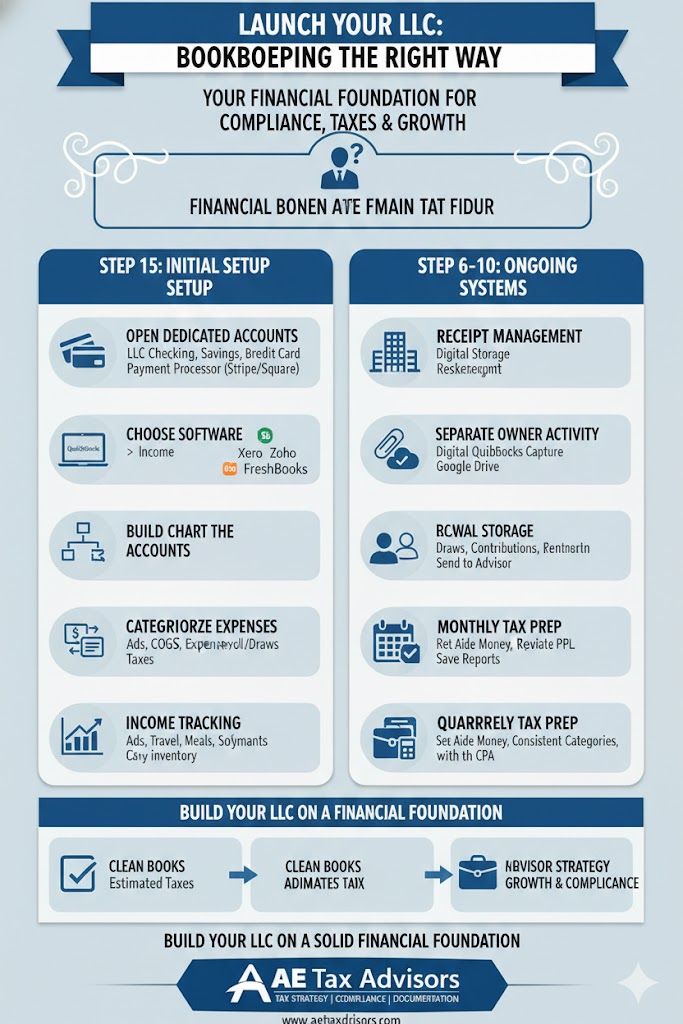
Why Bookkeeping Setup Matters the Moment You Form an LLC
When it comes to how to set up bookkeeping, understanding the fundamentals is key. Starting a new LLC is exciting, but the financial foundation you build on day one determines how smooth or stressful the months ahead will be. Clean bookkeeping is how you stay compliant, organized, and tax ready without scrambling at the end of the year. When owners skip bookkeeping setup in the early stages, mistakes compound, categories become inconsistent, and deductions get lost. This guide covers real estate bookkeeping and what it means for your tax situation.
This guide gives you the complete process to set up bookkeeping for a new LLC the right way. It is long form and built for business owners who want clarity, clean records, and a tax strategy that actually works. Cross reference our other foundational tutorials for deeper understanding, including Why Clean Books Matter for High Income Business Owners and The Ultimate Guide to Bookkeeping for Small Business Owners Who Want Lower Taxes. Both articles help you understand how your financial systems support tax savings.
How a New LLC Should Think About Money Flow
Before you create accounts or install software, you must understand how money should move inside your LLC. Everything starts with separation. Your LLC must operate independently from your personal finances so your liability protection, tax reporting, and accounting remain clean.
Your new LLC should have a structure like this:
A dedicated LLC checking account
A dedicated LLC savings account
A business credit card
A clean bookkeeping system connected to each account
This separation protects your business, supports your entity classification, and keeps tax planning straightforward.
Step One Open Proper Business Accounts
Your bookkeeping cannot begin until your LLC has the right accounts. Many owners start their LLC, wait weeks to open a bank account, then mix personal and business spending. This creates chaos from the start. Opening accounts immediately prevents that.
Open:
A business checking account for all deposits and operating expenses
A business savings account for taxes and reserves
A business credit card for recurring expenses and categorization
A payment processor if needed such as Stripe or Square
The cleaner your banking structure, the cleaner your books will be.
Step Two Choose Your Bookkeeping Software
Your bookkeeping system should not depend on a spreadsheet. You need a platform that updates automatically, categorizes consistently, and syncs with your bank.
These systems work best for new LLC owners:
QuickBooks Online
Xero
Zoho Books
FreshBooks
Choose one platform and commit to using it every month. The goal is consistency. If you want to understand how software choice ties into broader bookkeeping strategy, review Monthly Bookkeeping Checklist for Staying Compliant and Ready for Tax Season.
Step Three Create a Tax Efficient Chart of Accounts
Your chart of accounts is the backbone of your entire bookkeeping system. It determines how every dollar is categorized, how your profit is measured, and how efficient your tax reporting becomes.
Your chart of accounts should include:
Income categories
Cost of goods sold
Operating expenses
Payroll or owner draws
Taxes
Subscriptions
Repairs and maintenance
Marketing
Insurance
Professional services
The more intentional your categories are, the easier tax season becomes. AE Tax Advisors customizes chart of account structures to reduce confusion and support tax planning all year.
Step Four Set Up Your Expense Categories the Right Way
Expense categorization is where new LLC owners lose the most money. Mislabeling expenses or lumping everything together destroys your ability to run tax projections. A clean category structure ensures your CPA can identify deductions, patterns, and opportunities to save money.
Examples of categories every LLC should use:
Advertising
Travel
Meals
Contract labor
Equipment
Merchant fees
Office supplies
Utilities
Internet
Software
Insurance
If you do not know where an expense belongs, document it and categorize it later with your tax advisor. Clean categories lead to cleaner returns.
Step Five Establish Your Income Tracking System
Income must be tracked clearly and consistently from the first dollar in. Inaccurate income creates tax issues, cash flow problems, and confusion about profitability.
Install systems that capture:
Sales
Invoices
Client payments
Stripe payouts
PayPal transfers
ACH deposits
Every deposit should tie back to a source. This keeps your revenue reporting clean and helps your LLC stay audit ready.
Step Six Build a Receipt Management System That Works
Receipts matter. The IRS requires documentation for deductions, and you never want to scramble for proof after an audit notice. Your new LLC should begin with a digital system so nothing gets lost.
Use:
QuickBooks receipt capture
Google Drive
Dropbox
Expensify
Hubdoc
A dedicated receipts email folder
Your goal is to attach receipt documentation directly to the corresponding transaction.
Step Seven Separate Owner Activity From Business Activity
New LLC owners often create bookkeeping problems by mixing personal and business expenses. Even small mistakes can create major headaches later.
Your bookkeeping system must track:
Owner draws
Owner contributions
Reimbursements through an accountable plan
Personal expenses paid with business funds
Business expenses paid with personal funds
This is critical for tax reporting and long term legal protection.
Step Eight Implement a Monthly Close Process From Day One
Even if your business is not generating much revenue yet, you should close the books monthly. This builds the habit early and prevents disorganization.
Your monthly close process should include:
Reconciling all accounts
Categorizing every transaction
Reviewing income trends
Reviewing expense categories
Updating receipts
Checking for duplicates
Reviewing profitability
Saving financial statements
For help building a monthly routine, review Monthly Bookkeeping Checklist for Staying Compliant and Ready for Tax Season.
Step Nine Build a System for Quarterly Tax Preparation
Your LLC will eventually owe taxes, and preparing quarterly makes it easy. You avoid stress, penalties, and year end surprises.
Quarterly preparation includes:
Setting aside money for taxes
Updating your P and L
Tracking payroll or owner draws
Sending updated numbers to your tax advisor
Adjusting strategy
Avoid waiting until the end of the year. Good bookkeeping is proactive.
Step Ten Create a Year Round Tax Ready Bookkeeping Mindset
Your new LLC should operate in a tax ready state all year. This mindset keeps your books clean and lets AE Tax Advisors build long term strategies that save you money.
Year round readiness means:
Your books stay updated
Your categories stay consistent
You reconcile monthly
You store documentation
You separate business and personal
You review financial reports regularly
You communicate with your tax advisor
This is how new LLC owners grow faster with fewer mistakes.
Final Thoughts
Setting up bookkeeping for a new LLC the right way prevents long term headaches and gives you the financial visibility needed to grow with confidence. Clean books help you avoid IRS issues, reduce taxes, and make better decisions. The earlier you implement a system, the stronger your foundation becomes.
Understanding real estate bookkeeping is essential for maximizing your tax savings as a real estate investor.
When it comes to real estate bookkeeping, working with a specialized tax advisor makes all the difference.
Many investors overlook real estate bookkeeping, but it can be one of the most impactful strategies in your tax plan.
At AE Tax Advisors, we help clients navigate real estate bookkeeping to keep more of what they earn.
Real estate bookkeeping is one of the most important concepts for real estate investors to understand. When properly implemented, real estate bookkeeping can lead to significant tax savings that compound over time.
Many high-income earners miss out on real estate bookkeeping opportunities simply because their CPA lacks the specialized knowledge. A proactive approach to real estate bookkeeping can mean the difference between overpaying and optimizing your tax position.
At AE Tax Advisors, our team specializes in real estate bookkeeping for real estate investors and W-2 professionals. We have helped hundreds of clients use real estate bookkeeping to reduce their tax burden by $50,000 or more annually.
Understanding Real estate bookkeeping
Related services from AE Tax Advisors: entity structuring for rental portfolios and real estate bookkeeping review.
Real estate bookkeeping is a critical component of any comprehensive tax strategy for real estate investors. At AE Tax Advisors, we help clients navigate real estate bookkeeping to maximize their tax savings while maintaining full IRS compliance. Our proactive approach ensures you capture every available deduction and credit.
For more information, refer to the IRS Business Structures Guide.