

 This guide covers convert w-2 income passive and what it means for your tax situation.
Understanding How To Convert W-2 Income in 2026
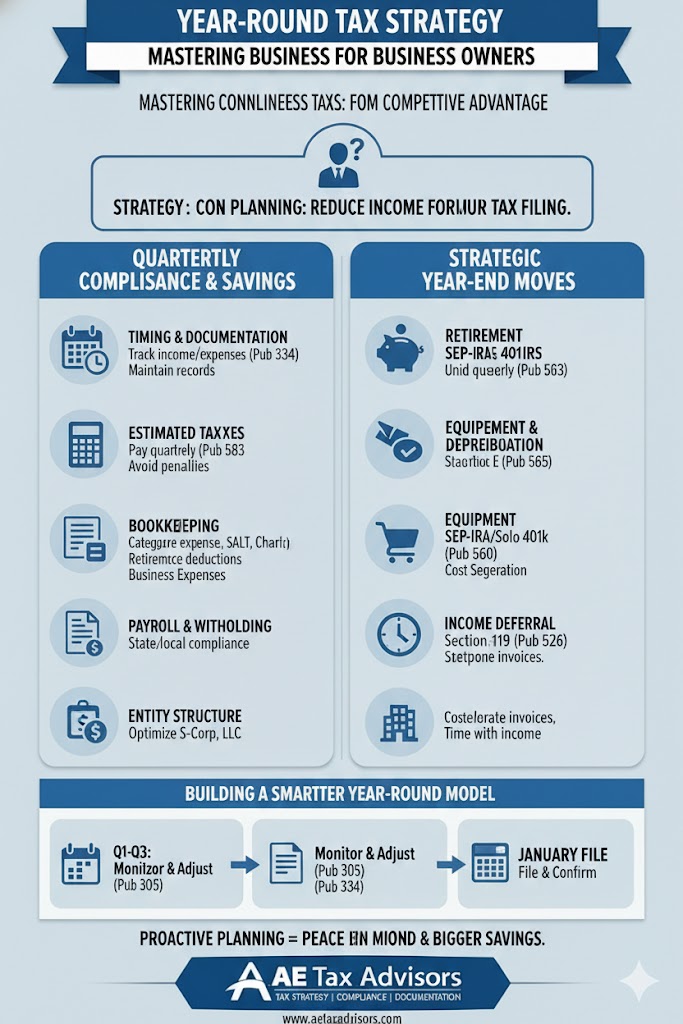
Most entrepreneurs think about taxes once a year — usually in a rush before the deadline. But smart business owners know tax planning isn’t an annual event; it’s a continuous process. The companies that build real wealth work with their advisors every month, not just every March.
At AE Tax Advisors, we teach business owners that year-round planning is the difference between surviving tax season and mastering it. You don’t wait until the scoreboard shows the final numbers to change your strategy — you adjust throughout the game.
1. The IRS Expects Year-Round Accuracy
Taxes for businesses operate on a rolling calendar. IRS Publication 334 makes it clear: income must be reported in the correct year, expenses must be documented as they occur, and estimated payments must be made quarterly.
That means tax compliance isn’t an April event — it’s an ongoing duty. AE Tax Advisors ensures each client’s books, payroll, and entity structure stay current with quarterly updates. This prevents underpayment penalties, last-minute stress, and missed deductions.
Our proactive system builds on The Difference Between Tax Preparation and Tax Planning — preparation records the past; planning designs the future.
2. Cash Flow and Tax Are Inseparable
Every decision that affects cash flow also affects tax outcomes. Buying equipment, hiring staff, leasing property — each carries potential deductions or credits under Publication 535.
AE Tax Advisors integrates tax forecasting into operational cash-flow models. Before spending, our clients know the tax impact. That’s how businesses grow sustainably while remaining fully compliant.
This concept ties back to How AE Tax Advisors Helps You Keep More of What You Earn, where we show that tax awareness is financial intelligence.
3. Quarterly Estimated Taxes Are Not Optional
The IRS requires most small businesses, partnerships, and self-employed individuals to pay estimated taxes four times per year — generally in April, June, September, and January.
Failure to make these payments can result in penalties, even if you end up getting a refund later. AE Tax Advisors projects quarterly obligations using real-time profit-and-loss data, ensuring clients meet Publication 505 safe-harbor thresholds.
By treating tax as a predictable, recurring expense rather than a surprise, we help business owners avoid the cash-flow panic that sinks so many companies in April.
4. Deductions Expire if You Don’t Track Them
You can’t claim what you don’t document. Under IRS Publication 583, businesses must maintain organized records of income, purchases, payroll, and expenses.
AE Tax Advisors implements digital recordkeeping systems that automatically categorize expenses, store receipts, and generate year-end summaries ready for filing. This ongoing documentation ensures that when tax season arrives, your deductions are fully supported — not estimated.
We reinforced this approach in 10 Common Tax Mistakes Most Professionals Make Every Year — proper recordkeeping isn’t optional, it’s protection.
5. Business Expenses Need Strategic Classification
Many business owners miss opportunities simply because they don’t know which expenses qualify. Per Publication 535, deductible costs must be both ordinary and necessary. That includes advertising, insurance, supplies, employee benefits, and travel.
AE Tax Advisors not only tracks these but categorizes them for maximum tax efficiency. For instance:
- Marketing and digital advertising can offset current-year profits.
- Professional fees (like accounting, legal, and consulting) are deductible in the year incurred.
- Education or certification tied directly to your trade is deductible as a business expense.
This granular classification makes every dollar work harder — an idea expanded in How to Legally Lower Your Tax Bill Before December 31.
6. Entity Structure Determines Tax Efficiency
Your business structure defines how profits are taxed — and how much you keep. S-Corps, LLCs, C-Corps, and partnerships all follow different IRS rules.
AE Tax Advisors reviews entity choice annually to ensure it still fits. For example:
- Converting from sole proprietorship to S-Corp can reduce self-employment tax.
- Using management companies can consolidate overhead and enable payroll optimization.
- Partnerships require special allocation tracking for compliance under Publication 541.
We revisit structure regularly because tax codes evolve. The entity that served you last year may no longer be the most efficient this year.
7. Retirement Planning Is a Business Strategy
Retirement contributions are one of the most powerful year-round tax tools available to business owners.
Under Publication 560, SEP-IRAs, SIMPLE IRAs, and Solo 401(k)s allow deductions of up to 25% of business income, capped at federal limits. These not only reduce current taxes but build long-term wealth.
AE Tax Advisors integrates retirement planning with quarterly forecasting — so contributions align with cash flow and IRS deadlines.
We explored this strategy in detail in How AE Tax Advisors Designs Tax Plans for W-2 Clients — and it applies even more strongly to entrepreneurs.
8. Real Estate and Depreciation Drive Hidden Value
Many business owners own their building or equipment — assets that depreciate over time. Depreciation deductions, outlined in Publication 946, can create significant year-to-year savings.
AE Tax Advisors conducts depreciation analyses and cost-segregation studies where applicable, ensuring every allowable deduction is used. This transforms fixed assets into active tax advantages.
Payroll isn’t just cutting checks. It involves federal and state filings, FICA taxes, and employee benefit reporting. Errors can trigger penalties or IRS audits.
AE Tax Advisors audits payroll systems quarterly to ensure compliance with IRS Circular E (Publication 15). We also coordinate with outside payroll providers so tax filings match business returns seamlessly.
10. Year-Round Tax Planning Unlocks Better Financing
Lenders and investors review tax returns to assess financial stability. Clean, strategic filings increase your credibility and borrowing power.
By maintaining accurate books and timely filings, AE Tax Advisors helps clients secure better financing terms. We teach owners how to show strong profit on paper while still minimizing taxable income legally — a skill detailed in How AE Tax Advisors Helps You Keep More of What You Earn.
11. Avoiding Audit Triggers
Consistent, year-round documentation significantly reduces audit risk. Publication 583 emphasizes keeping contemporaneous records — not recreating them later.
AE Tax Advisors aligns every client’s bookkeeping with IRS expectations, eliminating “red flags” like inconsistent expense patterns or unsubstantiated deductions.
12. Planning for State and Local Taxes
Business owners often overlook local tax obligations. State franchise taxes, business licenses, and local sales tax filings vary widely.
AE Tax Advisors builds comprehensive calendars so deadlines are never missed. We track state updates alongside federal regulations to maintain full compliance year-round.
13. The AE Tax Advisors Quarterly Planning Model
Every business client receives four structured reviews each year:
- Q1: Year-start projection and entity evaluation.
- Q2: Estimated payment check and mid-year cash-flow adjustment.
- Q3: Retirement and depreciation optimization.
- Q4: Year-end acceleration and charitable planning.
This method ensures no deduction expires, no credit is missed, and no return is filed reactively.
14. Why Waiting Until Tax Season Costs You
Most business owners who “save money” by skipping quarterly planning pay more later. Missed deductions, late payments, and overpaid taxes add up.
Year-round planning is an investment — one that often delivers immediate ROI through better cash flow and lower tax burdens.
This philosophy builds directly on The Difference Between Tax Preparation and Tax Planning, where we show that reactive filing is the most expensive way to operate.
15. Building Wealth Through Consistent Tax Efficiency
At its core, AE Tax Advisors believes that taxes should fund growth — not frustration. By tracking, planning, and executing year-round, business owners convert compliance into competitive advantage.
Each quarter brings opportunities: new credits, expense timing, equipment purchases, or retirement moves. When guided by professionals who understand both your books and the IRS’s playbook, tax becomes a strategic weapon.
Conclusion: Year-Round Strategy Is the Secret to Long-Term Success
Tax season isn’t when you make decisions — it’s when you confirm them. The smartest business owners collaborate with tax professionals all year, turning the tax code into a business asset.
At AE Tax Advisors, we partner with entrepreneurs to design continuous, compliant, cash-saving strategies. Our advisors follow Publications 334, 535, and 583, keeping you organized, efficient, and legally protected every step of the way.
Understanding convert w-2 income into is essential for maximizing your tax savings as a real estate investor.
When it comes to convert w-2 income into, working with a specialized tax advisor makes all the difference.
Many investors overlook convert w-2 income into, but it can be one of the most impactful strategies in your tax plan.
At AE Tax Advisors, we help clients navigate convert w-2 income into to keep more of what they earn.
Convert w-2 income into is one of the most important concepts for real estate investors to understand. When properly implemented, convert w-2 income into can lead to significant tax savings that compound over time.
Many high-income earners miss out on convert w-2 income into opportunities simply because their CPA lacks the specialized knowledge. A proactive approach to convert w-2 income into can mean the difference between overpaying and optimizing your tax position.
At AE Tax Advisors, our team specializes in convert w-2 income into for real estate investors and W-2 professionals. We have helped hundreds of clients use convert w-2 income into to reduce their tax burden by $50,000 or more annually.
The key to successful convert w-2 income into implementation is working with an advisor who understands real estate taxation. Every convert w-2 income into decision should be part of a comprehensive, multi-year tax plan.
If you are not actively using convert w-2 income into as part of your tax strategy, you are likely leaving money on the table. Contact AE Tax Advisors to learn how convert w-2 income into can work for your specific situation.
Understanding Convert w-2 income passive
Convert w-2 income passive is a critical component of any comprehensive tax strategy for real estate investors. At AE Tax Advisors, we help clients navigate convert w-2 income passive to maximize their tax savings while maintaining full IRS compliance. Our proactive approach ensures you capture every available deduction and credit.