

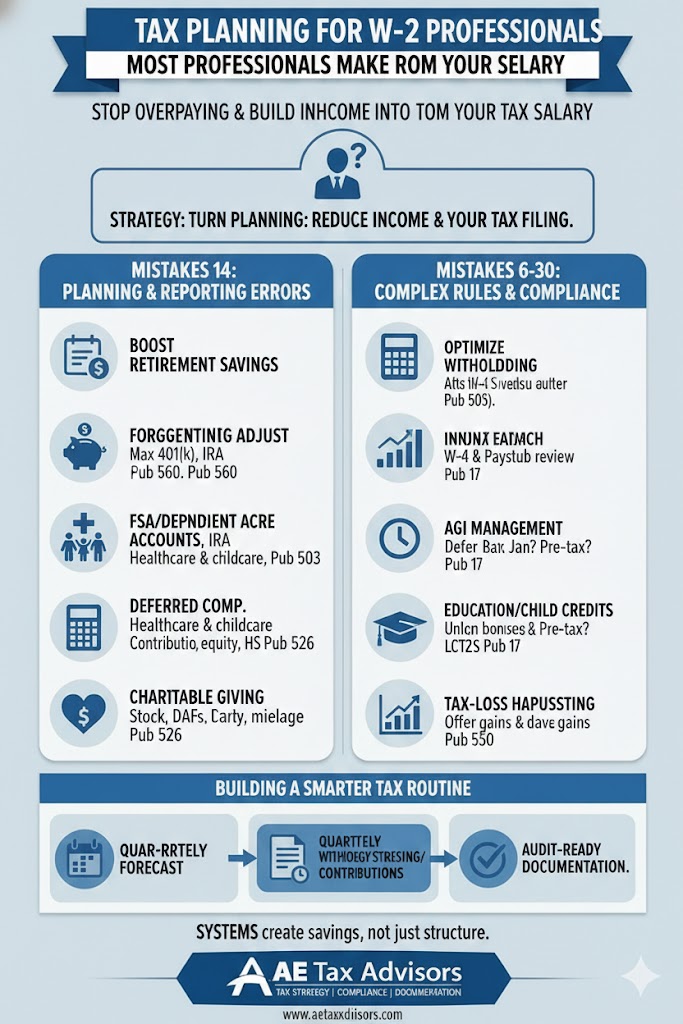
 This guide covers W-2 tax reduction and what it means for your tax situation.
Understanding How Ae Tax Advisors Designs in 2026
Most W-2 earners think they’re stuck with whatever taxes their employer withholds. After all, they don’t run a business, they can’t write off a home office, and payroll seems automatic. Yet the truth is that even salaried professionals can reclaim control of their tax destiny — if they understand how to plan.
At AE Tax Advisors, we build personalized tax strategies for high-income employees, executives, and professionals who want to stop overpaying and start using the tax code the way it was written: to reward smart financial behavior.
1. Understanding How the IRS Treats W-2 Income
Your employer reports wages and withholds taxes under Form W-2, and the IRS expects accuracy. According to IRS Publication 17, W-2 income includes wages, bonuses, and taxable benefits. But how you use deductions, pre-tax benefits, and timing determines your effective tax rate.
This forms the foundation of our system first discussed in The Ultimate Guide to Tax Planning for High-Income W-2 Earners — where knowledge turns ordinary employment income into an efficient wealth-building tool.
2. Starting with Data — Your Pay Stub and W-4
Every AE Tax Advisors engagement begins with a detailed review of the client’s pay stub and Form W-4. This small form drives the entire withholding process. As covered in 10 Common Tax Mistakes Employees Make with Withholding, inaccurate W-4s are the #1 cause of surprises at tax time.
Using Publication 505, our advisors calculate the precise adjustments needed to ensure the right amount is withheld — not too much, not too little.
3. Mapping Adjusted Gross Income (AGI)
Next comes the AGI map. As explained in Understanding Adjusted Gross Income and How to Reduce It, AGI governs eligibility for most credits and deductions.
AE Tax Advisors analyzes every potential adjustment — student-loan interest, HSA funding, IRA contributions, and retirement deferrals — to identify how much income can be legally shielded before the year ends.
4. Leveraging Employer Benefits Strategically
Many W-2 employees overlook powerful savings already embedded in their benefit packages.
Our advisors review:
- Health Savings Accounts (HSAs) under Publication 969,
- Flexible Spending Accounts (FSAs) for healthcare and childcare,
- Dependent-Care Credits per Publication 503, and
- Retirement plans under Publication 560.
By coordinating these, AE Tax Advisors turns passive payroll deductions into an intentional wealth strategy — reducing taxable income while enhancing long-term security.
5. Timing Bonuses and Deferred Compensation
Bonuses often arrive in December, but strategic timing can make a major difference. Deferring a bonus until January shifts it into a new tax year, while increasing pre-tax contributions offsets the impact.
AE Tax Advisors models both scenarios using current IRS brackets and projected income. In How to Legally Lower Your Tax Bill Before December 31, we show how timing alone can trim thousands in tax liability.
6. Maximizing Retirement Contributions
Under Publication 560, the IRS rewards savers with deductible contributions and tax-deferred growth. AE Tax Advisors ensures clients:
- Max out employer 401(k) and catch-up limits.
- Explore after-tax and Roth options for future flexibility.
- Coordinate with outside IRAs to avoid excess contributions under Publication 590-A.
For executives, we analyze non-qualified deferred-compensation plans to align distributions with lower-income years.
7. Integrating Charitable Giving
Charitable strategy isn’t just philanthropy; it’s optimization. Per Publication 526, donations made by December 31 reduce current-year tax liability if itemized. AE Tax Advisors helps clients:
- Donate appreciated stock to bypass capital gains.
- Fund donor-advised funds for immediate deductions.
- Time gifts with high-income years for maximum effect.
This approach complements Tax Credits vs Deductions — Which Saves You More?.
8. Real-Estate and Passive Investments
Even W-2 employees can own real estate or limited partnerships that affect taxes. Under Publication 527 and Publication 946, depreciation and passive-loss rules create unique planning opportunities.
AE Tax Advisors ensures these are integrated without conflicting with wage income — turning side investments into compliant, tax-efficient assets.
9. Quarter-by-Quarter Forecasting
Tax planning for W-2 clients isn’t one meeting a year; it’s four. Each quarter, AE Tax Advisors revisits pay stubs, benefit elections, and projected income to confirm alignment with Publication 505 safe-harbor rules.
This system prevents underpayment penalties and identifies mid-year adjustments before they become problems. It’s the proactive framework introduced in The Difference Between Tax Preparation and Tax Planning.
10. Coordinating Withholding and Estimated Taxes
For dual-income households or employees with investment income, withholding alone may not cover total liability. AE Tax Advisors calculates precise estimated payments using IRS Form 1040-ES tables to balance the equation.
This integration is especially valuable for clients with RSUs, ESPPs, or large bonuses where withholding percentages rarely match final effective tax rates.
11. Planning for Credits and Phase-Outs
Many credits disappear as income climbs. AE Tax Advisors models AGI to preserve eligibility for:
- Child Tax Credit,
- Saver’s Credit, and
- Education Credits (per Publication 970).
By adjusting pre-tax contributions, we can often reclaim credits that would otherwise phase out — blending strategy from Tax Credits vs Deductions — Which Saves You More? and Understanding Adjusted Gross Income.
12. Using Employer Equity Wisely
Stock options and restricted stock units (RSUs) can be either tax traps or goldmines. AE Tax Advisors reviews grant agreements, exercise timing, and potential AMT exposure under Publication 525.
We help employees coordinate option exercises with high-deduction years or charitable stock donations, following the same strategic sequencing outlined in How AE Tax Advisors Helps You Keep More of What You Earn.
13. Audit-Proof Documentation
Every deduction, deferral, or credit must be supported. AE Tax Advisors structures digital record-keeping per Publication 583 so clients can substantiate everything if the IRS ever asks.
We maintain encrypted copies of receipts, charitable acknowledgments, and payroll records — turning potential audits into simple verifications.
14. Education and Transparency
The IRS guarantees every taxpayer “the right to be informed.” AE Tax Advisors upholds that standard by teaching clients why each recommendation works.
Our educational reports summarize applicable code sections and publication references, giving clients the confidence that their savings are both legal and durable.
15. The AE Tax Advisors W-2 Planning Framework
- Collect data: W-2, pay stubs, benefits, investments.
- Analyze withholding: Apply Publication 505 safe-harbor logic.
- Model AGI: Identify legal reduction opportunities.
- Implement benefits: Maximize pre-tax programs.
- Forecast quarterly: Track changes and adjust in real time.
- Document everything: Ensure compliance under Publication 583.
This system turns ordinary employment income into an efficient, predictable wealth-building engine.
Conclusion: Planning Transforms Paychecks
You can’t rewrite your W-2, but you can redesign its outcome. With the right plan, a salaried job can generate the same strategic flexibility entrepreneurs enjoy.
At AE Tax Advisors, we bring proactive planning to employees who refuse to settle for reactive filing. Using verified IRS guidelines and decades of expertise, we show you how to legally lower your taxable income, protect your earnings, and plan for a future built on clarity — not confusion.
When your paychecks work as strategically as your career, that’s when true financial confidence begins.
Understanding W-2 tax reduction is essential for maximizing your tax savings as a real estate investor.
When it comes to W-2 tax reduction, working with a specialized tax advisor makes all the difference.
Many investors overlook W-2 tax reduction, but it can be one of the most impactful strategies in your tax plan.
At AE Tax Advisors, we help clients navigate W-2 tax reduction to keep more of what they earn.
W-2 tax reduction is one of the most important concepts for real estate investors to understand. When properly implemented, W-2 tax reduction can lead to significant tax savings that compound over time.
Many high-income earners miss out on W-2 tax reduction opportunities simply because their CPA lacks the specialized knowledge. A proactive approach to W-2 tax reduction can mean the difference between overpaying and optimizing your tax position.
At AE Tax Advisors, our team specializes in W-2 tax reduction for real estate investors and W-2 professionals. We have helped hundreds of clients use W-2 tax reduction to reduce their tax burden by $50,000 or more annually.
Understanding W-2 tax reduction
W-2 tax reduction is a critical component of any comprehensive tax strategy for real estate investors. At AE Tax Advisors, we help clients navigate W-2 tax reduction to maximize their tax savings while maintaining full IRS compliance. Our proactive approach ensures you capture every available deduction and credit.