

 This guide covers build accountable plan business and what it means for your tax situation.
Understanding How To Build An Accountable in 2026
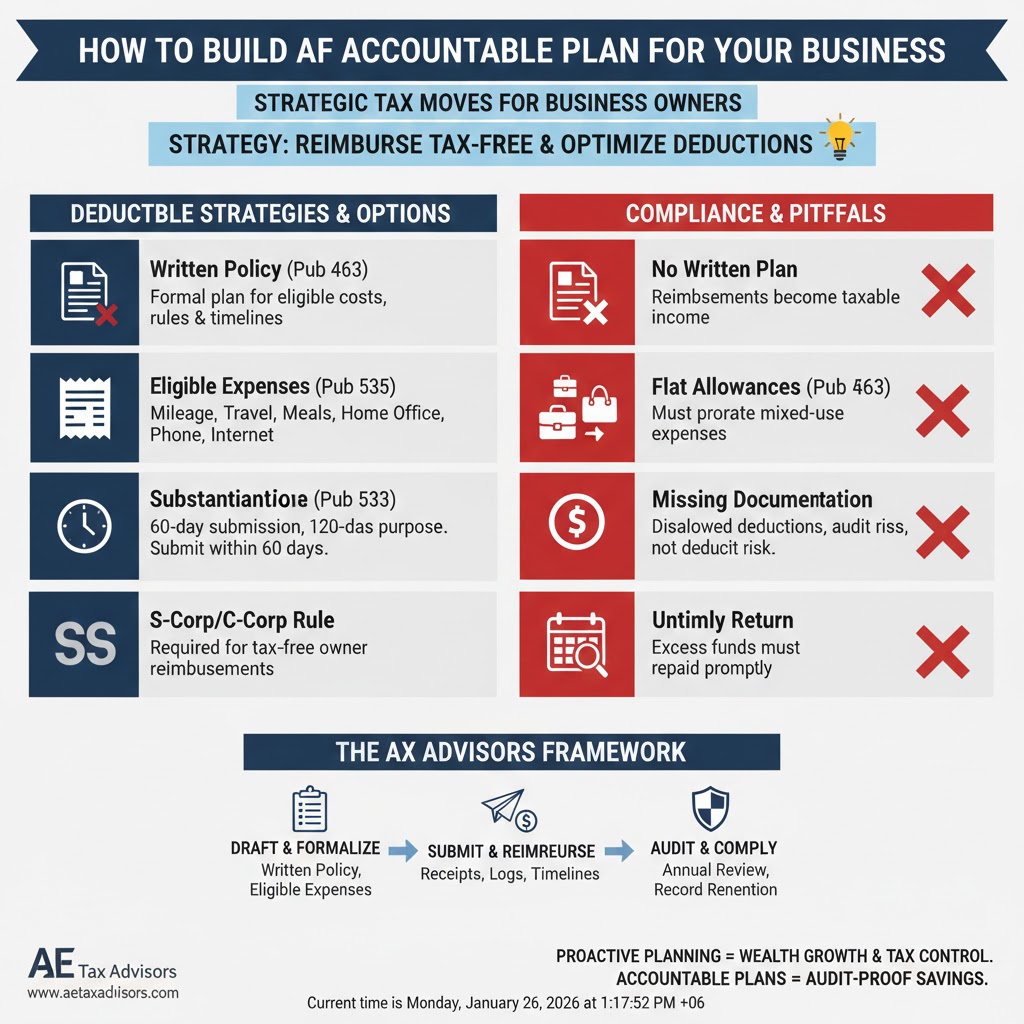
An accountable plan is one of the most powerful — yet underused — tax tools for business owners. It allows companies to reimburse employees or owners for business expenses without those reimbursements being treated as taxable income. When structured properly, you can pay yourself back for mileage, home-office costs, and other legitimate expenses — all tax-free.
At AE Tax Advisors, we help business owners design, document, and implement accountable plans that satisfy the IRS rules under Publications 463, 535, and 15-A, maximizing deductions while maintaining bulletproof compliance.
This article builds on The Ultimate Guide to S-Corporation Salary Optimization, The Complete Guide to Hiring Family Members in Your Business, and The Smart Way to Deduct Vehicle Expenses for Business.
What Is an Accountable Plan?
An accountable plan is a written policy that allows a business to reimburse employees (including owner-employees) for legitimate business expenses. These reimbursements are deductible for the company and not taxable to the employee — provided specific documentation rules are followed.
Under Publication 463, reimbursements must meet three IRS requirements:
- Business Connection: The expense must relate directly to your trade or business.
- Substantiation: You must provide proof (receipts, mileage logs, etc.) within a reasonable time.
- Return of Excess: Any overpayment or excess reimbursement must be returned to the company.
AE Tax Advisors drafts custom accountable plans that satisfy all three tests and integrate seamlessly with payroll and bookkeeping systems.
Step 1: Establish a Written Policy
The IRS expects accountable plans to be in writing. A clear written policy should state:
- What types of expenses are eligible for reimbursement.
- What documentation is required.
- How and when reimbursements will be submitted.
- The timeline for returning excess funds.
AE Tax Advisors provides templates and customized policy language that mirror IRS expectations outlined in Publication 15-A.
Step 2: Identify Eligible Expenses
Common reimbursable expenses under an accountable plan include:
- Mileage and vehicle costs (business portion).
- Travel, lodging, and meals.
- Home-office expenses (pro rata share).
- Cell phone and internet used for business.
- Professional dues, software, or subscriptions.
- Continuing education and certifications.
This connects directly to How to Write Off Your Cell Phone and Internet for Business Use and How to Legally Reimburse Yourself for Home Office Expenses.
Step 3: Set Reimbursement Procedures
The IRS requires a clear process for employees to submit expenses. Under Publication 463, documentation should include:
- Receipts or mileage logs.
- Date, amount, and business purpose of each expense.
- Submissions within 60 days of the expense.
AE Tax Advisors recommends businesses use digital submission tools (QuickBooks, Gusto, or Google Forms) to standardize reporting and create an automatic audit trail.
Step 4: Define “Reasonable Time”
According to Publication 463, reasonable time means:
- 60 days to submit expense reports.
- 120 days to return excess funds.
- Annual reconciliation of reimbursements and policy compliance.
AE Tax Advisors structures each policy with these timeframes, aligning them with quarterly accounting reviews.
Step 5: Reimbursements for Owners and Employees
Sole Proprietors and LLCs (Schedule C):
- Can deduct business expenses directly without a formal plan.
- However, written reimbursement plans still help maintain documentation discipline.
S-Corporations and C-Corporations:
- Must use accountable plans to make tax-free reimbursements to owners and employees.
- Without one, reimbursements become taxable income or non-deductible draws.
AE Tax Advisors integrates accountable plans with payroll systems, ensuring tax-free treatment under Publication 15-A.
Step 6: Reimburse Home Office and Utilities
If your business uses part of your home for administrative functions, the company can reimburse a proportional share of home expenses — rent, mortgage interest, utilities, and insurance — through the accountable plan.
This reimbursement must align with the business-use percentage calculated under Publication 587.
AE Tax Advisors provides detailed spreadsheets for calculating and documenting home-office reimbursements.
This ties directly to How to Legally Reimburse Yourself for Home Office Expenses.
Step 7: Mileage and Vehicle Reimbursements
Mileage reimbursements are one of the most common uses of accountable plans. The IRS standard mileage rate for 2025 is 67 cents per mile.
To qualify:
- Keep contemporaneous mileage logs showing dates, destinations, and business purpose.
- Submit reports at least quarterly.
AE Tax Advisors provides clients with digital mileage-tracking tools and templates that meet Publication 463 substantiation requirements.
This connects to The Smart Way to Deduct Vehicle Expenses for Business.
Step 8: Travel and Meals
Travel and meal expenses are deductible when incurred for business purposes and substantiated with receipts and meeting notes. Under Publication 463, only 50% of meals are typically deductible, while travel and lodging are 100%.
AE Tax Advisors ensures travel reimbursements are properly classified and recorded to prevent double deductions between company and individual returns.
This aligns with The Complete Guide to Travel, Meals, and Entertainment Deductions.
Step 9: Avoid Common Accountable Plan Mistakes
- No written plan. Oral agreements don’t meet IRS requirements.
- Mixing business and personal expenses. Always prorate mixed-use items.
- Paying flat allowances instead of reimbursements. Flat stipends are taxable income.
- Failing to return excess payments. Must be repaid within a reasonable time.
- Inconsistent documentation. Missing receipts can disqualify reimbursements.
AE Tax Advisors performs annual plan reviews to ensure policies remain compliant with IRS updates and Publication 535.
Step 10: Coordinate With Payroll and Bookkeeping
Every accountable plan should be integrated into the business’s financial systems. Reimbursements should flow through:
- A separate “Expense Reimbursement” account in QuickBooks.
- Payroll if paid on regular cycles.
- Direct bank transfers for clear documentation.
AE Tax Advisors configures client accounting systems to automate reimbursements and maintain clean audit records.
Step 11: Audit-Proofing and Record Retention
Under Publication 583, businesses must retain documentation for at least seven years. AE Tax Advisors recommends keeping digital copies of all expense reports, receipts, and mileage logs to support any IRS inquiry.
This connects to How to Build an Audit-Proof Recordkeeping System.
AE Tax Advisors Accountable Plan Framework
- Draft written plan outlining eligible expenses and timelines.
- Require receipts and proof of business connection.
- Enforce submission and repayment deadlines.
- Record reimbursements through accounting or payroll.
- Reconcile quarterly for accuracy and compliance.
This framework aligns with IRS Publications 463, 535, and 15-A, ensuring defensible reimbursements that reduce taxes and simplify audits.
Conclusion: Reimburse Smarter, Not Harder
A well-drafted accountable plan transforms ordinary expenses into strategic tax savings. It allows you to pay yourself back for legitimate business costs without adding taxable income — all while keeping your books clean and your compliance strong.
At AE Tax Advisors,, we design customized accountable plans that fit your business structure, integrate with payroll, and stand up under IRS scrutiny. Every reimbursement becomes an opportunity for precision, compliance, and efficiency.
Understanding build accountable plan business is essential for maximizing your tax savings as a real estate investor.
When it comes to build accountable plan business, working with a specialized tax advisor makes all the difference.
Many investors overlook build accountable plan business, but it can be one of the most impactful strategies in your tax plan.
At AE Tax Advisors, we help clients navigate build accountable plan business to keep more of what they earn.
Build accountable plan business is one of the most important concepts for real estate investors to understand. When properly implemented, build accountable plan business can lead to significant tax savings that compound over time.
Many high-income earners miss out on build accountable plan business opportunities simply because their CPA lacks the specialized knowledge. A proactive approach to build accountable plan business can mean the difference between overpaying and optimizing your tax position.
At AE Tax Advisors, our team specializes in build accountable plan business for real estate investors and W-2 professionals. We have helped hundreds of clients use build accountable plan business to reduce their tax burden by $50,000 or more annually.
Understanding Build accountable plan business
Build accountable plan business is a critical component of any comprehensive tax strategy for real estate investors. At AE Tax Advisors, we help clients navigate build accountable plan business to maximize their tax savings while maintaining full IRS compliance. Our proactive approach ensures you capture every available deduction and credit.
For more information, refer to the IRS.