

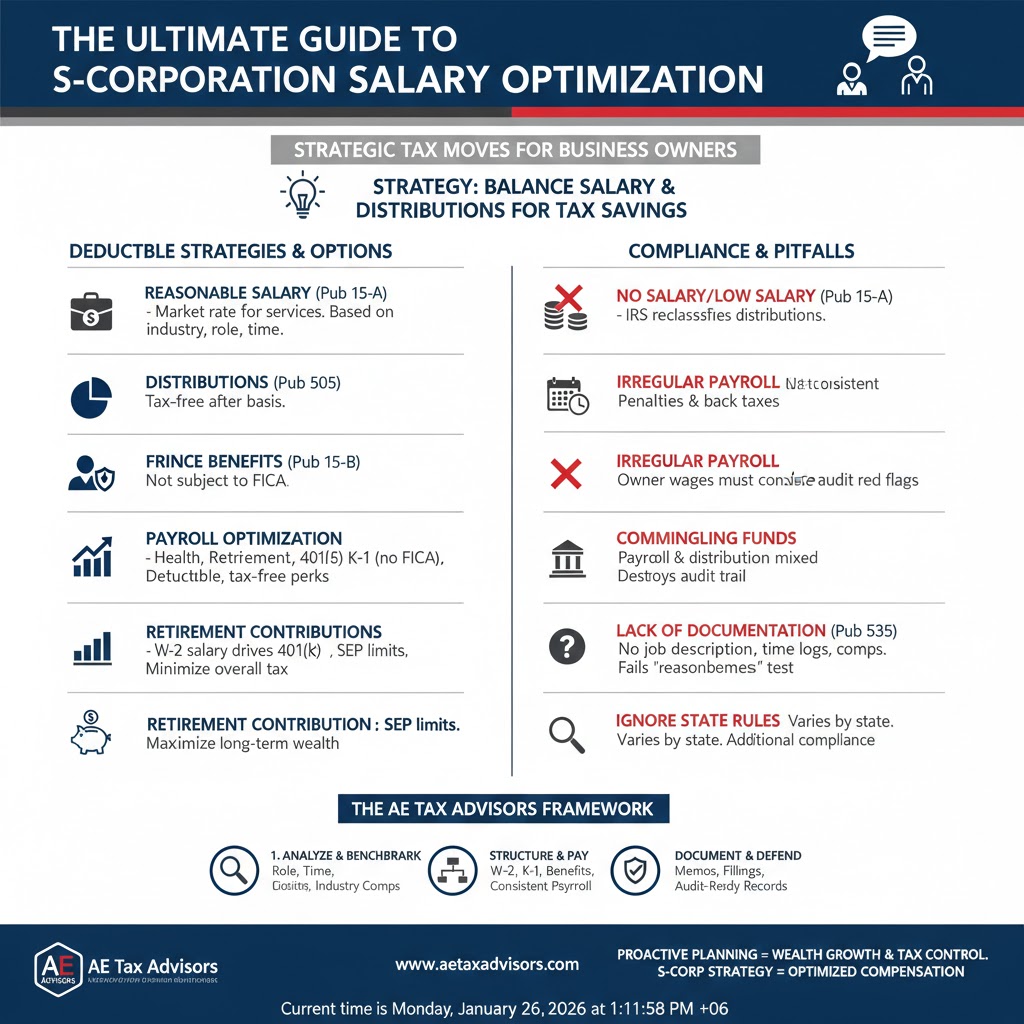
 This guide covers S-Corp tax strategy and what it means for your tax situation.
Understanding The Ultimate Guide To S-corporation in 2026
For business owners who elect S-Corporation status, the salary you pay yourself is one of the most critical — and misunderstood — parts of tax planning. The IRS requires “reasonable compensation,” but doesn’t define it precisely, leaving room for strategy and risk.
At AE Tax Advisors, we help business owners strike the perfect balance between salary and distributions under IRS Publications 15-A, 535, and 505, ensuring compliance, audit defensibility, and maximum tax efficiency.
This guide expands on The Complete Guide to Hiring Family Members in Your Business, The Business Owner’s Blueprint, and The Tax-Free Empire.
Why Salary Matters in an S-Corporation
S-Corporations allow income to “pass through” to owners, avoiding double taxation. However, the IRS requires owners who materially participate to take a reasonable salary subject to payroll taxes before taking any shareholder distributions.
If you pay too little, the IRS can reclassify distributions as wages, assess back taxes, and impose penalties. If you pay too much, you unnecessarily increase payroll tax exposure.
AE Tax Advisors designs compensation frameworks that optimize both sides — compliance first, savings second.
Step 1: Define “Reasonable Compensation”
Under Publication 15-A, reasonable compensation equals what a comparable business would pay for similar services under similar circumstances.
Factors considered include:
- Duties and responsibilities.
- Time devoted to the business.
- Training, experience, and qualifications.
- Business size, complexity, and revenue.
- Compensation of comparable non-shareholder employees.
AE Tax Advisors benchmarks owner salaries using industry data, regional comparisons, and IRS Job Aid guidelines from the Reasonable Compensation Issue Sheet.
Step 2: Establish Your Total Compensation Model
An owner’s total economic benefit includes:
- Salary (W-2 wages). Subject to payroll tax.
- Distributions (K-1 income). Not subject to FICA.
- Benefits and fringe items. Health, retirement, vehicle, or housing perks.
AE Tax Advisors builds individualized models balancing these three categories while maintaining IRS compliance and optimizing take-home cash.
Step 3: Benchmark Your Salary to Industry Standards
The IRS regularly reviews salary levels by industry. For example, accountants, consultants, and real-estate professionals often trigger audits due to low wage ratios.
AE Tax Advisors uses third-party databases and Bureau of Labor Statistics (BLS) data to justify wages within the median range for your profession.
Example:
- Net business profit: $300,000
- Comparable salary range: $80,000 – $120,000
- Selected salary: $90,000 (W-2) + $210,000 distributions
This structure satisfies “reasonableness” while minimizing unnecessary FICA exposure.
Step 4: Coordinate With Payroll Timing and Withholding
Under Publication 505, owners must withhold payroll taxes consistently throughout the year. Irregular or lump-sum payments raise red flags.
AE Tax Advisors structures owner payroll on a monthly or bi-weekly cadence to align with IRS withholding expectations and state labor rules.
Step 5: Leverage Fringe Benefits and Reimbursements
Beyond base salary, S-Corp owners can use fringe benefits and accountable plan reimbursements to reduce taxable wages without reducing total compensation.
Examples include:
- Health insurance premiums (deductible and excludable if reported correctly).
- Mileage and home-office reimbursements under accountable plans.
- Educational and professional development benefits.
AE Tax Advisors coordinates these strategies with The Ultimate Guide to Fringe Benefits and Tax-Free Employee Perks for seamless integration.
Step 6: Adjust for Multiple Owners or Spouses
When multiple shareholders or spouses are involved, salaries must reflect individual services rendered. Unequal ownership does not automatically justify unequal pay.
AE Tax Advisors documents each shareholder’s role, duties, and time commitment to substantiate payroll allocations under Publication 15-A.
Step 7: Handle Distributions Correctly
Once reasonable wages are paid, remaining profits can be distributed tax-free (to the extent of basis). However, these payments must be recorded separately from payroll.
AE Tax Advisors implements dual-entry systems ensuring:
- Payroll taxes apply only to W-2 wages.
- Distributions are recorded via owner-equity accounts.
- Basis adjustments are tracked annually.
This process ties directly to The Family Office Formula and The Tax-Free Empire.
Step 8: Plan for Payroll Tax Optimization
S-Corp owners pay 15.3% in combined Social Security and Medicare taxes on wages but not on distributions. Properly balancing the two can reduce total tax exposure dramatically.
Example:
- 100% salary model: $200,000 × 15.3% = $30,600 FICA.
- Optimized split: $90,000 salary + $110,000 distribution → $13,770 FICA.
Savings: ≈ $16,830 per year.
AE Tax Advisors helps calibrate these ratios while maintaining IRS defensibility.
Step 9: Address Retirement Plan Contributions
Your W-2 wages determine retirement contribution limits. Setting salary too low restricts your ability to contribute to 401(k), SEP, or defined-benefit plans.
AE Tax Advisors models contribution scenarios to balance tax savings now with long-term wealth accumulation, connecting this topic to The Family Office Formula.
Step 10: Avoid Common S-Corporation Payroll Mistakes
- Paying no salary at all.
- Paying only distributions with no payroll records.
- Failing to file payroll tax returns (Forms 941 and 940).
- Misclassifying reimbursements as non-taxable when they lack documentation.
- Neglecting state-level payroll obligations.
AE Tax Advisors monitors quarterly filings and integrates payroll systems to maintain compliance year-round.
Step 11: Integrate Family Employment and Fringe Benefits
If family members are also employees or shareholders, coordinate their salaries and benefits with your own to ensure consistency.
Publication 15-A requires all wages to be “ordinary and necessary,” regardless of relationship. AE Tax Advisors structures this within entity-level compliance covered in The Complete Guide to Hiring Family Members in Your Business.
Step 12: Prepare for IRS Review or Audit
The IRS routinely examines S-Corporation compensation during audits. To protect yourself:
- Keep payroll and distribution documentation separate.
- Maintain industry comparison reports.
- Retain accountant memos explaining salary methodology.
AE Tax Advisors prepares written reasonable-compensation memoranda for clients each year, referencing Publications 15-A and 535 to establish a defensible position.
AE Tax Advisors S-Corporation Compensation Framework
- Define reasonable compensation standards.
- Determine salary range based on industry and role.
- Schedule consistent payroll and withholding.
- Separate distributions from wages in accounting.
- Layer on fringe benefits and reimbursements.
- Document salary analysis for audit defense.
This approach aligns with IRS Publications 15-A, 535, and 505, achieving the dual goal of compliance and optimization.
Conclusion: Pay Yourself Right — Legally and Strategically
The difference between a good S-Corporation and a great one often comes down to how the owner’s salary is structured. The right balance minimizes taxes, funds retirement, and keeps the business fully compliant.
At AE Tax Advisors, we help owners build salary strategies that stand up to IRS scrutiny while maximizing efficiency. Every paycheck becomes a tax-planning tool — when guided by structure, data, and discipline.
Understanding S-Corp tax strategy is essential for maximizing your tax savings as a real estate investor.
When it comes to S-Corp tax strategy, working with a specialized tax advisor makes all the difference.
Many investors overlook S-Corp tax strategy, but it can be one of the most impactful strategies in your tax plan.
At AE Tax Advisors, we help clients navigate S-Corp tax strategy to keep more of what they earn.
S-Corp tax strategy is one of the most important concepts for real estate investors to understand. When properly implemented, S-Corp tax strategy can lead to significant tax savings that compound over time.
Many high-income earners miss out on S-Corp tax strategy opportunities simply because their CPA lacks the specialized knowledge. A proactive approach to S-Corp tax strategy can mean the difference between overpaying and optimizing your tax position.
At AE Tax Advisors, our team specializes in S-Corp tax strategy for real estate investors and W-2 professionals. We have helped hundreds of clients use S-Corp tax strategy to reduce their tax burden by $50,000 or more annually.
Understanding S-Corp tax strategy
S-Corp tax strategy is a critical component of any comprehensive tax strategy for real estate investors. At AE Tax Advisors, we help clients navigate S-Corp tax strategy to maximize their tax savings while maintaining full IRS compliance. Our proactive approach ensures you capture every available deduction and credit.
For more information, refer to the IRS S-Corporation guidance.