

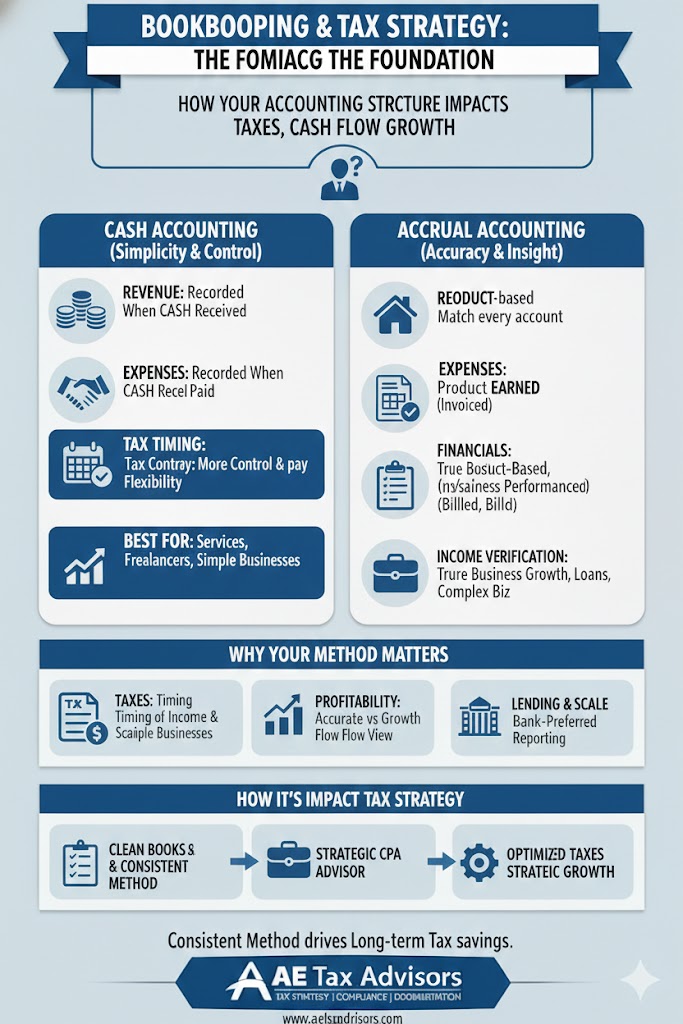
 This guide covers accounting method matters think and what it means for your tax situation.
Understanding Why Your Accounting Method Matters in 2026
Choosing between cash accounting and accrual accounting does much more than change how your books look. It affects your tax bill, your financial clarity, the way your business reports income, how your CPA plans ahead, and even how lenders analyze your financials. Most business owners pick a method without realizing what it means for their future.
Your accounting method determines when revenue is recognized, when expenses are deducted, and how accurately you can see the financial performance of your business throughout the year. The right choice supports long term tax efficiency, easier bookkeeping, and cleaner financial reports. The wrong choice creates confusion, inaccurate profit tracking, and limited tax planning options.
If you have not yet reviewed our foundational articles, read these for context before choosing a method:
• Why Clean Books Matter for High Income Business Owners
• The Ultimate Guide to Bookkeeping for Small Business Owners Who Want Lower Taxes
• Monthly Bookkeeping Checklist for Staying Compliant and Ready for Tax Season
These articles lay the groundwork for understanding why your bookkeeping system must be clean before you commit to cash or accrual accounting.
What Is Cash Accounting
Cash accounting records revenue when money hits your bank account and records expenses when you actually pay them. It is simple, easy to understand, and ideal for many small business owners who want straightforward bookkeeping without complex adjustments.
With cash accounting, the books match the bank balance closely. You always see your available cash, and your tax reporting stays simple. This is one reason many service based businesses, single member LLCs, and early stage operations choose cash accounting.
On a cash basis, you only pay taxes on the income you actually collected. Unpaid invoices do not count as income. This reduces surprises and keeps taxes more predictable.
The Benefits of Cash Accounting for Small Business Owners
Cash accounting keeps things simple and predictable. The biggest benefits include:
• Straightforward reporting
• Easier bookkeeping and fewer adjustments
• Taxes due only when cash is received
• Lower complexity for small teams
• Clear visibility into cash flow
• Perfect for service businesses and new LLCs
Because it is simple, it is also ideal for business owners who need to keep their books accurate without getting overwhelmed. And when paired with a strong monthly process like the one described in Monthly Bookkeeping Checklist for Staying Compliant and Ready for Tax Season, cash accounting gives you consistent clarity all year.
The Limitations of Cash Accounting
Even though cash accounting is simple, it has real limitations for growing businesses.
Cash basis does not:
• Show future liabilities
• Show income that you earned but have not collected
• Show expenses you owe but have not paid
• Accurately reflect profitability for businesses with significant receivables
• Support advanced financial modeling
• Provide the insight lenders want to see
As your business scales, cash basis bookkeeping sometimes becomes too shallow to guide strong financial decisions. You might appear more profitable than you are, or less profitable than you are, depending on the timing of transactions.
What Is Accrual Accounting
Accrual accounting records income when it is earned and expenses when they are incurred, even before money moves in or out. It reflects what truly happened in the business instead of what simply cleared the bank. This creates a more accurate financial picture.
Accrual accounting is essential for businesses with:
• Invoicing
• Inventory
• Vendor terms
• Large contractor networks
• Deferred revenue
• High volume operations
• Multiple revenue channels
• Growing teams
Accrual shows what you genuinely earned and what you genuinely owe, giving you a long term view of profitability.
The Benefits of Accrual Accounting
Accrual accounting is more work, but it gives you deeper clarity. Benefits include:
• More accurate profit tracking
• Better understanding of real performance
• Ability to plan ahead using earned revenue
• Insight into upcoming liabilities
• Stronger financial statements for lenders
• Cleaner growth forecasting
• Better matching of expenses to revenue
For scaling businesses, accrual accounting is often the only method that keeps the financial picture accurate.
The Limitations of Accrual Accounting
Accrual accounting is more complex. It often requires:
• A bookkeeper or CPA
• Adjusting entries
• Reliable invoicing and billing systems
• Regular reconciliation
• A monthly close process
• More detailed financial controls
Without a strong bookkeeping system, accrual accounting becomes messy quickly. This is why we emphasized clean systems in Why Clean Books Matter for High Income Business Owners. When accrual is done correctly, it is powerful. When done poorly, it creates confusion.
How Your Accounting Method Impacts Your Taxes
Your accounting method directly affects your taxable income.
On cash accounting:
• You pay taxes only on money collected
• You deduct expenses only when paid
On accrual accounting:
• You pay taxes when revenue is earned
• You deduct expenses when incurred
This means that accrual may show higher income in months where you billed heavily but have not been paid. This surprises business owners who switch to accrual without understanding how the IRS views earned income.
Your method influences:
• The timing of tax payments
• The accuracy of tax projections
• Eligibility for certain strategies
• Whether your CPA can plan effectively
• Your end of year deductions
• How depreciation integrates into your books
Both methods can support strong tax planning, but they must be used consistently and correctly.
When Cash Accounting Is the Best Fit
Cash accounting is usually best if you:
• Own a service based business
• Have minimal inventory
• Do not send many invoices
• Need simple books
• Want straightforward tax reporting
• Are under the IRS threshold for accrual requirements
• Are in the early growth stage
If your business is small, lean, and cash driven, you may not need accrual accounting yet.
When Accrual Accounting Is the Best Fit
Accrual accounting is ideal if you:
• Operate at scale
• Invoice clients monthly
• Manage inventory
• Make long term financial decisions
• Need strong reporting for lenders
• Have variable revenue cycles
• Run a construction, medical, agency, or product business
• Want accurate profit tracking
If you plan on growing aggressively, accrual accounting often gives you the clarity required to scale responsibly.
Switching from Cash to Accrual or Vice Versa
You can switch methods, but it must be done carefully. The IRS requires consistency once a method is chosen. Switching without a formal process creates mismatched income, incorrect deductions, and audit exposure.
A proper switch includes:
• IRS Form 3115 (Change in Accounting Method)
• Adjusting prior year numbers
• Cleaning historical transactions
• Aligning categories
• Updating your chart of accounts
• Rebuilding starting balances
• Reconfiguring your bookkeeping system
This is one of the reasons AE Tax Advisors handles accounting method transitions for high income business owners who are scaling quickly.
How to Decide Which Method Is Right for Your Business
Ask yourself these questions:
Do you invoice clients?
Do you carry inventory?
Do you need financials for financing?
Do you have a large team?
Do your expenses and revenue fluctuate?
Do you plan to scale aggressively?
Does your CPA need more accurate data?
Do you want to strengthen your tax positioning?
If your business is simple and cash based, the cash method is fine.
If your business relies on timing, billing cycles, or inventory, accrual may be the right move.
How Your Accounting Method Affects Tax Strategy
Your tax strategy relies heavily on your accounting method. Here is how:
Cash accounting helps with:
• Deferring income when needed
• Accelerating deductions at year end
• Clean and simple projections
Accrual accounting helps with:
• Matching revenue and expenses
• Stronger multi year forecasting
• Scaling with better financial control
• Better reporting for lenders
This decision influences everything that AE Tax Advisors does for your tax plan. It sets the foundation for QBI calculations, payroll analysis, depreciation timing, and long term planning.
Understanding accounting method matters more is essential for maximizing your tax savings as a real estate investor.
When it comes to accounting method matters more, working with a specialized tax advisor makes all the difference.
Many investors overlook accounting method matters more, but it can be one of the most impactful strategies in your tax plan.
At AE Tax Advisors, we help clients navigate accounting method matters more to keep more of what they earn.
Accounting method matters more is one of the most important concepts for real estate investors to understand. When properly implemented, accounting method matters more can lead to significant tax savings that compound over time.
Many high-income earners miss out on accounting method matters more opportunities simply because their CPA lacks the specialized knowledge. A proactive approach to accounting method matters more can mean the difference between overpaying and optimizing your tax position.
At AE Tax Advisors, our team specializes in accounting method matters more for real estate investors and W-2 professionals. We have helped hundreds of clients use accounting method matters more to reduce their tax burden by $50,000 or more annually.
The key to successful accounting method matters more implementation is working with an advisor who understands real estate taxation. Every accounting method matters more decision should be part of a comprehensive, multi-year tax plan.
If you are not actively using accounting method matters more as part of your tax strategy, you are likely leaving money on the table. Contact AE Tax Advisors to learn how accounting method matters more can work for your specific situation.
Final Thoughts
Related services from AE Tax Advisors: long-term rental tax planning and rental tax filing cleanup.
Choosing between cash and accrual accounting is not just an accounting decision. It is a tax decision, a growth decision, a reporting decision, and a clarity decision. The right method supports your long term goals, strengthens your bookkeeping system, and ensures your CPA can use your financials to build a powerful tax strategy all year.
For more information, refer to the IRS.