

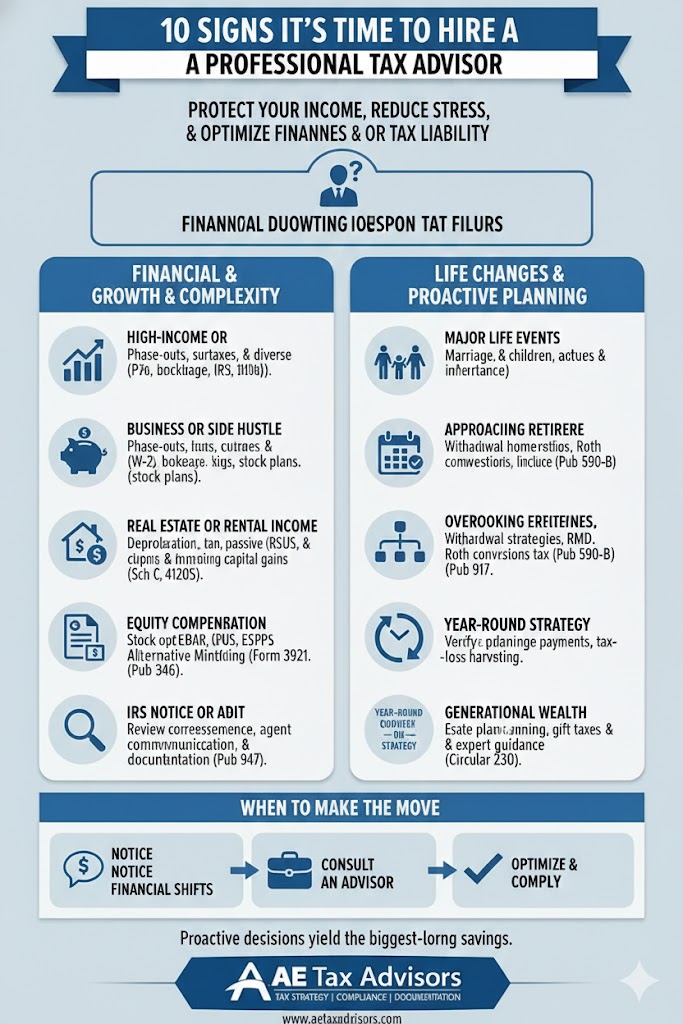
 This guide covers hire professional tax advisor and what it means for your tax situation.
Understanding When Should You Hire A in 2026
For most people, taxes begin as a do-it-yourself project. Online software seems easy enough; the forms appear straightforward. But as your income, investments, or business interests grow, so does your exposure to tax risk. The right time to bring in a professional is usually before the first major financial shift — not after the IRS sends a notice.
At AE Tax Advisors, we help clients decide when professional support moves from optional to essential. The answer depends on life changes, income complexity, and long-term goals.
1. When Your Income or Investments Grow Beyond Simplicity
When you first start your career, a W-2 and a single bank account may be all you need. But the moment you add brokerage accounts, side projects, or employer stock plans, your tax landscape changes.
As detailed in The Ultimate Guide to Tax Planning for High-Income W-2 Earners, higher income introduces phase-outs for deductions and credits, new Medicare surtaxes, and stricter documentation rules. A professional advisor interprets these thresholds and times income or deductions accordingly — something automated software cannot anticipate.
2. When You Start a Business or Side Hustle
Launching a small business, even as a side gig, brings new filing requirements. Under IRS Publication 334, you must track gross receipts, deductible expenses, and self-employment tax. Choosing the wrong entity or missing estimated payments can erase profits.
AE Tax Advisors structures new ventures correctly from day one. We explain how Schedule C, Form 1065, or Form 1120S fit your situation and how each affects your adjusted gross income. As covered in What a Tax Advisor Really Does and Why It Matters, the right structure saves money, while the wrong one multiplies liability.
3. When Your Return Includes Real Estate or Depreciation
Real-estate ownership changes everything. Depreciation schedules, passive-activity limits, and capital-gain timing are governed by Publication 946 and Form 8582.
AE Tax Advisors helps property owners determine whether they qualify as real-estate professionals, when to use cost-segregation studies, and how to document material participation. Without professional guidance, investors often misclassify deductions or fail to carry forward passive losses correctly.
4. When Life Changes Affect Your Tax Profile
Marriage, children, homeownership, inheritance — each creates new opportunities and obligations. According to Publication 17, filing status alone can change brackets, credits, and refund amounts.
A professional advisor anticipates these shifts. AE Tax Advisors reviews withholding elections, dependent credits, and education incentives annually so clients never miss timing windows or compliance steps.
5. When You Receive Equity Compensation
Stock options, RSUs, and ESPPs are powerful wealth tools but notoriously complex. Exercising at the wrong time can trigger the Alternative Minimum Tax.
Our advisors use IRS Form 3921 and Publication 525 to project the tax impact before you act. We design exit strategies that balance cash flow with tax efficiency — part of the proactive philosophy outlined in How AE Tax Advisors Helps You Keep More of What You Earn.
6. When You Approach Retirement
As retirement nears, tax focus shifts from accumulation to distribution. Withdrawals, Social Security, and RMDs require coordination under Publication 590-B and Form 5329.
AE Tax Advisors builds multi-year withdrawal strategies combining Roth conversions, charitable giving, and trust planning. By acting before mandatory distribution age, we help clients smooth income and avoid penalty taxes.
7. When You Receive an IRS Notice or Face an Audit
Receiving a letter from the IRS can be unsettling. IRS Publication 947 and Circular 230 outline who may represent taxpayers and how they must practice before the IRS.
AE Tax Advisors operates strictly within those standards. We review correspondence, communicate with agents, and compile documentation that satisfies audit requests. Our 10 Common Tax Mistakes Most Professionals Make Every Year article emphasizes that prevention is easier than defense — but if issues arise, professional representation protects you.
8. When You Want Year-Round Strategy Instead of Seasonal Stress
Many taxpayers treat April 15 as the only tax date that matters. Professionals know better. Quarterly planning prevents underpayment penalties and identifies mid-year savings opportunities.
AE Tax Advisors holds structured reviews every quarter. We project AGI, estimated payments, and retirement contributions — extending the forward-looking approach discussed in The Difference Between Tax Preparation and Tax Planning.
9. When You’re Building Generational Wealth
Estate and gift taxes affect more families than ever. Form 709 and Publication 559 govern transfers that, if misfiled, can create years of confusion.
AE Tax Advisors collaborates with estate attorneys to align trusts, family management companies, and charitable strategies. The goal: pass wealth efficiently while remaining fully compliant.
10. When You Simply Want Peace of Mind
Sometimes the best reason to hire a professional is confidence. Knowing your return is accurate, your strategy compliant, and your future optimized is invaluable.
At AE Tax Advisors, every engagement includes:
- Verified compliance with Circular 230 standards.
- Documentation aligned with Publications 17, 334, 535, and 946.
- Transparent, education-driven communication so you understand every move.
We don’t just file returns; we build systems that protect income and reduce anxiety year after year.
When to Make the Move
You don’t need to wait for complexity to overwhelm you. The best time to hire a professional tax advisor is when you first notice your financial life changing. That’s when small decisions yield the biggest long-term savings.
Whether you’re a high-income employee, entrepreneur, or new investor, AE Tax Advisors is ready to guide you. Our advisors follow IRS rules, teach the reasoning behind every strategy, and make sure you pay what’s required — not what’s avoidable.
Understanding should hire professional tax is essential for maximizing your tax savings as a real estate investor.
When it comes to should hire professional tax, working with a specialized tax advisor makes all the difference.
Many investors overlook should hire professional tax, but it can be one of the most impactful strategies in your tax plan.
At AE Tax Advisors, we help clients navigate should hire professional tax to keep more of what they earn.
Should hire professional tax is one of the most important concepts for real estate investors to understand. When properly implemented, should hire professional tax can lead to significant tax savings that compound over time.
Many high-income earners miss out on should hire professional tax opportunities simply because their CPA lacks the specialized knowledge. A proactive approach to should hire professional tax can mean the difference between overpaying and optimizing your tax position.
At AE Tax Advisors, our team specializes in should hire professional tax for real estate investors and W-2 professionals. We have helped hundreds of clients use should hire professional tax to reduce their tax burden by $50,000 or more annually.
The key to successful should hire professional tax implementation is working with an advisor who understands real estate taxation. Every should hire professional tax decision should be part of a comprehensive, multi-year tax plan.
Understanding Hire professional tax advisor
Related services from AE Tax Advisors: cost segregation studies and discover how AE Tax Advisors can help.
Hire professional tax advisor is a critical component of any comprehensive tax strategy for real estate investors. At AE Tax Advisors, we help clients navigate hire professional tax advisor to maximize their tax savings while maintaining full IRS compliance. Our proactive approach ensures you capture every available deduction and credit.