

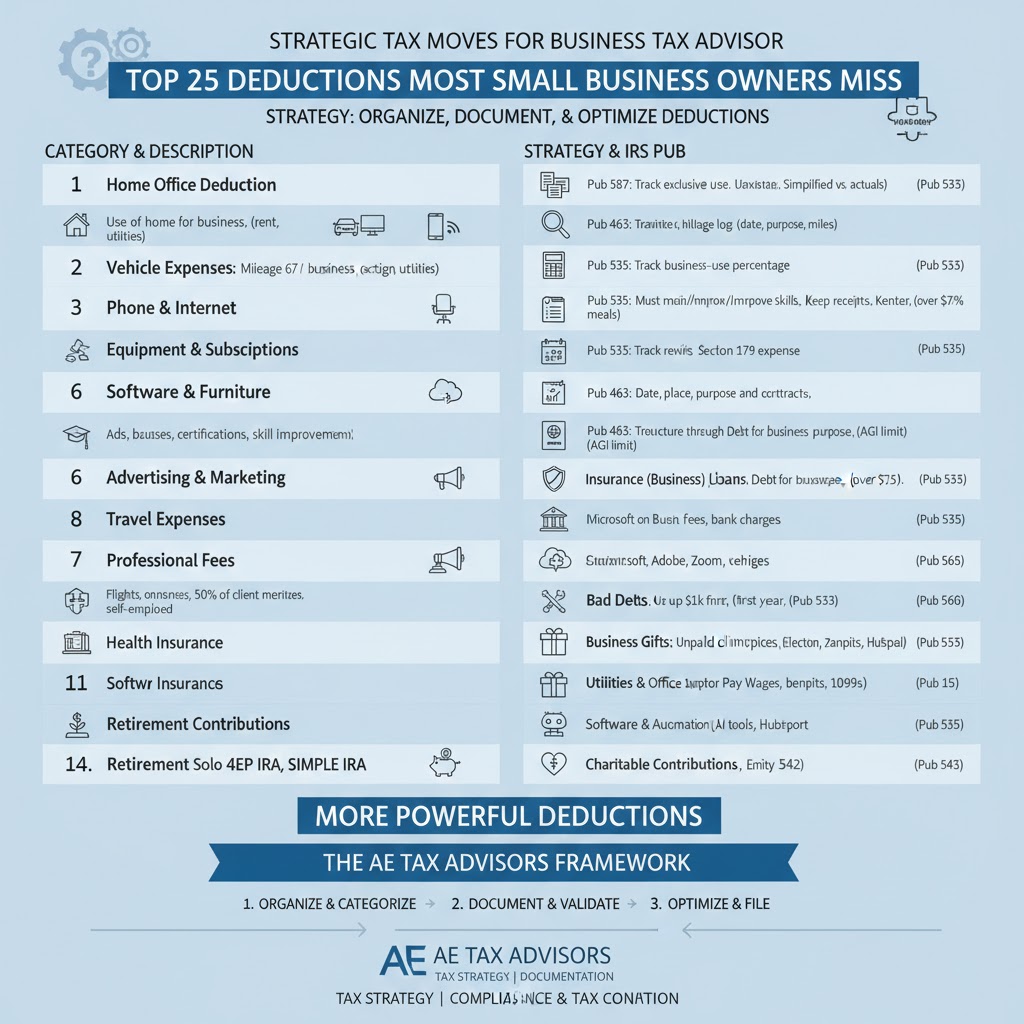
 This guide covers top deductions small business and what it means for your tax situation.
Understanding Top 25 Deductions Most Small in 2026
Every year, small business owners overpay the IRS simply because they don’t know what they can legally deduct. The tax code isn’t designed to punish entrepreneurs — it rewards those who keep accurate records and understand the rules.
At AE Tax Advisors, we help clients identify legitimate, defensible deductions that are fully supported by IRS standards. This guide outlines 25 powerful deductions that most business owners overlook but could claim every year.
This article connects directly to The Ultimate Tax Checklist for Small Business Owners, How to Build an Audit-Proof Tax Documentation System, and How AE Tax Advisors Helps You Keep More of What You Earn.
1. Home Office Deduction
Under IRS Publication 587, you can deduct a portion of home expenses if part of your home is used exclusively and regularly for business. This includes rent, mortgage interest, utilities, and repairs. AE Tax Advisors calculates both the simplified and actual method to ensure the largest legal deduction.
2. Vehicle Mileage or Actual Expenses
Publication 463 allows you to deduct mileage at the IRS standard rate or actual costs (gas, repairs, insurance, depreciation). You must log miles with dates and business purposes. AE Tax Advisors provides digital mileage templates to automate tracking.
3. Cell Phone and Internet
If you use your personal phone or internet for business, you can deduct the business-use percentage. Publication 535 confirms these as ordinary and necessary expenses.
4. Equipment and Furniture
Office chairs, computers, printers, and even desks qualify for depreciation under Publication 946 or immediate expensing through Section 179. AE Tax Advisors evaluates which method produces the highest deduction.
5. Software and Subscriptions
Any digital tools you pay for — like CRM systems, accounting apps, or design software — are deductible as business expenses. Many small businesses miss these recurring monthly costs.
6. Continuing Education
Courses, certifications, and professional training that maintain or improve your skills are fully deductible under Publication 970. AE Tax Advisors tracks course payments to ensure substantiation.
7. Professional Fees
Attorney, accountant, and consultant fees are deductible when directly related to running your business, per Publication 535. AE Tax Advisors includes its own services under this category — because planning itself is a legitimate expense.
8. Advertising and Marketing
All expenses related to promoting your business — from paid ads to branding design and content creation — qualify under Publication 535. AE Tax Advisors often finds business owners underreport this category.
9. Business Meals
You can deduct 50% of business-related meals when directly tied to client meetings or business discussions. Publication 463 provides the substantiation rules: date, place, purpose, and attendees.
10. Travel Expenses
Flights, hotels, taxis, and 50% of meals while traveling for business are deductible under Publication 463. AE Tax Advisors ensures each trip is documented with receipts and business purpose logs.
11. Health Insurance Premiums
If you’re self-employed, Publication 535 allows you to deduct health insurance premiums paid for yourself, your spouse, and dependents. AE Tax Advisors structures these deductions through your S-Corp or LLC for compliance.
12. Retirement Contributions
Contributions to Solo 401(k)s, SEP IRAs, or SIMPLE IRAs are fully deductible within annual limits under Publication 560. AE Tax Advisors coordinates these with your entity’s payroll setup for maximum benefit.
13. Rent and Lease Payments
Rent paid for office space, equipment, or vehicles is deductible under Publication 535. AE Tax Advisors also designs compliant leaseback structures between your operating business and property entity.
14. Insurance (Beyond Health)
Liability, property, professional, and business interruption insurance premiums are fully deductible when they protect business operations. This deduction is often overlooked by small firms.
15. Bank and Merchant Fees
Credit card processing fees, bank charges, and loan origination costs are deductible operating expenses. AE Tax Advisors helps clients categorize these correctly in bookkeeping systems.
16. Interest on Business Loans
Interest on loans, credit cards, and lines of credit used for business purposes is deductible under Publication 535. AE Tax Advisors advises clients to maintain separate business accounts for traceability.
17. Software Licenses and Online Tools
Everything from Microsoft 365 to Adobe, QuickBooks, and Zoom falls into deductible software expenses. AE Tax Advisors recommends tracking them monthly to ensure they’re captured at year-end.
18. Depreciation and Cost Segregation
Assets with a useful life over one year must be depreciated. Under Publication 946, cost segregation can accelerate depreciation for buildings and renovations, creating large early deductions.
19. Startup and Organizational Costs
New businesses can deduct up to $5,000 of startup costs in their first year and amortize the rest over 15 years under Publication 535. AE Tax Advisors ensures these are categorized correctly for new entities.
20. Bad Debts
If a client fails to pay, you can deduct the unpaid amount if previously included in income. Publication 535 defines this deduction for accrual-based businesses.
21. Business Gifts
You can deduct up to $25 per client per year for business gifts under Publication 463. AE Tax Advisors documents gift logs with receipts and business purposes.
22. Employee and Contractor Expenses
Wages, benefits, and 1099 payments are deductible when properly documented. AE Tax Advisors confirms compliance with Publication 15 payroll rules and Form 1099-NEC filing standards.
23. Utilities and Office Expenses
Electricity, water, internet, and office maintenance are all deductible if used for business purposes. AE Tax Advisors calculates home and shared space allocations for accuracy.
24. Software-Based Automation Tools
Zapier, HubSpot, Asana, or AI tools that automate workflows qualify as deductible business expenses. Publication 535 considers these as necessary tools for efficiency.
25. Charitable Contributions from Your Business
If your entity donates to qualified charities, the deduction depends on structure. S-Corps and partnerships pass it through to owners; C-Corps deduct it directly under Publication 542. AE Tax Advisors helps document charitable intent, ensuring it meets IRS qualification rules.
How to Make These Deductions Count
Deductions only work when supported by documentation. Every expense must meet three legal standards:
- Ordinary and necessary: Common in your line of business.
- Business-related: Clearly connected to your income generation.
- Substantiated: Supported by receipts, invoices, and records.
AE Tax Advisors aligns every client’s deductions with Publications 334, 463, and 535, ensuring they’re legal, traceable, and audit-ready.
The AE Tax Advisors Advantage
We don’t just identify deductions — we build systems around them. Our approach includes:
- Quarterly expense audits to catch missed opportunities.
- Categorization strategies aligned with entity structure.
- Year-end reconciliations that prevent overstatement or omission.
This philosophy mirrors The Difference Between Tax Preparation and Tax Planning and How AE Tax Advisors Helps You Keep More of What You Earn.
Conclusion: Every Dollar Matters When It’s Documented
The IRS rewards diligence, not luck. By claiming legitimate deductions under the correct code sections, you strengthen both your tax position and your audit defense.
At AE Tax Advisors, we ensure every client gets credit for the expenses they already make — legally, efficiently, and strategically.
Your next tax saving isn’t in a loophole; it’s in your ledger. Keep it clean, keep it documented, and let every expense work for you.
Understanding top deductions most small is essential for maximizing your tax savings as a real estate investor.
When it comes to top deductions most small, working with a specialized tax advisor makes all the difference.
Many investors overlook top deductions most small, but it can be one of the most impactful strategies in your tax plan.
At AE Tax Advisors, we help clients navigate top deductions most small to keep more of what they earn.
Top deductions most small is one of the most important concepts for real estate investors to understand. When properly implemented, top deductions most small can lead to significant tax savings that compound over time.
Many high-income earners miss out on top deductions most small opportunities simply because their CPA lacks the specialized knowledge. A proactive approach to top deductions most small can mean the difference between overpaying and optimizing your tax position.
At AE Tax Advisors, our team specializes in top deductions most small for real estate investors and W-2 professionals. We have helped hundreds of clients use top deductions most small to reduce their tax burden by $50,000 or more annually.
The key to successful top deductions most small implementation is working with an advisor who understands real estate taxation. Every top deductions most small decision should be part of a comprehensive, multi-year tax plan.
If you are not actively using top deductions most small as part of your tax strategy, you are likely leaving money on the table. Contact AE Tax Advisors to learn how top deductions most small can work for your specific situation.
Understanding Top deductions small business
Related services from AE Tax Advisors: 3-year tax lookback cleanup and entity structuring for rental portfolios.
Top deductions small business is a critical component of any comprehensive tax strategy for real estate investors. At AE Tax Advisors, we help clients navigate top deductions small business to maximize their tax savings while maintaining full IRS compliance. Our proactive approach ensures you capture every available deduction and credit.
For official IRS guidance, visit the IRS Newsroom.