

 This guide covers W-2 tax reduction and what it means for your tax situation.
Understanding The Ultimate Guide To Tax in 2026
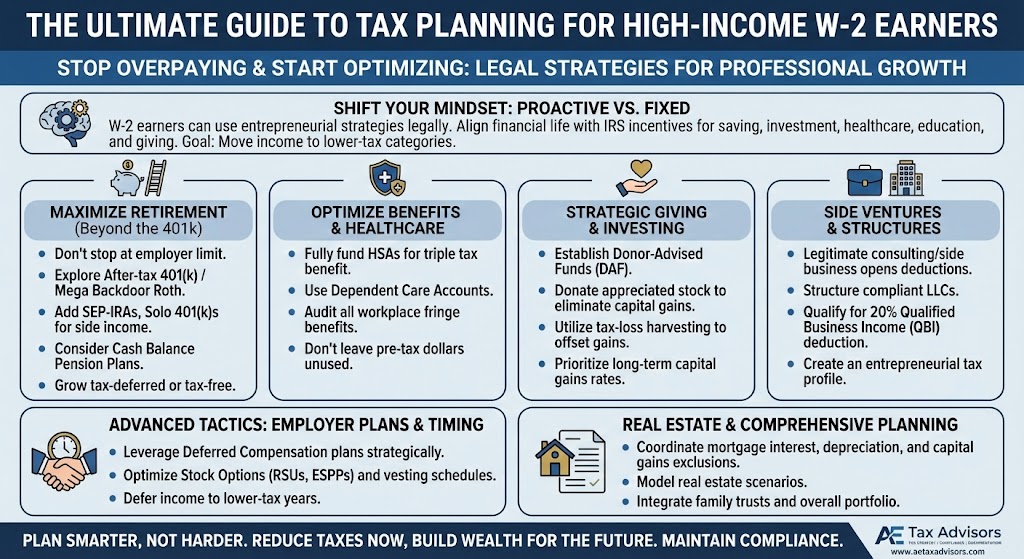
Most professionals earning strong salaries assume their taxes are fixed — that there’s little room to optimize beyond standard deductions and pre-tax 401(k) contributions. But that belief leaves tens of thousands of dollars on the table every year. The truth is that W-2 earners can implement many of the same strategies used by entrepreneurs, as long as they approach their income and benefits proactively. At AE Tax Advisors, we design tax plans for top-earning professionals who want to stop overpaying and start using the tax code to their advantage.
Tax planning isn’t about loopholes or risky moves. It’s about legally aligning your financial life with incentives that already exist in the Internal Revenue Code. Those incentives reward saving, investment, healthcare planning, education funding, and smart charitable giving. High-income professionals often contribute more to the government than necessary simply because they aren’t structuring these incentives strategically. A proactive tax plan changes that.
The first step for any high-income W-2 earner is to understand how their marginal tax rate and effective tax rate differ. A $250,000 salary may put you in the 32% marginal bracket, but that doesn’t mean all your income is taxed at that rate. The goal of AE Tax Advisors is to move as much income as possible into lower-tax categories — either through pre-tax contributions, tax-favored accounts, or allowable deductions that reduce adjusted gross income. Each dollar sheltered early compounds its advantage year after year.
A key area of focus is maximizing retirement contributions. High earners should not stop at their employer 401(k) limit. Many companies offer after-tax 401(k) contributions or a “mega backdoor Roth” option that can add significant tax-free growth potential. AE Tax Advisors helps clients layer in additional vehicles such as SEP-IRAs, solo 401(k)s for side consulting work, and cash balance pension plans. The objective is to take income you’re already earning and move it into structures that grow tax-deferred or tax-free.
Healthcare savings accounts are another underused opportunity. HSAs offer a triple tax benefit — contributions are pre-tax, growth is tax-free, and withdrawals for qualified medical expenses are untaxed. For high earners, fully funding an HSA each year creates a secondary retirement pool that can later be used for healthcare in retirement. The same concept applies to dependent care accounts and other fringe benefits often overlooked on HR forms. AE Tax Advisors frequently audits benefit elections to make sure clients are not leaving pre-tax dollars unused.
Charitable giving also plays a strategic role. Instead of writing one-off checks, high earners can establish donor-advised funds. A DAF allows you to take the deduction in a high-income year while distributing gifts over time. Pairing this with appreciated stock donations can eliminate capital gains while increasing the charitable impact. AE Tax Advisors designs charitable giving plans that combine generosity with measurable tax efficiency.
For those with investment portfolios, the difference between short-term and long-term gains is critical. Holding appreciated assets for more than twelve months shifts the tax rate downward. Tax-loss harvesting can offset gains in the same year and up to three thousand dollars of ordinary income annually. Coordinating this with an advisor ensures that portfolio decisions align with broader tax goals rather than just market timing.
Even without a business, W-2 professionals can sometimes create legitimate side ventures or consulting activities that open new deductions. Income from a small side business can qualify for the 20% Qualified Business Income (QBI) deduction under Section 199A if structured properly. AE Tax Advisors assists clients in setting up compliant LLCs, tracking business expenses, and determining whether QBI or other deductions apply. The result is a personal tax profile that looks more like an entrepreneur’s — controlled, optimized, and strategic.
One of the most powerful, yet overlooked, strategies for W-2 earners is aligning with their employer’s benefit plan design. Many executives fail to leverage non-qualified deferred compensation plans or stock options efficiently. Tax timing matters: deferring income into a future year when you expect to earn less can significantly reduce taxes. AE Tax Advisors reviews employer benefit documents line by line to build a plan around vesting schedules, RSUs, ESPPs, and deferred comp choices so clients never make accidental timing mistakes.
Effective tax planning also involves what you do outside of earnings. Coordinating personal real estate decisions, family trusts, and investment accounts ensures the plan is comprehensive. Buying a home, refinancing, or investing in rental property all create new tax dynamics. The mortgage interest deduction, depreciation, and capital gains exclusions on primary residences should be calculated carefully to avoid surprises. AE Tax Advisors models different real-estate scenarios to show clients how each decision impacts their overall tax burden.
At the end of the day, high-income W-2 earners don’t need to work harder — they need to plan smarter. The IRS rewards organization, documentation, and foresight. Having a dedicated advisor means you’re not reacting at tax time; you’re making informed decisions throughout the year. The professionals at AE Tax Advisors combine CPA-level technical knowledge with a family-office mindset. Every plan is designed to reduce taxes now, build wealth for the future, and maintain compliance at every step.
Smart tax planning isn’t about paying nothing — it’s about paying only what the law requires. High-income professionals who treat tax strategy like an investment routinely see returns measured in saved dollars and reduced stress. AE Tax Advisors exists to deliver that result year after year.
Understanding W-2 tax reduction is essential for maximizing your tax savings as a real estate investor.
When it comes to W-2 tax reduction, working with a specialized tax advisor makes all the difference.
Many investors overlook W-2 tax reduction, but it can be one of the most impactful strategies in your tax plan.
At AE Tax Advisors, we help clients navigate W-2 tax reduction to keep more of what they earn.
W-2 tax reduction is one of the most important concepts for real estate investors to understand. When properly implemented, W-2 tax reduction can lead to significant tax savings that compound over time.
Many high-income earners miss out on W-2 tax reduction opportunities simply because their CPA lacks the specialized knowledge. A proactive approach to W-2 tax reduction can mean the difference between overpaying and optimizing your tax position.
Understanding W-2 tax reduction
Related services from AE Tax Advisors: discover how AE Tax Advisors can help and 1031 exchange coordination.
W-2 tax reduction is a critical component of any comprehensive tax strategy for real estate investors. At AE Tax Advisors, we help clients navigate W-2 tax reduction to maximize their tax savings while maintaining full IRS compliance. Our proactive approach ensures you capture every available deduction and credit.
For more information, refer to the IRS.