

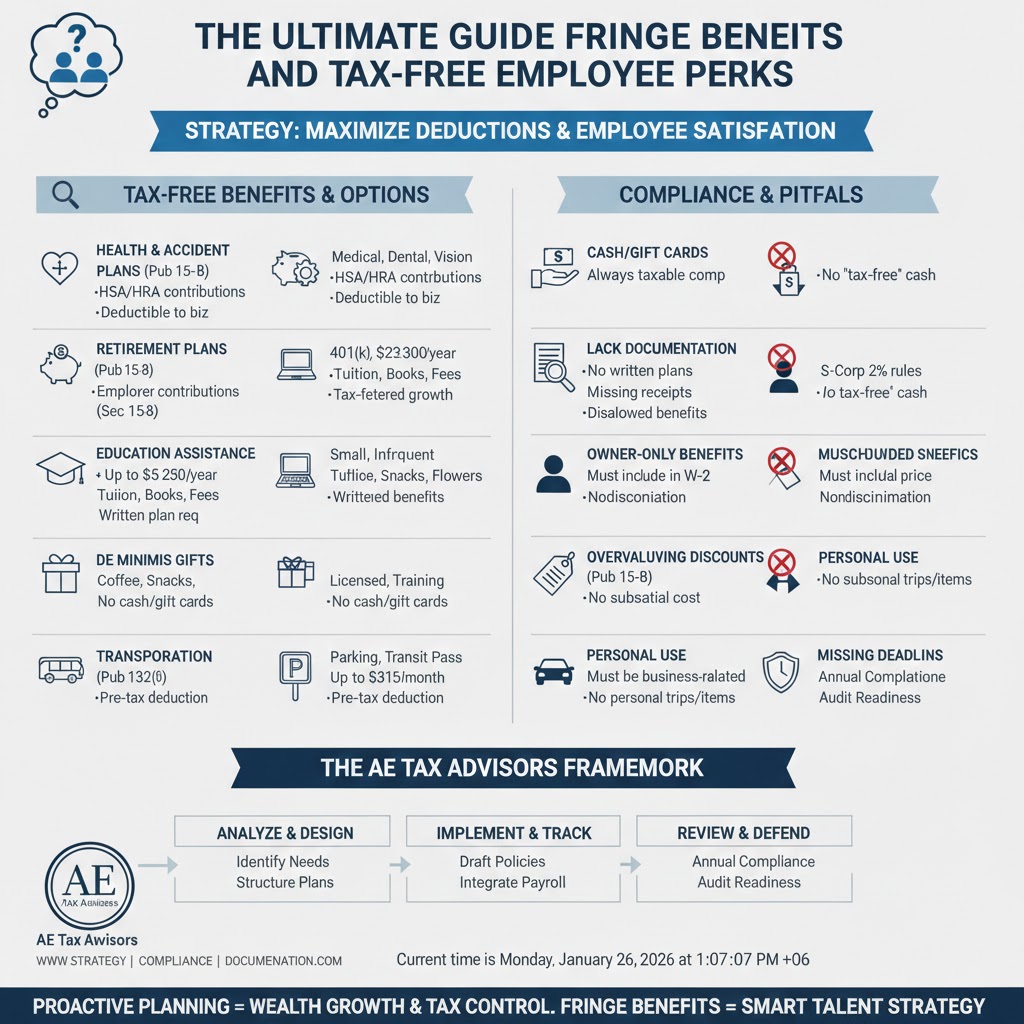
 This guide covers ultimate guide fringe benefits and what it means for your tax situation.
Understanding The Ultimate Guide To Fringe in 2026
Employee benefits have evolved far beyond health insurance. Today, small businesses and corporations use fringe benefits to attract talent, reward loyalty, and improve retention — and many of these benefits are completely tax-free when structured correctly.
At AE Tax Advisors, we design compliant benefit programs that maximize both employer deductions and employee satisfaction under IRS Publications 15-B, 535, and 463.
This guide builds upon How to Deduct Business Gifts, Bonuses, and Incentives, The Ultimate Tax Checklist for Small Business Owners, and The Family Office Formula: How Business Owners Turn Cash Flow into Generational Wealth.
What Are Fringe Benefits?
A fringe benefit is any form of compensation other than wages provided to an employee. Under Publication 15-B, fringe benefits are taxable unless they qualify for a specific exclusion.
Examples of common fringe benefits include:
- Health insurance and HSAs.
- Employer retirement contributions.
- Cell phones, vehicles, and equipment for business use.
- Educational assistance and training.
- Meals, lodging, and commuter benefits.
- Employee discounts and de minimis gifts.
AE Tax Advisors reviews each benefit type to determine whether it’s tax-free, partially taxable, or fully taxable based on the latest IRS guidelines.
Step 1: Health and Accident Plans
Health insurance premiums paid by the employer are generally tax-free to employees and fully deductible to the business under Publication 535. This includes:
- Medical, dental, and vision insurance.
- Health reimbursement arrangements (HRAs).
- Health savings accounts (HSAs) and employer contributions.
AE Tax Advisors helps clients coordinate these plans with S-Corp shareholder rules to ensure proper reporting on W-2 forms.
Step 2: Retirement Contributions
Employer contributions to qualified plans (401(k), SEP, or SIMPLE IRAs) are deductible to the employer and excluded from employee income until withdrawal.
Publication 15-B specifies that contributions must be made under a written plan and not disproportionately favor highly compensated employees.
AE Tax Advisors integrates retirement benefits into entity-level planning so businesses can maximize deductions and comply with ERISA testing requirements.
Step 3: Education Assistance
Employers can provide up to $5,250 per year in tax-free education assistance per employee under Section 127 of the Code. This includes tuition, books, fees, and supplies.
Publication 15-B requires a written plan for qualification and excludes reimbursement for non-job-related courses unless they help maintain skills.
AE Tax Advisors structures education reimbursement policies that double as retention tools for small businesses.
Step 4: Working Condition Fringe Benefits
These are items provided so employees can do their jobs — and they’re fully tax-free when used for business.
Examples include:
- Company cell phones.
- Laptops and software.
- Job-required certifications or memberships.
- Professional licenses and continuing education.
Under Publication 535, these must have a clear business connection and be substantiated by receipts or invoices.
This ties directly to How to Set Up an Accountable Plan for Your Business.
Step 5: De Minimis Fringe Benefits
De minimis means “too small to account for.” Examples: occasional snacks, coffee, birthday flowers, or modest holiday gifts.
These are tax-free to employees and deductible to the business when they are infrequent and low in value.
Publication 15-B requires that they not be cash or cash equivalents (gift cards).
AE Tax Advisors helps employers formalize policies defining what qualifies as de minimis to prevent audit issues.
Step 6: Transportation and Commuter Benefits
Employers may provide up to $315 per month (2025 limit) in qualified transportation benefits tax-free. This includes:
- Parking near the workplace.
- Transit passes.
- Vanpooling expenses.
These benefits are fully deductible under Publication 535 and excluded from employee income under Section 132(f).
AE Tax Advisors coordinates these programs with payroll providers to ensure accurate reporting and pre-tax deductions.
Step 7: Meals and Lodging
Meals furnished for the employer’s convenience or on business premises can be tax-free to employees under Section 119. Lodging provided for business reasons (e.g., on-site housing for managers) is also excludable.
AE Tax Advisors evaluates housing and meal benefits for compliance with Publications 463 and 15-B, ensuring proper documentation of business necessity.
This aligns with The Complete Guide to Travel, Meals, and Entertainment Deductions.
Step 8: Employee Discounts and No-Additional-Cost Services
Under Publication 15-B, employers can offer tax-free discounts on products or services if they don’t exceed 20% of the price offered to customers and if they don’t create significant extra cost to the company.
AE Tax Advisors reviews pricing policies to ensure discounts qualify as “no-additional-cost services,” especially for retail and service businesses.
Step 9: Dependent Care and Adoption Assistance
Employers can provide up to $5,000 per year in dependent care assistance and up to $16,810 (2025 limit) for adoption assistance tax-free to employees.
These benefits must be offered under a written plan and comply with nondiscrimination testing rules.
AE Tax Advisors helps companies document these plans and track payments to qualifying providers.
Step 10: Fringe Benefits for S-Corp Owners
Owners of S-Corporations owning more than 2% of stock are subject to special rules under Publication 15-B. Certain benefits — like health insurance — must be included in W-2 wages but may still be deductible by the company.
AE Tax Advisors balances these owner benefits with salary optimization strategies covered in The Ultimate Guide to S-Corporation Salary Optimization.
Step 11: Fringe Benefits for Family Members
When family members are employees, benefits must be reasonable and available to all employees on similar terms. AE Tax Advisors structures family employment plans to ensure fringe benefits remain tax-free and fully deductible under Publication 535.
This connects with The Ultimate Guide to Hiring Family Members in Your Business.
Step 12: Avoid Common Mistakes
- Providing cash or gift cards as “tax-free” benefits — always taxable.
- Failing to document written plans for education or dependent care.
- Overvaluing employee discounts.
- Offering owner-only benefits that disqualify plans.
- Mixing personal and business use without substantiation.
AE Tax Advisors audits benefit plans annually to ensure continued IRS compliance and maximize deductions.
AE Tax Advisors Fringe Benefit Compliance Framework
- Identify eligible benefits under IRS rules.
- Determine taxability and deductibility.
- Draft written plans for qualified programs.
- Track and report benefits through payroll.
- Reconcile annually for accuracy and compliance.
This system aligns with IRS Publications 15-B, 535, and 463, balancing employer deductions with employee tax efficiency.
Conclusion: Reward Your Team — and Reduce Your Taxes
Smart benefits aren’t just about perks — they’re about strategy. When you design plans that follow IRS rules, you create win-win situations for you and your team: happier employees and lower taxes.
At AE Tax Advisors, we build custom benefit frameworks that help businesses retain top talent, stay IRS-compliant, and capture every legitimate deduction available. Fringe benefits done right aren’t expenses — they’re investments in your people and your profitability.
Understanding ultimate guide fringe benefits is essential for maximizing your tax savings as a real estate investor.
When it comes to ultimate guide fringe benefits, working with a specialized tax advisor makes all the difference.
Many investors overlook ultimate guide fringe benefits, but it can be one of the most impactful strategies in your tax plan.
At AE Tax Advisors, we help clients navigate ultimate guide fringe benefits to keep more of what they earn.
Ultimate guide fringe benefits is one of the most important concepts for real estate investors to understand. When properly implemented, ultimate guide fringe benefits can lead to significant tax savings that compound over time.
Many high-income earners miss out on ultimate guide fringe benefits opportunities simply because their CPA lacks the specialized knowledge. A proactive approach to ultimate guide fringe benefits can mean the difference between overpaying and optimizing your tax position.
At AE Tax Advisors, our team specializes in ultimate guide fringe benefits for real estate investors and W-2 professionals. We have helped hundreds of clients use ultimate guide fringe benefits to reduce their tax burden by $50,000 or more annually.
Understanding Ultimate guide fringe benefits
Ultimate guide fringe benefits is a critical component of any comprehensive tax strategy for real estate investors. At AE Tax Advisors, we help clients navigate ultimate guide fringe benefits to maximize their tax savings while maintaining full IRS compliance. Our proactive approach ensures you capture every available deduction and credit.
For more information, refer to the IRS.