

 This guide covers depreciation tax strategy and what it means for your tax situation.
Understanding The Complete Guide To Section in 2026
Few areas of the tax code give business owners as much leverage as Section 179 and bonus depreciation. Together, they let you deduct the full cost of qualifying business equipment, vehicles, and improvements in the year you buy them — creating immediate cash flow advantages and strategic tax timing opportunities.
At AE Tax Advisors, we help business owners plan their purchases and depreciation schedules using the latest IRS guidance from Publications 946, 946-A, and 535 to legally minimize tax while staying fully compliant.
This article builds directly on How to Deduct Your Vehicle the Right Way, How to Deduct Your Home Office Correctly, and The Business Owner’s Blueprint: How to Build, Protect, and Multiply Wealth Through Entity Strategy.
Understanding Depreciation
Depreciation is how businesses recover the cost of assets that last more than one year, like vehicles, machinery, or office furniture. Instead of expensing the entire cost upfront, you spread deductions across the asset’s useful life.
But with Section 179 and bonus depreciation, the IRS lets you accelerate that process — sometimes to 100% in the year of purchase.
Under Publication 946, assets must meet three conditions:
- Be used in your business (not personally).
- Have a determinable useful life longer than one year.
- Lose value over time (not land or inventory).
AE Tax Advisors helps clients identify which assets qualify and how best to allocate depreciation across multiple tax years for strategic impact.
What Is Section 179?
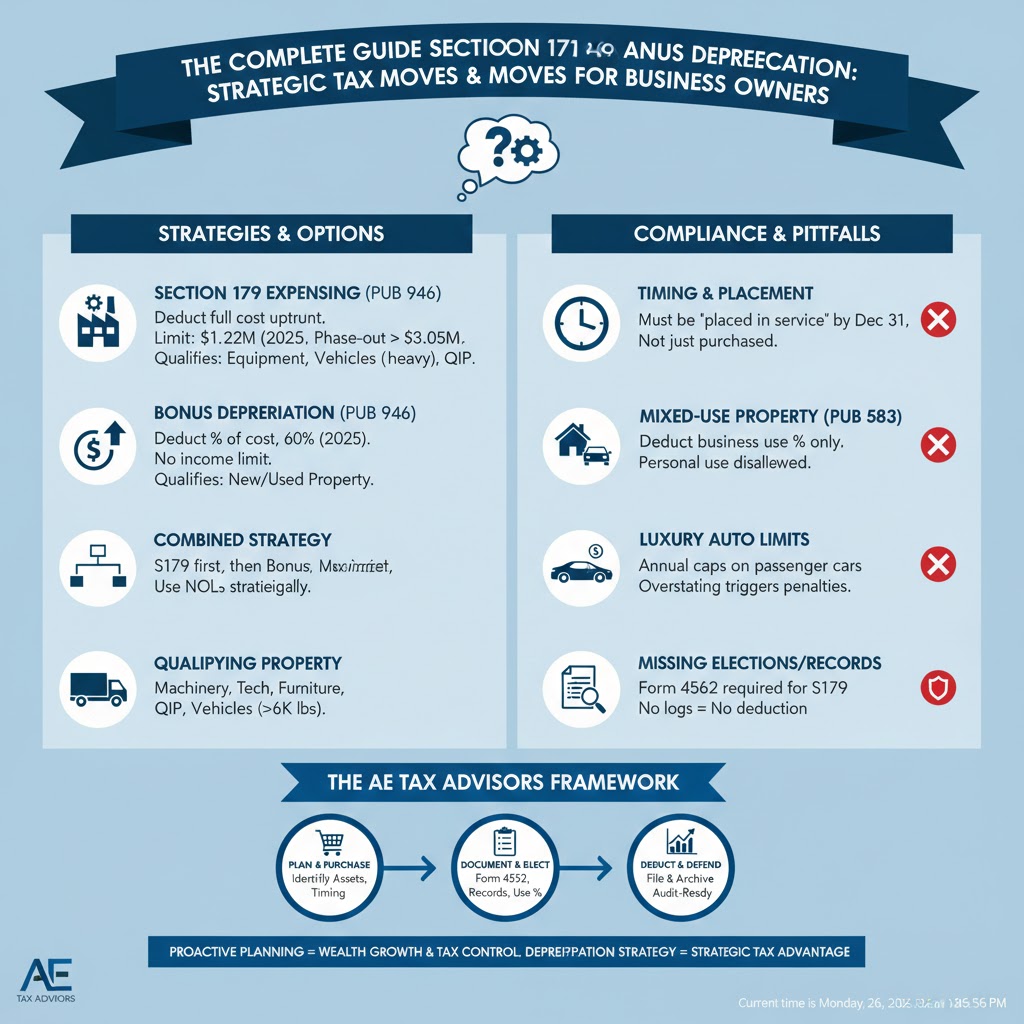
Section 179 of the Internal Revenue Code allows businesses to deduct the full purchase price of qualifying property in the year it’s placed in service.
For 2025, the limits are:
- Deduction cap: $1,220,000.
- Phase-out threshold: $3,050,000 (deduction reduced dollar-for-dollar once total equipment purchases exceed this amount).
That means if you buy $3,500,000 worth of qualifying equipment, your Section 179 deduction would be reduced by $450,000.
Publication 946 clarifies that Section 179 applies to:
- Machinery and equipment.
- Computers and office technology.
- Furniture and fixtures.
- Certain off-the-shelf software.
- Qualified improvement property (QIP) such as interior building upgrades.
AE Tax Advisors calculates each client’s optimal Section 179 election by coordinating entity income, cash flow, and long-term plans.
What Is Bonus Depreciation?
Bonus depreciation (also known as additional first-year depreciation) lets you deduct a large percentage of an asset’s cost in the first year — even beyond Section 179 limits.
Key facts for 2025 under Publication 946:
- Current rate: 60% (phasing down annually from 100% after the 2017 TCJA).
- No income limitation (unlike Section 179).
- Can create a net operating loss (NOL) for the year.
- Applies automatically unless you elect out.
Bonus depreciation applies to new and used property (as long as it’s the taxpayer’s first use).
AE Tax Advisors uses bonus depreciation strategically when clients exceed Section 179 limits or want to create controlled losses for tax planning.
Section 179 vs. Bonus Depreciation
While both reduce taxable income by accelerating deductions, they differ in important ways:
| Feature | Section 179 | Bonus Depreciation |
|---|---|---|
| Income limitation | Limited to taxable income | No limit, can create a loss |
| Annual deduction cap | $1,220,000 (2025) | None |
| Property type | Tangible personal property + some improvements | Most depreciable property |
| Election required | Yes (Form 4562) | No (automatic unless opted out) |
| Carryforward | Unused amount can carry forward | Cannot carry forward |
AE Tax Advisors helps clients combine both methods — applying Section 179 first to target profitable years, then using bonus depreciation to zero out remaining taxable income if desired.
Step 1: Identify Eligible Property
Qualifying property includes:
- Business vehicles (subject to limits).
- Equipment and tools.
- Computers, printers, and office electronics.
- Furniture and shelving.
- HVAC, lighting, and building interior improvements.
Non-qualifying property includes:
- Land.
- Inventory for resale.
- Buildings (though interior improvements may qualify as QIP).
AE Tax Advisors uses asset ledgers that classify each purchase under the correct MACRS recovery period as defined in Publication 946-A.
Step 2: Place Property in Service
To claim Section 179 or bonus depreciation, property must be placed in service — meaning ready and available for business use — before year-end.
Ordering or paying for equipment isn’t enough. Installation, setup, and operational readiness all count toward that date.
AE Tax Advisors coordinates these details with accountants and vendors to ensure proper timing and documentation.
Step 3: Maintain Detailed Records
Under Publication 583, records must include:
- Description of the property.
- Date acquired and placed in service.
- Cost and percentage of business use.
- Proof of payment and ownership.
- Election statement for Section 179 (Form 4562).
AE Tax Advisors builds digital depreciation folders that house all supporting evidence, creating audit-ready documentation for every asset.
This process ties into How to Build an Audit-Proof Recordkeeping System.
Step 4: Calculate the Best Mix of Deductions
The optimal strategy depends on your goals:
- If your business is profitable: Use Section 179 to offset income up to limits.
- If your business wants to accelerate losses: Use bonus depreciation to create NOLs for future offsets.
- If you’re planning major growth: Use MACRS depreciation to spread deductions for stability.
AE Tax Advisors models multiple depreciation scenarios annually so clients can choose the most strategic combination.
Step 5: Apply Vehicle Rules
Vehicles require special attention under Publication 946:
- Passenger vehicles: Subject to “luxury auto” limits (approx. $12,200 first-year cap for 2025).
- SUVs and trucks over 6,000 lbs GVWR: Eligible for full Section 179 or bonus depreciation.
- Mixed-use vehicles: Deduct only business-use percentage.
This strategy complements How to Deduct Your Vehicle the Right Way.
AE Tax Advisors maintains GVWR documentation, mileage logs, and proof of business use to ensure all vehicle deductions are defensible.
Step 6: Understand Qualified Improvement Property (QIP)
QIP includes interior improvements to commercial buildings such as lighting, flooring, and HVAC systems.
Under the 2020 CARES Act correction, QIP now has a 15-year recovery period and qualifies for both Section 179 and bonus depreciation under Publication 946-A.
AE Tax Advisors integrates cost segregation studies to separate QIP from non-qualifying components, unlocking larger immediate deductions for commercial clients.
This connects to Real Estate Inside the Business: The Overlooked Wealth Strategy of the 1%.
Step 7: Avoid Common Pitfalls
- Placing property in service too late: Assets must be operational by December 31.
- Mixing personal and business use: Deduct only business-use percentages.
- Ignoring state conformity rules: Some states don’t follow federal depreciation laws.
- Overclaiming SUV deductions: Vehicles under 6,000 lbs do not qualify for full expensing.
- Forgetting to elect Section 179 on Form 4562: No election = no deduction.
AE Tax Advisors reviews every return to ensure elections are properly filed and state adjustments are made.
Step 8: Coordinate with Tax Planning
Depreciation is more than a deduction — it’s a timing tool. AE Tax Advisors integrates it with:
- Entity selection (LLC, S-Corp, C-Corp).
- Income splitting between salary and distributions.
- Asset acquisition schedules for multi-year planning.
- Exit strategy considerations to manage recapture.
This forward-looking approach connects to The Tax-Free Empire: How to Build Wealth Without Paying More Than You Legally Owe.
AE Tax Advisors Depreciation Optimization Framework
- Identify all qualifying property.
- Place in service and document properly.
- Elect Section 179 strategically.
- Apply bonus depreciation as needed.
- Track depreciation schedules annually.
- Reconcile with state tax conformity.
- Review for recapture impact on sale.
This system aligns with IRS Publications 946, 946-A, and 535, ensuring compliance, flexibility, and maximum benefit.
Conclusion: Accelerate Deductions, Not Risk
When structured properly, Section 179 and bonus depreciation are among the most powerful tax tools available to small business owners. They let you reinvest faster, manage taxable income precisely, and plan for long-term financial efficiency — all within the rules.
At AE Tax Advisors, we help business owners design year-by-year depreciation strategies that maximize cash flow while maintaining perfect IRS compliance. Every dollar you invest in your business can work harder, sooner, and smarter — when you know how to use these tools the right way.
Understanding depreciation tax strategy is essential for maximizing your tax savings as a real estate investor.
When it comes to depreciation tax strategy, working with a specialized tax advisor makes all the difference.
Many investors overlook depreciation tax strategy, but it can be one of the most impactful strategies in your tax plan.
At AE Tax Advisors, we help clients navigate depreciation tax strategy to keep more of what they earn.
Depreciation tax strategy is one of the most important concepts for real estate investors to understand. When properly implemented, depreciation tax strategy can lead to significant tax savings that compound over time.
Many high-income earners miss out on depreciation tax strategy opportunities simply because their CPA lacks the specialized knowledge. A proactive approach to depreciation tax strategy can mean the difference between overpaying and optimizing your tax position.
At AE Tax Advisors, our team specializes in depreciation tax strategy for real estate investors and W-2 professionals. We have helped hundreds of clients use depreciation tax strategy to reduce their tax burden by $50,000 or more annually.
The key to successful depreciation tax strategy implementation is working with an advisor who understands real estate taxation. Every depreciation tax strategy decision should be part of a comprehensive, multi-year tax plan.
Understanding Depreciation tax strategy
Related services from AE Tax Advisors: cost segregation studies and short-term rental tax planning.
Depreciation tax strategy is a critical component of any comprehensive tax strategy for real estate investors. At AE Tax Advisors, we help clients navigate depreciation tax strategy to maximize their tax savings while maintaining full IRS compliance. Our proactive approach ensures you capture every available deduction and credit.
For official IRS guidance, visit the IRS Newsroom.