

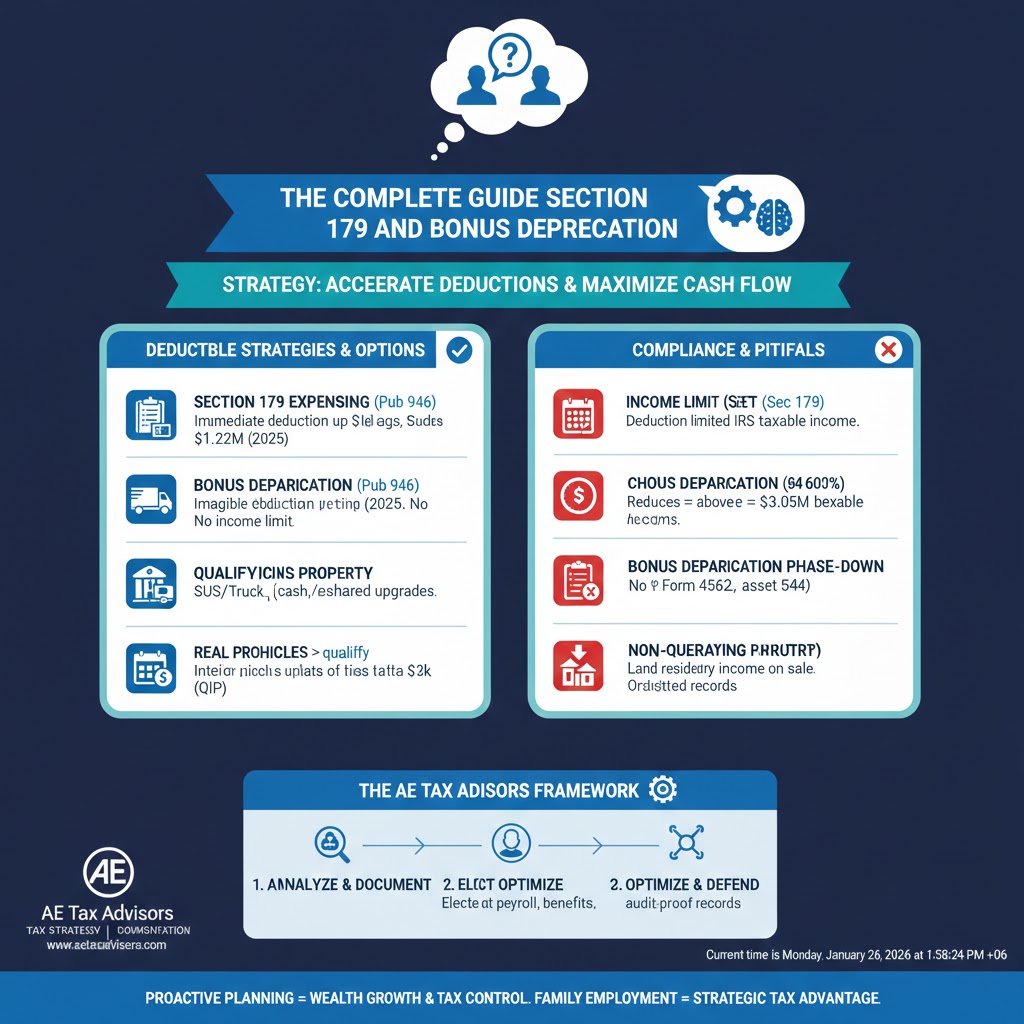
 This guide covers depreciation tax strategy and what it means for your tax situation.
Understanding The Complete Guide To Section in 2026
For business owners, one of the most powerful ways to reduce taxes is through accelerated depreciation. Section 179 and bonus depreciation allow you to deduct the cost of qualifying business assets immediately — rather than spreading those deductions over years. Used properly, these tools can save tens or even hundreds of thousands in taxes while strengthening cash flow.
At AE Tax Advisors, we help clients apply these rules correctly under IRS Publications 946, 535, and 463, ensuring every deduction is optimized, documented, and audit-proof.
This article builds upon The Business Owner’s Guide to Depreciation and Cost Recovery, The Business Owner’s Guide to Depreciation Recapture and Asset Sales, and The Family Office Formula.
Why Accelerated Depreciation Matters
Depreciation is how you recover the cost of business property over time. But the tax code gives you two options — Section 179 and bonus depreciation — to recover those costs faster.
Accelerated depreciation helps you:
- Reduce taxable income immediately.
- Improve short-term cash flow.
- Offset taxable gains from other areas.
- Reinvest savings into future growth.
AE Tax Advisors structures depreciation elections to fit your broader tax and cash strategy.
Step 1: What Is Section 179?
Section 179 lets you deduct the full cost of qualifying property in the year it’s placed in service, instead of depreciating it over several years.
2025 limits:
- Maximum deduction: $1,220,000.
- Phase-out threshold: $3,050,000 (deduction reduces dollar-for-dollar above this amount).
- Applies to new or used tangible personal property, and certain building improvements.
Under Publication 946, qualifying assets include:
- Machinery and equipment.
- Furniture and fixtures.
- Vehicles used for business.
- Computers, servers, and software.
- Qualified improvements to nonresidential buildings.
AE Tax Advisors ensures assets meet the definition of “placed in service” and allocates costs properly to maximize the Section 179 deduction.
Step 2: What Is Bonus Depreciation?
Bonus depreciation allows an immediate deduction for a percentage of an asset’s cost after Section 179 is applied. It applies to new and used property with a recovery period of 20 years or less.
2025 bonus depreciation rate: 60% (scheduled to phase down from 80% in 2023 and 100% in prior years).
Bonus depreciation can create or increase a net operating loss (NOL), making it more flexible than Section 179, which is limited to taxable income.
AE Tax Advisors helps businesses determine whether to use Section 179, bonus depreciation, or both — depending on entity type, income level, and growth plans.
Step 3: Qualifying Property for Section 179 and Bonus
Under Publication 946, qualifying property must be:
- Tangible, depreciable, and used more than 50% for business.
- Acquired by purchase (not gift or inheritance).
- Placed in service during the tax year.
Common examples:
- Work trucks, vans, and equipment.
- Computers and office furniture.
- Manufacturing machinery.
- Retail or warehouse improvements.
AE Tax Advisors documents each purchase with invoices, payment records, and service logs to prove eligibility.
Step 4: Vehicles and Heavy Equipment
Vehicles are a common area for accelerated depreciation. The IRS sets different limits depending on vehicle type:
- Passenger vehicles (under 6,000 lbs GVWR): Subject to annual caps ($12,200 for year 1 in 2025 plus $8,000 bonus).
- Heavy SUVs, trucks, and vans (over 6,000 lbs GVWR): Qualify for 100% Section 179 up to $28,900 (for 2025).
AE Tax Advisors helps clients classify vehicles correctly under Publication 463 and track business-use percentages for compliance.
This ties directly to The Smart Way to Deduct Vehicle Expenses for Business.
Step 5: Real Property and Improvements
While land cannot be depreciated, certain qualified improvement property (QIP) can be expensed under Section 179 or bonus depreciation.
Examples include:
- Interior renovations.
- Lighting upgrades.
- HVAC and electrical systems.
- Flooring, ceilings, and partitions.
To qualify, improvements must be to the interior of nonresidential property and not involve structural enlargement or elevators.
AE Tax Advisors performs cost segregation analysis to separate QIP from structural components — accelerating deductions while maintaining accuracy.
This connects with The Business Owner’s Guide to Depreciation and Cost Recovery.
Step 6: Section 179 vs. Bonus Depreciation — Key Differences
| Feature | Section 179 | Bonus Depreciation |
|---|---|---|
| Deduction Limit | $1,220,000 | No limit |
| Income Restriction | Limited to taxable income | Can create NOL |
| Property Type | Tangible, certain improvements | Tangible with <20-year life |
| New/Used | New or used | New or used |
| Elective | Must be elected | Automatic (opt-out available) |
AE Tax Advisors often combines both methods: applying Section 179 to smaller assets and bonus depreciation to large purchases.
Step 7: Recordkeeping Requirements
Under Publication 535, documentation must show:
- Description and cost of the property.
- Date placed in service.
- Business-use percentage.
- Section 179 election on Form 4562, Part I.
AE Tax Advisors maintains digital asset logs to ensure every deduction is supported and reconciles to your tax returns.
Step 8: Limitations and Phase-Outs
Section 179 deductions phase out once total asset purchases exceed $3,050,000. The deduction is reduced dollar-for-dollar beyond that threshold.
Bonus depreciation, on the other hand, has no phase-out limit but will gradually decline:
- 2025: 60%
- 2026: 40%
- 2027: 20%
- 2028: 0% (unless extended by Congress)
AE Tax Advisors monitors legislative updates to ensure clients capitalize on current-year opportunities before phase-downs occur.
Step 9: Interaction With Entity Types
Depreciation strategies vary by entity:
- Sole Proprietorship/LLC: Report on Schedule C.
- S-Corporation: Deduction flows through to shareholders’ K-1s.
- C-Corporation: Deduction remains at corporate level.
AE Tax Advisors coordinates Section 179 and bonus depreciation elections across multi-entity groups, ensuring compliance with Publication 946 aggregation rules.
This ties to The Business Owner’s Blueprint and The Family Office Formula.
Step 10: Planning for Depreciation Recapture
When assets depreciated under Section 179 or bonus are sold, the IRS may recapture part of the deduction as ordinary income under Publication 544.
AE Tax Advisors tracks asset bases and schedules recapture management as part of exit and sale planning, preventing unexpected tax liabilities.
This connects directly to The Business Owner’s Guide to Depreciation Recapture and Asset Sales.
Step 11: Combining With Other Strategies
Accelerated depreciation works best when layered with:
- Accountable plans for reimbursements.
- Entity-level tax planning for owner-operators.
- 1031 exchanges for real estate transitions.
- Roth or retirement funding using freed-up cash flow.
AE Tax Advisors integrates these methods into comprehensive business tax maps for maximum compound efficiency.
AE Tax Advisors Accelerated Depreciation Framework
- Identify eligible property and confirm business use.
- Decide between Section 179 and bonus depreciation (or both).
- Elect proper treatment on Form 4562.
- Maintain detailed asset documentation.
- Plan future sales to minimize recapture exposure.
This framework aligns with IRS Publications 946, 535, and 463, ensuring tax efficiency, compliance, and defensibility.
Conclusion: Accelerate Deductions, Not Risk
Accelerated depreciation rewards smart planning — not shortcuts. When you apply Section 179 and bonus depreciation strategically, you can reduce taxes today while preserving flexibility for tomorrow. The key is accurate classification, timing, and documentation.
At AE Tax Advisors, we design depreciation strategies that blend immediate tax relief with long-term sustainability. Every asset you buy has hidden power — and when you unlock it properly, your balance sheet becomes your biggest tax advantage.
Understanding depreciation tax strategy is essential for maximizing your tax savings as a real estate investor.
When it comes to depreciation tax strategy, working with a specialized tax advisor makes all the difference.
Many investors overlook depreciation tax strategy, but it can be one of the most impactful strategies in your tax plan.
At AE Tax Advisors, we help clients navigate depreciation tax strategy to keep more of what they earn.
Depreciation tax strategy is one of the most important concepts for real estate investors to understand. When properly implemented, depreciation tax strategy can lead to significant tax savings that compound over time.
Many high-income earners miss out on depreciation tax strategy opportunities simply because their CPA lacks the specialized knowledge. A proactive approach to depreciation tax strategy can mean the difference between overpaying and optimizing your tax position.
At AE Tax Advisors, our team specializes in depreciation tax strategy for real estate investors and W-2 professionals. We have helped hundreds of clients use depreciation tax strategy to reduce their tax burden by $50,000 or more annually.
Understanding Depreciation tax strategy
Depreciation tax strategy is a critical component of any comprehensive tax strategy for real estate investors. At AE Tax Advisors, we help clients navigate depreciation tax strategy to maximize their tax savings while maintaining full IRS compliance. Our proactive approach ensures you capture every available deduction and credit.
For more information, refer to the IRS Publication 946.