

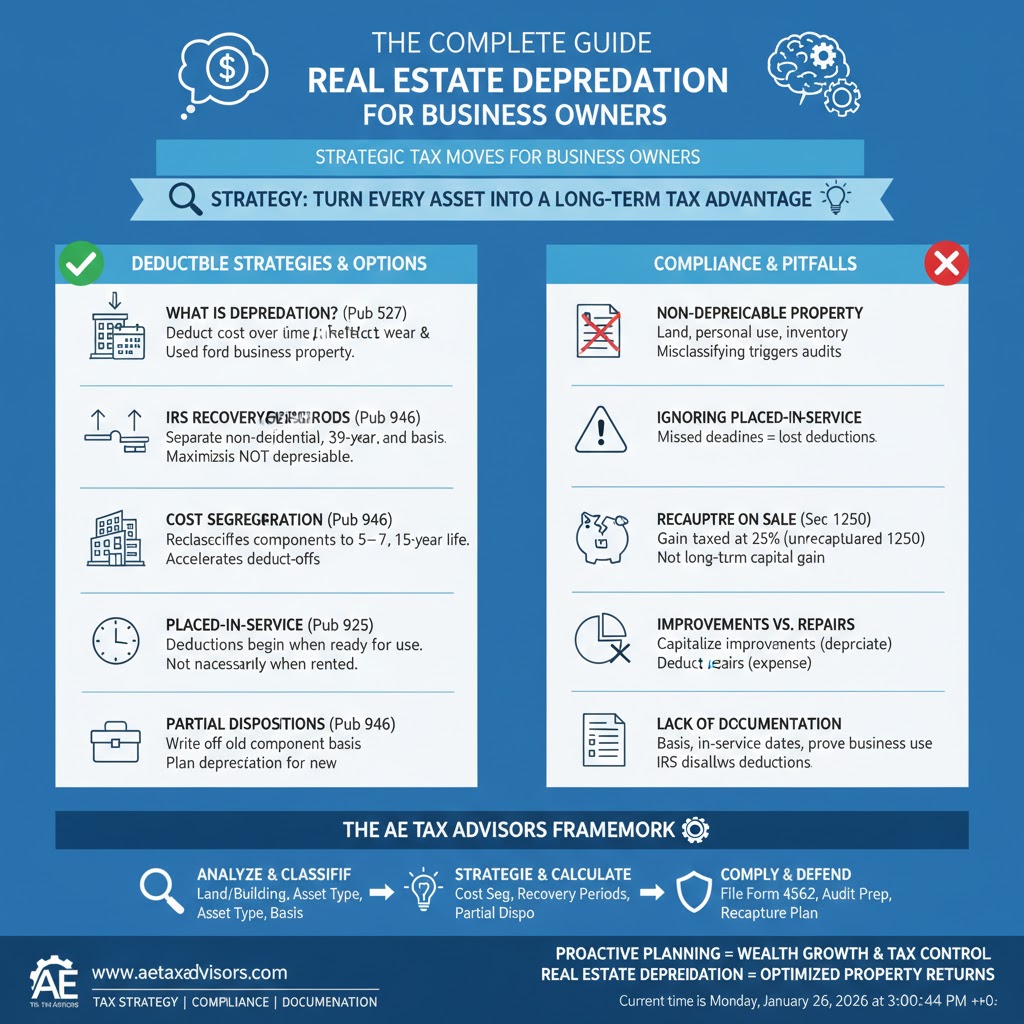
 This guide covers depreciation tax strategy and what it means for your tax situation.
Understanding The Complete Guide To Real in 2026
Real estate is one of the most powerful wealth-building tools in the tax code. Whether you own your office building, a warehouse, or investment properties, depreciation lets you write off a portion of the property’s value every year — even as it often appreciates in real life.
At AE Tax Advisors, we help business owners understand and apply real estate depreciation correctly under IRS Publications 946, 527, and 535, ensuring every eligible dollar of value is captured as a deduction.
This guide builds upon The Business Owner’s Guide to Depreciation and Cost Recovery, The Complete Guide to Section 179 and Bonus Depreciation, and Real Estate Inside the Business: The Overlooked Wealth Strategy of the 1%.
Why Real Estate Depreciation Matters
Depreciation is not just an accounting entry — it’s one of the most significant tax benefits available to property owners. It allows you to recover the cost of income-producing real estate over time, reducing taxable income while maintaining cash flow.
In short:
- You get to deduct the wear and tear of your property each year.
- You keep more cash in the business.
- You often gain appreciation simultaneously.
AE Tax Advisors structures real estate depreciation schedules strategically to balance short-term deductions with long-term gain management.
Step 1: What Properties Qualify for Depreciation
According to IRS Publication 527, you can depreciate property that meets all of the following conditions:
- You own it (or are treated as the owner for tax purposes).
- You use it in business or to produce income.
- It has a determinable useful life longer than one year.
Depreciable real estate includes:
- Commercial buildings.
- Rental properties.
- Mixed-use properties.
- Improvements (HVAC, roofing, parking lots, interior finishes).
Non-depreciable property includes:
- Land.
- Personal-use property.
- Vacant lots or land held for speculation.
AE Tax Advisors helps identify which parts of a property are depreciable, often through cost segregation.
Step 2: The IRS Recovery Periods for Real Estate
The IRS assigns specific recovery periods for real estate depreciation under Publication 946:
- Residential rental property: 27.5 years.
- Nonresidential commercial property: 39 years.
These periods apply under the Modified Accelerated Cost Recovery System (MACRS) using the straight-line method.
Example:
A $1,000,000 commercial property depreciated over 39 years yields an annual deduction of roughly $25,641 per year.
AE Tax Advisors prepares recovery schedules that align with IRS MACRS tables to ensure every deduction is properly timed and supported.
Step 3: Land vs. Building Allocation
Land is not depreciable, but the building and its improvements are. Therefore, when acquiring real estate, you must allocate the purchase price between land and building.
This can be done using:
- County tax assessor values.
- Independent appraisals.
- Cost segregation analysis.
AE Tax Advisors performs detailed land-to-building allocation to maximize the depreciable portion of your purchase — while staying compliant with Publication 535.
Step 4: Cost Segregation for Accelerated Depreciation
A cost segregation study breaks down a building into its component parts — land improvements, personal property, and structural assets — allowing some portions to be depreciated faster (5, 7, or 15 years instead of 39).
Examples of reclassified assets:
- Carpeting, cabinetry, and fixtures.
- Parking lots and landscaping.
- Lighting and electrical systems.
AE Tax Advisors coordinates third-party cost segregation studies to help business owners capture accelerated deductions early, increasing cash flow.
This ties directly to The Business Owner’s Guide to Depreciation and Cost Recovery.
Step 5: Placed-in-Service Rules
Depreciation begins when the property is placed in service — meaning it’s ready and available for business use, not necessarily when it starts generating income.
Example:
If you close on a property in December but don’t rent it out until January, depreciation still begins in December if it’s ready for use.
AE Tax Advisors ensures proper timing for placed-in-service dates to align deductions with operational readiness.
Step 6: Improvements vs. Repairs
Repairs and maintenance expenses are typically deductible immediately, while improvements must be capitalized and depreciated.
Repairs restore property to its previous condition.
Improvements enhance value, extend life, or adapt the property for new use.
Examples:
- Repair: Replacing a broken window (deductible).
- Improvement: Replacing the entire roof (depreciable).
AE Tax Advisors classifies each expense under Publication 535 to ensure compliance and maximum benefit.
Step 7: Bonus Depreciation for Real Estate
While buildings themselves do not qualify for bonus depreciation, many components identified through cost segregation do.
Items with a useful life under 20 years — like carpet, lighting, and landscaping — can qualify for bonus depreciation under Section 168(k).
AE Tax Advisors layers bonus depreciation with standard real estate deductions to accelerate recovery without triggering recapture risk later.
This connects directly to The Complete Guide to Section 179 and Bonus Depreciation.
Step 8: Partial Dispositions and Renovations
When renovating a property, you may be able to write off the remaining basis of components being replaced — such as roofs, HVAC systems, or electrical upgrades.
This is called a partial disposition election under Publication 946.
Example:
You replace an HVAC system that had $15,000 remaining basis — you can deduct that full amount in the year of replacement.
AE Tax Advisors ensures these partial dispositions are documented and reported properly to maximize deductions.
This ties to The Ultimate Guide to Business Asset Disposal and Replacement.
Step 9: Recapture on Sale
When selling real estate, the IRS may require depreciation recapture — taxing prior deductions at a rate of up to 25% under Section 1250.
Example:
If you depreciated $400,000 on a building and sell it for a profit, that $400,000 is taxed as unrecaptured Section 1250 gain.
AE Tax Advisors helps you plan for recapture by structuring sales, 1031 exchanges, or timing strategies to defer or offset taxes.
This connects to The Business Owner’s Guide to Depreciation Recapture and Asset Sales.
Step 10: Real Estate Held in Different Entities
Depreciation treatment depends on entity structure:
- Sole proprietors/LLCs: Report on Schedule E or C.
- Partnerships/LLCs: Deduct via K-1 allocations.
- S-Corps and C-Corps: Depreciation claimed directly on corporate returns.
AE Tax Advisors coordinates depreciation schedules across multi-entity setups to maintain basis integrity and maximize efficiency.
This integrates with The Business Owner’s Blueprint: How to Build, Protect, and Multiply Wealth Through Entity Strategy.
Step 11: Depreciation for Mixed-Use and Short-Term Rentals
For properties used both personally and for business — such as vacation rentals or short-term stays — only the business-use percentage of depreciation is deductible.
Example:
If your property is rented 75% of the year and used personally 25%, only 75% of depreciation can be claimed.
AE Tax Advisors applies Publication 527 guidance to ensure accurate percentage calculations and audit-ready records.
Step 12: Depreciation After Improvements or Refinancing
Major renovations reset the basis for depreciation on the improved portion of the property. Refinancing does not affect depreciation unless capital improvements are rolled into the loan.
AE Tax Advisors maintains running basis adjustments to ensure cumulative depreciation is correctly reflected and reconciled annually.
AE Tax Advisors Real Estate Depreciation Framework
- Allocate purchase price between land and building.
- Identify and classify assets via cost segregation.
- Apply proper recovery periods under MACRS.
- Record depreciation accurately on Form 4562.
- Track improvements and partial dispositions.
- Plan recapture and replacement timing strategically.
This system aligns with IRS Publications 946, 527, and 535, ensuring accuracy, compliance, and long-term tax efficiency.
Conclusion: Depreciation Is the Real Estate Owner’s Hidden Engine
Depreciation turns ordinary ownership into extraordinary tax efficiency. When managed strategically, it creates predictable, compounding savings every year — while your property continues to grow in value.
At AE Tax Advisors, we help business owners turn depreciation into a strategic advantage. Through cost segregation, improvement tracking, and long-term planning, we make sure every property you own becomes a permanent contributor to your financial growth.
Understanding depreciation tax strategy is essential for maximizing your tax savings as a real estate investor.
When it comes to depreciation tax strategy, working with a specialized tax advisor makes all the difference.
Many investors overlook depreciation tax strategy, but it can be one of the most impactful strategies in your tax plan.
At AE Tax Advisors, we help clients navigate depreciation tax strategy to keep more of what they earn.
Depreciation tax strategy is one of the most important concepts for real estate investors to understand. When properly implemented, depreciation tax strategy can lead to significant tax savings that compound over time.
Many high-income earners miss out on depreciation tax strategy opportunities simply because their CPA lacks the specialized knowledge. A proactive approach to depreciation tax strategy can mean the difference between overpaying and optimizing your tax position.
At AE Tax Advisors, our team specializes in depreciation tax strategy for real estate investors and W-2 professionals. We have helped hundreds of clients use depreciation tax strategy to reduce their tax burden by $50,000 or more annually.
The key to successful depreciation tax strategy implementation is working with an advisor who understands real estate taxation. Every depreciation tax strategy decision should be part of a comprehensive, multi-year tax plan.
Understanding Depreciation tax strategy
Depreciation tax strategy is a critical component of any comprehensive tax strategy for real estate investors. At AE Tax Advisors, we help clients navigate depreciation tax strategy to maximize their tax savings while maintaining full IRS compliance. Our proactive approach ensures you capture every available deduction and credit.
For more information, refer to the IRS Publication 946.