

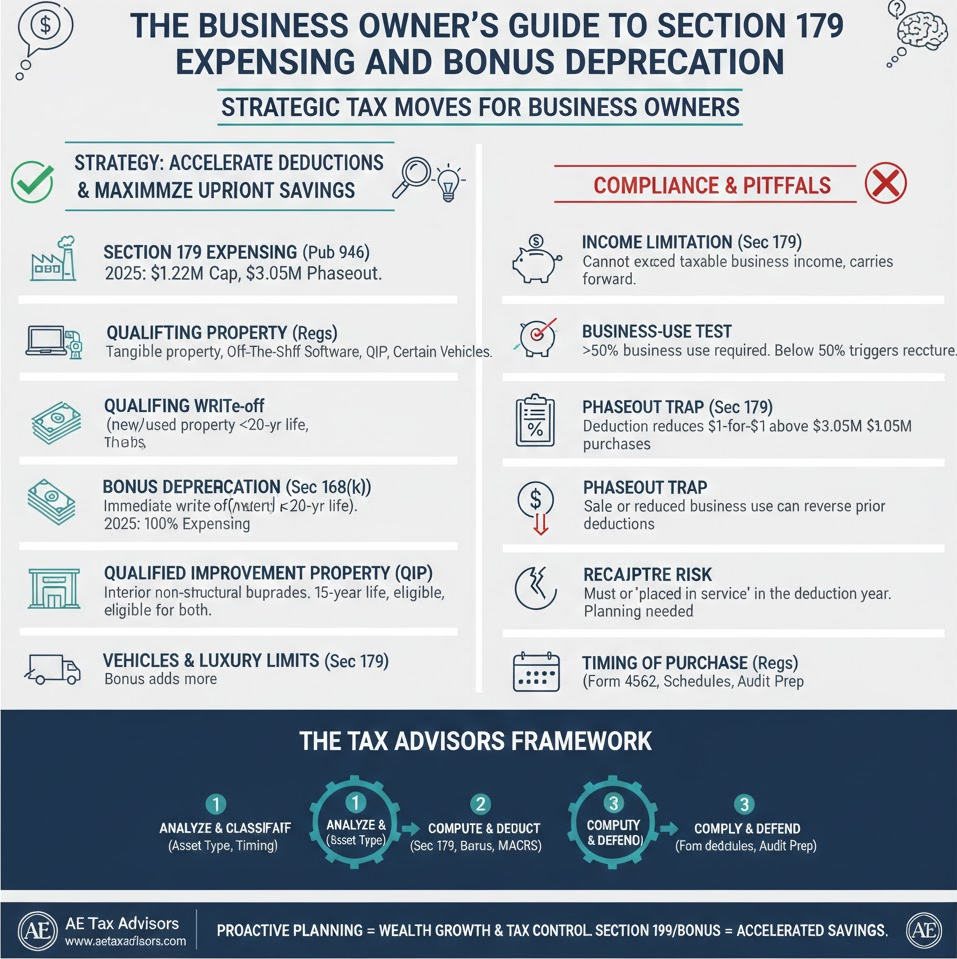
 This guide covers depreciation tax strategy and what it means for your tax situation.
Understanding The Business Owner’s Guide To in 2026
Every successful business eventually faces the same question: how do you deduct major purchases like equipment, vehicles, or property improvements without waiting years to recover costs?
That’s where Section 179 and bonus depreciation come in. These two provisions allow business owners to immediately deduct a substantial portion—or even all—of their qualifying asset purchases in the year they’re placed in service.
At AE Tax Advisors, we help business owners navigate the nuanced limits, eligibility rules, and timing strategies behind Section 179 and bonus depreciation, ensuring compliance with IRS Publications 946, 535, and 551 while maximizing upfront deductions and long-term tax efficiency.
This article builds upon The Business Owner’s Guide to Section 199A Qualified Business Income (QBI) Deduction, The Business Owner’s Guide to Depreciation and Cost Recovery, and The Business Owner’s Blueprint for Tax-Efficient Capital Expenditures.
What Is Section 179 Expensing?
Section 179 allows business owners to elect to deduct the full cost of qualifying property in the year it’s placed in service—rather than depreciating it over several years.
In 2025, the maximum Section 179 deduction is approximately $1.22 million, with a phaseout threshold of about $3.05 million in qualifying purchases. These amounts are indexed for inflation annually.
AE Tax Advisors structures equipment and vehicle purchases to optimize timing and stay below the phaseout threshold.
Step 1: What Property Qualifies for Section 179
To qualify for Section 179 expensing, property must be:
- Tangible personal property used in business (e.g., equipment, machinery, computers, furniture).
- Off-the-shelf software (readily available for general public use).
- Qualified improvement property (interior improvements to nonresidential buildings).
- Certain business vehicles, subject to specific dollar limits.
Real estate and land generally do not qualify.
AE Tax Advisors reviews asset classifications to confirm eligibility under Publication 946 and Reg. §1.179-2(a).
Step 2: The Section 179 Dollar and Investment Limits
The 2025 deduction is capped at:
- $1.22 million maximum deduction.
- Reduced dollar-for-dollar once total purchases exceed $3.05 million.
Example:
If you purchase $3.55 million of qualifying assets, the deduction is reduced by $500,000 ($3.55M – $3.05M).
AE Tax Advisors times capital purchases across entities and tax years to preserve full eligibility.
Step 3: Business-Use Requirement
To claim Section 179, property must be used more than 50% for business purposes. If usage later drops below 50%, previously claimed deductions may be recaptured as income.
AE Tax Advisors tracks asset usage and ensures proper business documentation to avoid recapture under Section 179(d)(10).
Step 4: Section 179 vs. Bonus Depreciation
While Section 179 is elective and limited by income, bonus depreciation (under Section 168(k)) allows 100% immediate write-offs for qualifying property without income limits.
Key differences:
| Feature | Section 179 | Bonus Depreciation |
|---|---|---|
| Deduction limit | $1.22M cap | No cap |
| Income limit | Cannot exceed taxable business income | No limit |
| Property type | Tangible property only | New or used qualifying property |
| Election | Optional per item | Automatic unless opted out |
AE Tax Advisors often combines both methods strategically—using Section 179 first, then applying bonus depreciation for remaining amounts.
Step 5: Qualified Improvement Property (QIP)
QIP refers to interior, non-structural improvements to nonresidential buildings. It qualifies for both Section 179 and bonus depreciation with a 15-year recovery period.
AE Tax Advisors performs cost segregation studies to identify QIP components, maximizing depreciation efficiency under Publication 946.
This connects directly to The Business Owner’s Guide to Depreciation and Cost Recovery.
Step 6: Vehicles and Luxury Auto Limits
Certain business vehicles qualify for Section 179, but passenger vehicles are subject to strict limits.
For 2025:
- Cars: ~$12,200 deduction limit.
- SUVs >6,000 lbs: up to $28,900 deduction under Section 179.
- Bonus depreciation can further increase first-year deductions.
AE Tax Advisors confirms gross vehicle weight (GVWR) and business usage documentation to safely maximize these deductions.
Step 7: Income Limitation
Section 179 deductions cannot exceed taxable business income from all active trades or businesses. Unused deductions are carried forward indefinitely.
AE Tax Advisors uses entity-level coordination to allocate Section 179 deductions efficiently across multiple businesses.
This ties directly to The Business Owner’s Guide to Section 469 Passive Activity Loss Rules and Material Participation.
Step 8: Bonus Depreciation Overview
Bonus depreciation under Section 168(k) allows immediate expensing of new and used property with a recovery period of 20 years or less, including:
- Equipment and machinery.
- Certain vehicles.
- Computer software.
- Qualified improvement property.
The deduction percentage is scheduled to remain high through 2025 but will begin phasing down unless extended by Congress.
AE Tax Advisors monitors annual legislative updates and plans accordingly for clients with major capital expenditures.
Step 9: New vs. Used Property Rules
Unlike older tax laws, bonus depreciation now applies to both new and used property, as long as:
- The property was not previously used by the taxpayer, and
- The acquisition was at arm’s length and not from a related party.
AE Tax Advisors confirms purchase agreements meet IRS related-party standards under Reg. §1.168(k)-2(b)(3).
Step 10: Ordering Rules — How Section 179 and Bonus Work Together
When both deductions apply:
- Apply Section 179 expensing first.
- Apply bonus depreciation to remaining cost.
- Apply regular MACRS depreciation to any leftover basis.
AE Tax Advisors sequences these deductions to optimize immediate write-offs while preserving future flexibility.
Step 11: Example — Combined Deduction
Equipment cost: $1,500,000
- Section 179 deduction: $1,000,000
- Remaining basis: $500,000
- Bonus depreciation (100%): $500,000
- Total first-year deduction: $1,500,000
AE Tax Advisors uses modeling software to coordinate Section 179 and bonus depreciation across entity structures.
Step 12: Recapture Rules
If property’s business use drops below 50% or the asset is sold, some of the prior deductions may be recaptured as income under Section 179(d)(10) or Section 1245.
AE Tax Advisors monitors disposition events and handles recapture reporting on Form 4797 to avoid audit exposure.
Step 13: Entity and Ownership Implications
Section 179 limits apply at the entity level and owner level:
- Partnerships and S corporations elect Section 179 at the entity level, but the limit passes through to partners/shareholders.
- Bonus depreciation applies directly to the entity, without owner-level limits.
AE Tax Advisors coordinates elections and allocations across pass-through structures under Publication 541.
Step 14: Section 179 for Real Estate Businesses
Although buildings themselves don’t qualify, many real estate improvements—HVAC systems, roofing, alarm systems, and fire protection—do.
AE Tax Advisors performs detailed property improvement analyses to identify qualifying assets.
This connects directly to The Business Owner’s Guide to Real Estate Inside the Business: The Overlooked Wealth Strategy of the 1%.
Step 15: Interaction With Section 263A and Capitalization Rules
Even when property is expensed under Section 179 or bonus depreciation, capitalization rules still apply for inventory or indirect costs.
AE Tax Advisors ensures capitalization and expensing remain compliant under Section 263A (UNICAP) and Publication 535.
Step 16: Documentation and Elections
- Section 179 elections are made on Form 4562, Part I.
- Bonus depreciation is automatic but can be opted out on Form 4562, Part II.
AE Tax Advisors maintains depreciation schedules and election statements consistent with Reg. §1.179-5 and Reg. §1.168(k)-1(e).
Step 17: AE Tax Advisors Expensing Compliance Framework
- Identify all qualifying assets.
- Separate Section 179 and bonus-eligible property.
- Calculate optimal deduction order and amount.
- Integrate depreciation schedules with tax planning.
- File elections and maintain audit-ready documentation.
This framework follows IRS Publications 946, 535, and 551, ensuring every deduction is compliant, traceable, and strategically optimized.
Step 18: Strategic Planning With Expensing and Depreciation
AE Tax Advisors uses Section 179 and bonus depreciation planning to:
- Accelerate deductions in high-income years.
- Smooth income fluctuations across entities.
- Defer tax through timing of purchases.
- Combine expensing with QBI and cost segregation for compounding benefits.
Conclusion: Turning Depreciation Into an Immediate Tax Advantage
Section 179 and bonus depreciation transform the economics of business investment. With careful timing and classification, they allow business owners to recover capital immediately—freeing cash flow for reinvestment.
At AE Tax Advisors, we turn these complex depreciation provisions into strategic planning tools. Whether you’re upgrading equipment, improving property, or expanding operations, our experts ensure every dollar invested produces the maximum allowable deduction under current IRS rules.
Understanding depreciation tax strategy is essential for maximizing your tax savings as a real estate investor.
When it comes to depreciation tax strategy, working with a specialized tax advisor makes all the difference.
Many investors overlook depreciation tax strategy, but it can be one of the most impactful strategies in your tax plan.
At AE Tax Advisors, we help clients navigate depreciation tax strategy to keep more of what they earn.
Depreciation tax strategy is one of the most important concepts for real estate investors to understand. When properly implemented, depreciation tax strategy can lead to significant tax savings that compound over time.
Many high-income earners miss out on depreciation tax strategy opportunities simply because their CPA lacks the specialized knowledge. A proactive approach to depreciation tax strategy can mean the difference between overpaying and optimizing your tax position.
At AE Tax Advisors, our team specializes in depreciation tax strategy for real estate investors and W-2 professionals. We have helped hundreds of clients use depreciation tax strategy to reduce their tax burden by $50,000 or more annually.
The key to successful depreciation tax strategy implementation is working with an advisor who understands real estate taxation. Every depreciation tax strategy decision should be part of a comprehensive, multi-year tax plan.
Understanding Depreciation tax strategy
Depreciation tax strategy is a critical component of any comprehensive tax strategy for real estate investors. At AE Tax Advisors, we help clients navigate depreciation tax strategy to maximize their tax savings while maintaining full IRS compliance. Our proactive approach ensures you capture every available deduction and credit.
For more information, refer to the IRS Publication 946.