

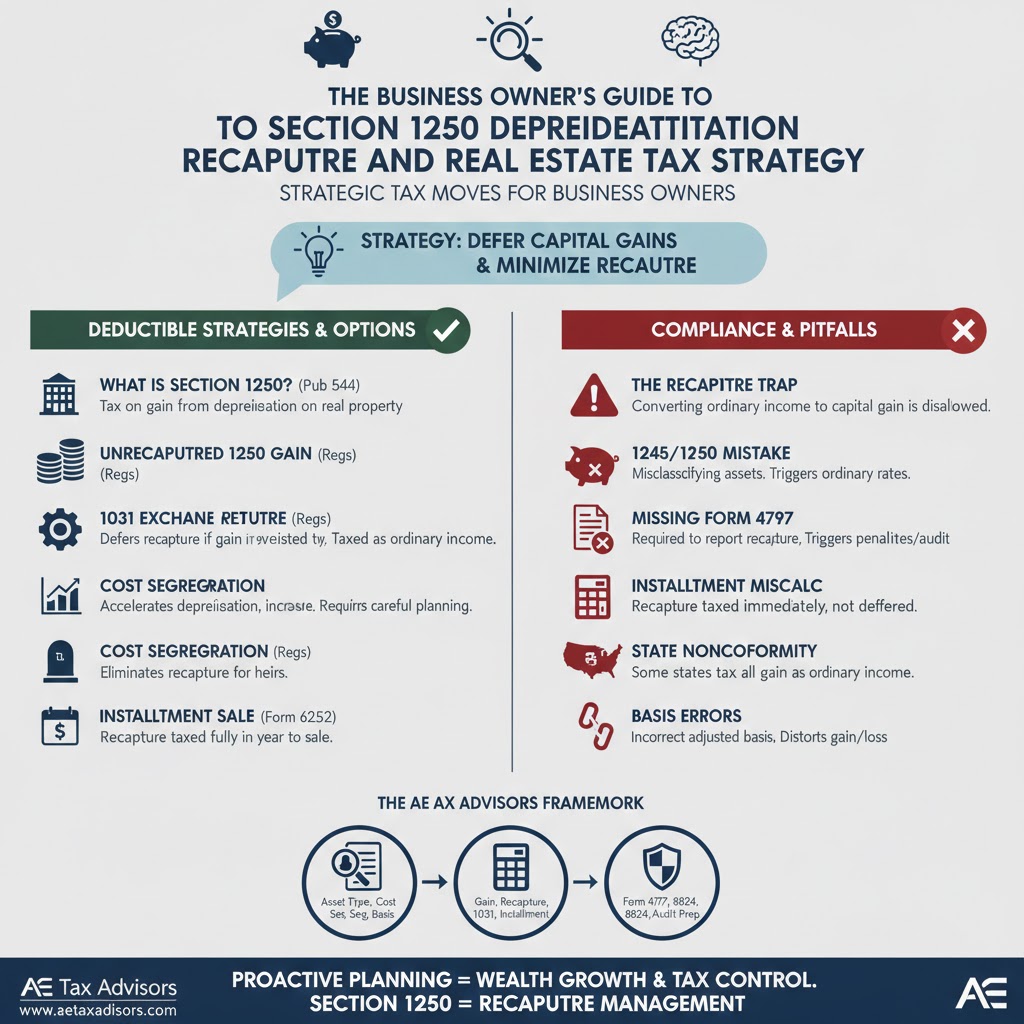
 This guide covers depreciation tax strategy and what it means for your tax situation.
Understanding The Business Owner’s Guide To in 2026
For real estate investors, depreciation is both a friend and a future tax liability. It lowers taxable income during ownership — but when the property is sold, the IRS may require you to “recapture” that benefit as taxable income under Section 1250.
Depreciation recapture ensures that taxpayers who previously deducted depreciation pay ordinary or special capital gains rates on the portion of gain attributable to those deductions.
At AE Tax Advisors, we design strategies that manage depreciation recapture efficiently, using 1031 exchanges, cost segregation studies, and long-term planning to defer or minimize tax exposure.
This article builds upon The Business Owner’s Guide to Section 1031 Like-Kind Exchanges and Deferral Strategy, The Business Owner’s Guide to Section 469 Passive Activity Loss Rules and Material Participation, and The Business Owner’s Guide to Section 754 Basis Adjustments and Partnership Step-Ups.
What Is Section 1250 Depreciation Recapture?
Section 1250 applies when you sell or dispose of real property that was depreciated using an accelerated or straight-line method. The IRS “recaptures” part of the gain as ordinary income — specifically the portion attributable to depreciation deductions.
AE Tax Advisors models these recapture amounts under IRS Publication 544 and Reg. §1.1250-1 through §1.1250-3 to ensure accuracy and tax efficiency.
Step 1: The Purpose of Recapture
Depreciation is a timing benefit — not a permanent deduction. Recapture rules prevent taxpayers from converting ordinary deductions into long-term capital gains by taxing the previously deducted amounts at higher rates upon sale.
AE Tax Advisors manages this process to balance short-term savings with long-term consequences.
Step 2: Property Subject to Section 1250
Section 1250 covers real property such as:
- Residential rental buildings.
- Commercial office or retail properties.
- Warehouses and industrial facilities.
- Any structure that is depreciated under the straight-line or accelerated cost recovery system (ACRS/MACRS).
AE Tax Advisors verifies the classification of each asset using Publication 946 to confirm applicable depreciation methods.
Step 3: The Concept of “Unrecaptured Section 1250 Gain”
Not all depreciation recapture is taxed as ordinary income. For real estate, unrecaptured Section 1250 gain is taxed at a maximum rate of 25%, not ordinary income rates.
This gain represents the portion of appreciation attributable to prior depreciation taken on the property.
AE Tax Advisors separates gains into three layers:
- Ordinary income (from Section 1245 personal property).
- Unrecaptured Section 1250 gain (real property).
- Long-term capital gain (true appreciation).
Step 4: How Recapture Is Calculated
The general calculation steps are:
- Determine total gain on sale (sales price minus adjusted basis).
- Determine depreciation taken during ownership.
- Reclassify that portion of the gain as unrecaptured Section 1250 gain (taxed up to 25%).
- Any remaining gain is taxed as capital gain (0–20%).
AE Tax Advisors provides detailed transaction worksheets following Publication 544 and Form 4797 instructions.
Step 5: Example — Apartment Building Sale
You purchased an apartment building for $2 million and claimed $800,000 in depreciation. You sell it for $3 million.
- Adjusted basis: $1.2 million ($2M – $800K depreciation).
- Gain: $1.8 million ($3M – $1.2M).
- Of this, $800K is unrecaptured Section 1250 gain taxed up to 25%.
- The remaining $1M is long-term capital gain taxed up to 20%.
AE Tax Advisors models this outcome before sale to prepare cash flow and reinvestment strategies.
Step 6: Depreciation Recapture vs. 1031 Exchange
In a properly executed Section 1031 exchange, both capital gains and depreciation recapture can be deferred — provided all proceeds are reinvested in qualifying like-kind property.
AE Tax Advisors structures exchanges to defer both layers of tax, carrying forward recapture potential into the new property under Reg. §1.1031(d)-1.
This connects directly to The Business Owner’s Guide to Section 1031 Like-Kind Exchanges and Deferral Strategy.
Step 7: Section 1245 vs. 1250
Section 1245 applies to personal property (fixtures, equipment, and certain leasehold improvements). All depreciation under 1245 is recaptured as ordinary income.
Section 1250 applies to real property and only recaptures accelerated depreciation beyond straight-line — but the Tax Reform Act of 1986 largely eliminated accelerated real estate depreciation, so most modern property falls under unrecaptured 1250 gain at 25%.
AE Tax Advisors distinguishes between 1245 and 1250 assets using cost segregation analysis to optimize both categories.
Step 8: Cost Segregation and Recapture
Cost segregation separates building components into shorter-lived assets (5-, 7-, 15-year property). While this accelerates deductions, it also increases 1245 recapture potential later.
AE Tax Advisors balances cost segregation benefits with eventual recapture exposure, modeling both cash flow and exit strategy outcomes.
Step 9: Installment Sales and Recapture
When property is sold on an installment basis, depreciation recapture is taxed in the year of sale, not deferred across payments.
AE Tax Advisors coordinates installment reporting on Form 6252 and Form 4797 to properly isolate recapture versus deferred gain.
Step 10: Partnership and Entity-Level Rules
Partnerships must track 1250 gain separately on Schedule K and K-1 for each partner. Each partner’s share of depreciation and gain is calculated individually.
AE Tax Advisors ensures consistency between partnership depreciation schedules, basis adjustments, and partner-level reporting under Publication 541.
Step 11: 1031 Exchange vs. Sale Comparison
Without 1031:
- $800K recapture × 25% = $200K tax.
- $1M capital gain × 20% = $200K tax.
- Total = $400K tax due.
With 1031:
- All gain deferred.
- Basis in new property reduced accordingly.
AE Tax Advisors presents this side-by-side modeling to guide client decision-making.
Step 12: State-Level Recapture
Some states (like California and New York) do not conform to federal 1031 or recapture treatment, taxing all gain as ordinary income.
AE Tax Advisors evaluates both federal and state recapture exposure in pre-sale tax modeling.
Step 13: Depreciation Recapture Upon Death
When a taxpayer passes away, their heirs receive a step-up in basis, eliminating both capital gains and unrecaptured 1250 gain.
AE Tax Advisors integrates estate planning with entity ownership structures to permanently eliminate deferred recapture through basis step-up.
Step 14: Passive Activity and Recapture
Depreciation recapture is not offset by suspended passive losses. Those losses are deductible upon sale, but the recapture is separately recognized as income.
AE Tax Advisors reconciles both categories on Form 4797 and Form 8582 to maintain accuracy.
Step 15: Common Audit Triggers
- Misreporting total depreciation claimed.
- Failing to separate 1245 and 1250 components.
- Excluding recapture on installment or partial sales.
- Reporting incorrect rates for unrecaptured gain.
- Inconsistent data across K-1, 4797, and 8824.
AE Tax Advisors conducts internal depreciation and gain audits before filing to ensure perfect consistency.
Step 16: Recordkeeping Requirements
Maintain:
- Original purchase documents and settlement statements.
- Depreciation schedules and cost segregation reports.
- Exchange documentation (if applicable).
- Closing statements and appraisal reports.
AE Tax Advisors stores and reconciles this data annually under Publication 946 best practices.
Step 17: Planning to Minimize Recapture
- Use 1031 exchanges for long-term deferral.
- Hold properties until death to achieve basis step-up.
- Convert property to primary residence under Section 121 (partial exclusion).
- Invest in Opportunity Zones to defer or exclude capital gain.
- Time sales with lower-income years to reduce effective tax rate.
AE Tax Advisors tailors these strategies to each investor’s timeline and entity structure.
Step 18: AE Tax Advisors 1250 Compliance Framework
- Calculate total gain and depreciation claimed.
- Separate 1245 and 1250 property components.
- Determine unrecaptured 1250 gain at 25%.
- Apply 1031 or installment deferral where applicable.
- Prepare and reconcile Form 4797, 8824, and K-1.
This framework follows IRS Publications 544, 946, and 527, ensuring full compliance and optimized tax outcomes.
Step 19: Example — Commercial Property Sale
A commercial property purchased for $5 million has taken $1.5 million of depreciation. The sale price is $7 million.
- Adjusted basis: $3.5M.
- Total gain: $3.5M.
- Of this, $1.5M is taxed as unrecaptured 1250 gain at 25%.
- Remaining $2M taxed as long-term capital gain.
AE Tax Advisors models this outcome and prepares both federal and state-level recapture reconciliations.
Conclusion: Deferral, Planning, and Permanent Elimination
Depreciation recapture is inevitable for most investors — but it can be deferred, reduced, or eliminated entirely with proper planning. Whether through 1031 exchanges, strategic holding periods, or estate integration, Section 1250 does not have to mean higher taxes.
At AE Tax Advisors, we turn depreciation recapture into an opportunity. By coordinating depreciation schedules, exchange strategies, and long-term entity planning, we help investors build wealth efficiently, stay compliant, and minimize tax impact over generations.
Understanding depreciation tax strategy is essential for maximizing your tax savings as a real estate investor.
When it comes to depreciation tax strategy, working with a specialized tax advisor makes all the difference.
Many investors overlook depreciation tax strategy, but it can be one of the most impactful strategies in your tax plan.
At AE Tax Advisors, we help clients navigate depreciation tax strategy to keep more of what they earn.
Depreciation tax strategy is one of the most important concepts for real estate investors to understand. When properly implemented, depreciation tax strategy can lead to significant tax savings that compound over time.
Many high-income earners miss out on depreciation tax strategy opportunities simply because their CPA lacks the specialized knowledge. A proactive approach to depreciation tax strategy can mean the difference between overpaying and optimizing your tax position.
At AE Tax Advisors, our team specializes in depreciation tax strategy for real estate investors and W-2 professionals. We have helped hundreds of clients use depreciation tax strategy to reduce their tax burden by $50,000 or more annually.
The key to successful depreciation tax strategy implementation is working with an advisor who understands real estate taxation. Every depreciation tax strategy decision should be part of a comprehensive, multi-year tax plan.
Understanding Depreciation tax strategy
Depreciation tax strategy is a critical component of any comprehensive tax strategy for real estate investors. At AE Tax Advisors, we help clients navigate depreciation tax strategy to maximize their tax savings while maintaining full IRS compliance. Our proactive approach ensures you capture every available deduction and credit.
For more information, refer to the IRS Publication 946.