

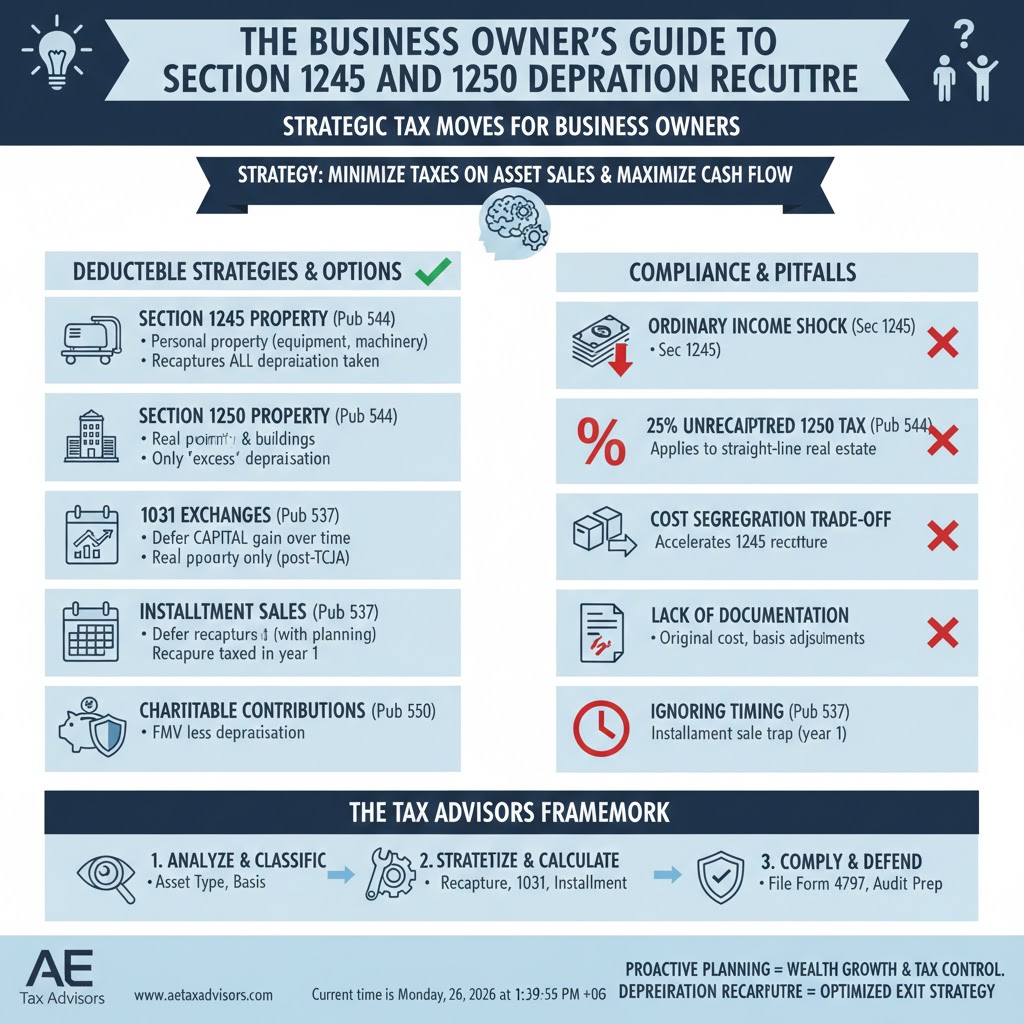
 This guide covers depreciation tax strategy and what it means for your tax situation.
Understanding The Business Owner’s Guide To in 2026
Depreciation is one of the most powerful tax benefits available to business owners and real estate investors. It allows you to recover the cost of property over time and reduce taxable income annually. But when that property is sold, the IRS may “recapture” some of those deductions — converting what you thought was long-term capital gain into ordinary income.
At AE Tax Advisors, we help business owners and investors navigate Sections 1245 and 1250, ensuring depreciation benefits are maximized during ownership and that recapture is minimized at disposition.
This article builds upon The Business Owner’s Guide to Installment Sales and Deferred Gain Strategies, The Complete Guide to Real Estate Depreciation for Business Owners, and The Business Owner’s Blueprint: How to Build, Protect, and Multiply Wealth Through Entity Strategy.
What Is Depreciation Recapture?
Depreciation recapture is the IRS’s way of taxing previously claimed depreciation deductions when you sell an asset for more than its adjusted basis. It essentially recharacterizes a portion of your gain as ordinary income, representing the tax savings you enjoyed during the ownership period.
Two major types of recapture apply:
- Section 1245: Applies to personal property (machinery, equipment, furniture, fixtures, etc.).
- Section 1250: Applies to real property (buildings and structural components).
AE Tax Advisors calculates both types of recapture in every sale scenario to help clients plan proactively before disposition.
Step 1: Understanding Section 1245 Property
Section 1245 property includes assets that are subject to depreciation or amortization and are not real property — such as:
- Equipment and machinery.
- Vehicles and office furnishings.
- Computers and appliances.
- Leasehold improvements (in some cases).
When you sell 1245 property, the IRS requires you to recapture all depreciation taken or allowed, up to the amount of gain realized.
Example:
- Equipment purchased for $100,000.
- Depreciation claimed: $60,000.
- Sold for $90,000.
- Gain = $50,000 ($90,000 sale price – $40,000 basis).
- Entire $50,000 is recapture, taxed as ordinary income under Section 1245.
AE Tax Advisors helps clients structure 1245 asset sales to minimize ordinary income recharacterization, often through installment or exchange strategies.
Step 2: Understanding Section 1250 Property
Section 1250 property applies to depreciable real property, such as buildings or improvements to real estate. However, only the “excess depreciation” (accelerated depreciation beyond straight-line) is subject to recapture as ordinary income.
For most modern properties depreciated on a straight-line basis, no Section 1250 recapture applies — instead, gains may be taxed as unrecaptured Section 1250 gain at a maximum rate of 25%.
AE Tax Advisors calculates both recapture and unrecaptured gain components in each property sale for accurate tax planning.
Step 3: The Difference Between 1245 and 1250 Property
| Feature | Section 1245 | Section 1250 |
|---|---|---|
| Type of Property | Tangible personal property | Real property (buildings) |
| Depreciation Recaptured | All depreciation taken | Only excess depreciation |
| Tax Rate | Ordinary income rates (up to 37%) | 25% maximum on unrecaptured gain |
| Common Assets | Machinery, vehicles, furniture | Residential or commercial buildings |
AE Tax Advisors reviews depreciation schedules to properly classify property components under the correct section.
Step 4: The Role of Cost Segregation
Cost segregation studies divide real property into personal and structural components. While this accelerates depreciation during ownership, it also shifts more value into Section 1245 property, which is fully recaptured at sale.
Example:
- A $2 million property is segregated into:
- $1.6M building (1250 property).
- $400K personal components (1245 property).
- Upon sale, that $400K may trigger higher recapture exposure.
AE Tax Advisors balances cost segregation benefits against future recapture liabilities, building multi-year forecasts to identify the optimal depreciation strategy.
This ties directly to The Business Owner’s Guide to Cost Segregation Studies and Building Component Analysis.
Step 5: Calculating Recapture Gain
The general calculation formula for recapture is:
Recapture = lesser of (gain realized) or (depreciation taken).
Any remaining gain after recapture is treated as capital gain.
Example:
- Basis: $300,000.
- Depreciation taken: $100,000.
- Sale price: $450,000.
- Total gain: $150,000.
- Recapture: $100,000 (ordinary income).
- Capital gain: $50,000 (long-term).
AE Tax Advisors models these calculations for each asset before sale to evaluate timing and installment options.
Step 6: Installment Sales and Recapture
Under Publication 537, depreciation recapture is recognized in full in the year of sale, even in an installment sale. Only the capital gain portion can be deferred.
This often surprises sellers expecting to defer all gain recognition.
AE Tax Advisors integrates recapture recognition into installment schedules, ensuring clients maintain proper liquidity for tax payments.
This connects directly to The Business Owner’s Guide to Installment Sales and Deferred Gain Strategies.
Step 7: 1031 Exchanges and Recapture Avoidance
Section 1031 exchanges allow you to defer both capital gain and depreciation recapture if you reinvest in like-kind property. However, personal property no longer qualifies after the Tax Cuts and Jobs Act (TCJA) — only real property does.
AE Tax Advisors structures exchanges to maximize the portion treated as real property, minimizing taxable recapture on disposition.
This connects directly to The Complete Guide to 1031 Exchanges and Tax Deferral.
Step 8: Unrecaptured Section 1250 Gain
Even if no 1250 recapture applies, the IRS still taxes prior straight-line depreciation as “unrecaptured Section 1250 gain” at a maximum 25% rate.
Example:
- Property depreciated by $300,000.
- Sold for $800,000 with $500,000 total gain.
- $300,000 taxed at 25% (unrecaptured 1250).
- $200,000 taxed at long-term capital gains rate (15–20%).
AE Tax Advisors plans exit strategies to manage 25% recapture exposure while aligning timing with broader tax positioning.
Step 9: Depreciation Recapture for Partnerships and S-Corps
For partnerships and S-Corporations, recapture is allocated to partners or shareholders based on their ownership interests. The entity itself does not pay the tax — each owner reports their share.
AE Tax Advisors reconciles entity-level and owner-level records under Publication 541 to ensure accurate allocations and prevent mismatched K-1 reporting.
Step 10: Charitable Contributions and Gifting
Donating or gifting depreciated property can eliminate future recapture exposure, but only if structured properly.
When you donate property to a qualified charity, the deduction is generally limited to fair market value minus depreciation taken.
AE Tax Advisors coordinates charitable planning strategies under Publication 550, ensuring deductions are optimized and recapture is avoided.
Step 11: State-Level Variations
Some states treat depreciation recapture differently or don’t recognize 1031 exchanges. AE Tax Advisors evaluates each state’s conformity rules to forecast the true after-tax impact of any property sale.
This connects directly to The Business Owner’s Guide to Multi-State Tax Strategy and Nexus Compliance.
Step 12: Planning Strategies to Minimize Recapture
- Use 1031 exchanges to defer both gain and recapture for real property.
- Sell in low-income years to take advantage of lower marginal rates.
- Convert 1245 assets to 1250 by reclassifying fixed improvements when possible.
- Gift property before sale to shift basis and avoid recognition.
- Hold assets until death — the step-up in basis eliminates recapture entirely.
AE Tax Advisors models multi-year hold, sale, and exchange scenarios to identify which timing creates the lowest cumulative tax exposure.
Step 13: Recordkeeping Requirements
Maintain detailed records of:
- Original cost and placed-in-service dates.
- Depreciation schedules and methods used.
- Improvements and basis adjustments.
- Disposition dates and sale contracts.
AE Tax Advisors uses these records to reconcile Form 4797 and Schedule D entries, ensuring full compliance with Publication 946 and Publication 544.
AE Tax Advisors Depreciation Recapture Framework
- Classify assets as Section 1245 or 1250 property.
- Calculate cumulative depreciation taken.
- Forecast sale price and compute recapture exposure.
- Evaluate 1031 or installment sale options.
- Implement timing and gifting strategies to minimize tax.
This framework aligns with IRS Publications 544, 946, and 535, ensuring compliance, accuracy, and the lowest possible tax burden.
Conclusion: Turning Recapture Risk Into Opportunity
Depreciation is a gift — but every gift comes with fine print. Understanding Sections 1245 and 1250 ensures you can keep more of your gains when selling valuable assets. Proper planning can convert tax traps into long-term opportunities for deferral, reinvestment, and generational wealth transfer.
At AE Tax Advisors, we help clients manage depreciation and disposition from start to finish — identifying exposure, designing strategies, and ensuring every transaction is structured for maximum after-tax benefit.
Understanding depreciation tax strategy is essential for maximizing your tax savings as a real estate investor.
When it comes to depreciation tax strategy, working with a specialized tax advisor makes all the difference.
Many investors overlook depreciation tax strategy, but it can be one of the most impactful strategies in your tax plan.
At AE Tax Advisors, we help clients navigate depreciation tax strategy to keep more of what they earn.
Depreciation tax strategy is one of the most important concepts for real estate investors to understand. When properly implemented, depreciation tax strategy can lead to significant tax savings that compound over time.
Many high-income earners miss out on depreciation tax strategy opportunities simply because their CPA lacks the specialized knowledge. A proactive approach to depreciation tax strategy can mean the difference between overpaying and optimizing your tax position.
At AE Tax Advisors, our team specializes in depreciation tax strategy for real estate investors and W-2 professionals. We have helped hundreds of clients use depreciation tax strategy to reduce their tax burden by $50,000 or more annually.
The key to successful depreciation tax strategy implementation is working with an advisor who understands real estate taxation. Every depreciation tax strategy decision should be part of a comprehensive, multi-year tax plan.
Understanding Depreciation tax strategy
Depreciation tax strategy is a critical component of any comprehensive tax strategy for real estate investors. At AE Tax Advisors, we help clients navigate depreciation tax strategy to maximize their tax savings while maintaining full IRS compliance. Our proactive approach ensures you capture every available deduction and credit.
For more information, refer to the IRS Publication 946.