

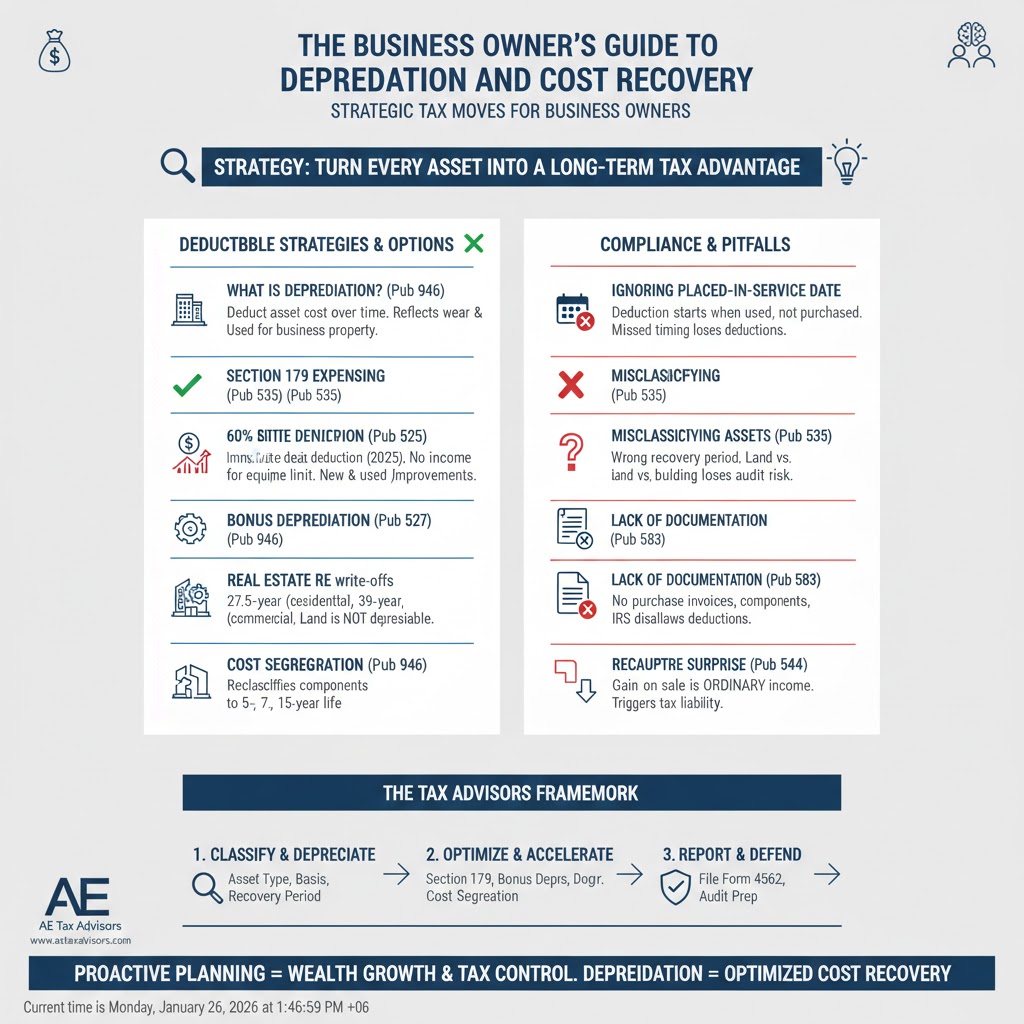
 This guide covers depreciation tax strategy and what it means for your tax situation.
Understanding The Business Owner’s Guide To in 2026
Every business owner invests in equipment, vehicles, technology, or property — but not every business owner captures the full tax benefit of those investments. Depreciation and cost recovery are how you legally write off the wear, tear, and obsolescence of your business assets over time.
At AE Tax Advisors, we help business owners apply depreciation rules correctly under IRS Publications 946, 535, and 463, ensuring every eligible dollar invested becomes a deduction that builds long-term tax efficiency.
This article builds on How to Build an Accountable Plan for Your Business, The Smart Way to Deduct Vehicle Expenses for Business, and The Family Office Formula: How Business Owners Turn Cash Flow into Generational Wealth.
What Is Depreciation?
Depreciation is the process of deducting the cost of business assets over their useful life rather than all at once. It reflects how an asset loses value due to use, time, or obsolescence.
You can depreciate property that:
- You own.
- You use in business or income-producing activity.
- Has a determinable useful life greater than one year.
Examples include:
- Buildings and improvements.
- Machinery and vehicles.
- Computers, software, and office furniture.
- Rental property assets.
Under Publication 946, depreciation begins when the asset is placed in service — not when it’s purchased.
AE Tax Advisors ensures assets are categorized and depreciated accurately by type and service date.
Step 1: Understand Cost Recovery Systems
The IRS defines specific systems for calculating depreciation. Most assets use the Modified Accelerated Cost Recovery System (MACRS).
Under Publication 946, MACRS includes two main methods:
- General Depreciation System (GDS): Default system for most assets.
- Alternative Depreciation System (ADS): Used for tax-exempt use property, certain listed property, or foreign assets.
AE Tax Advisors helps clients select the correct system, balancing compliance with strategic timing of deductions.
Step 2: Identify Depreciable Property
Not everything in your business can be depreciated.
Depreciable assets include:
- Buildings and equipment.
- Furniture and fixtures.
- Vehicles used for business.
- Improvements that add value or extend useful life.
Non-depreciable assets include:
- Land.
- Inventory.
- Intangible assets (except certain amortizable items).
AE Tax Advisors reviews fixed-asset schedules annually to ensure each item is classified correctly under Publication 535.
Step 3: Determine Basis and Recovery Period
Your depreciation deduction is based on the asset’s basis, which is generally its cost plus any expenses required to place it in service (shipping, installation, etc.).
The IRS assigns recovery periods for different assets under Publication 946:
- Computers, equipment, and vehicles: 5 years.
- Office furniture and fixtures: 7 years.
- Residential rental property: 27.5 years.
- Nonresidential property: 39 years.
AE Tax Advisors uses these recovery periods to create detailed depreciation schedules for each asset class.
Step 4: Section 179 Expensing
Section 179 allows you to immediately expense up to $1,220,000 (2025 limit) of qualifying assets purchased and placed in service during the tax year.
Qualifying property includes:
- Tangible personal property (equipment, furniture, etc.).
- Off-the-shelf computer software.
- Certain building improvements.
Limitations apply if total asset purchases exceed $3,050,000.
AE Tax Advisors helps clients strategically elect Section 179 for maximum upfront savings while balancing long-term depreciation opportunities.
This connects directly to The Complete Guide to Section 179 and Bonus Depreciation.
Step 5: Bonus Depreciation
Bonus depreciation allows you to deduct a percentage of an asset’s cost in the first year it’s placed in service.
As of 2025, 60% bonus depreciation is available for new or used qualifying property with a recovery period of 20 years or less.
Unlike Section 179, bonus depreciation is not limited by income or purchase totals and can create a loss.
AE Tax Advisors advises clients on whether to combine or separate Section 179 and bonus depreciation depending on their profit level and future planning needs.
Step 6: Depreciation for Vehicles
Vehicles have special rules under Publication 463:
- Passenger vehicles are subject to annual depreciation caps (“luxury auto limits”).
- SUVs and heavy vehicles (over 6,000 lbs GVWR) may qualify for full Section 179 or bonus depreciation.
- Business use percentage determines deductibility.
AE Tax Advisors calculates depreciation based on mileage logs and asset classification to ensure correct deductions.
This connects to The Smart Way to Deduct Vehicle Expenses for Business.
Step 7: Real Estate Depreciation
Buildings used for business or rental are depreciated using straight-line methods over long recovery periods.
- Residential rentals: 27.5 years.
- Commercial property: 39 years.
Land cannot be depreciated, but improvements such as landscaping, HVAC, or parking lots can.
AE Tax Advisors performs cost segregation studies to separate short-life assets (like flooring, lighting, and fixtures) from the main structure, accelerating deductions and improving cash flow.
This ties directly to Real Estate Inside the Business: The Overlooked Wealth Strategy of the 1%.
Step 8: Mid-Year and Mid-Quarter Conventions
Depreciation begins when assets are placed in service, and the IRS assigns conventions to determine timing:
- Half-Year Convention: Default for most assets.
- Mid-Quarter Convention: Required if more than 40% of total assets are placed in service in the last quarter of the year.
- Mid-Month Convention: Used for real property.
AE Tax Advisors applies the correct convention to each asset class to ensure accuracy and prevent IRS adjustments.
Step 9: Recapture Rules and Dispositions
When you sell or dispose of depreciated property, the IRS may require recapture — treating some or all of the gain as ordinary income to the extent of prior depreciation.
Under Publication 544, depreciation recapture ensures deductions aren’t permanently excluded from taxation.
AE Tax Advisors manages recapture planning, especially for vehicles and real estate, to minimize tax exposure.
This connects directly to The Business Owner’s Guide to Depreciation Recapture and Asset Sales.
Step 10: Recordkeeping and Audit Defense
Depreciation is highly documentation-sensitive. Maintain:
- Purchase invoices and installation costs.
- Proof of business use.
- Depreciation schedules and election statements.
Under Publication 583, records should be retained for at least seven years after the asset is fully depreciated or disposed.
AE Tax Advisors stores digital asset logs and integrates depreciation tracking into accounting systems for easy verification.
Step 11: Depreciation in Entity Structures
Different entities treat depreciation differently:
- Sole Proprietorships: Report on Schedule C.
- Partnerships/LLCs: Allocated through K-1s.
- S-Corporations: Reported through corporate returns and flow to shareholders.
- C-Corporations: Deduct directly on corporate Form 1120.
AE Tax Advisors coordinates depreciation schedules with each client’s entity type to ensure proper reporting and avoid mismatched basis tracking.
Step 12: Strategic Cost Recovery Planning
Depreciation is not just an accounting function — it’s a tax strategy. AE Tax Advisors helps clients:
- Time major purchases for maximum deduction impact.
- Layer Section 179 and bonus depreciation effectively.
- Use cost segregation to accelerate building write-offs.
- Plan for eventual sale or recapture management.
This long-term approach integrates with The Family Office Formula and The Tax-Free Empire.
AE Tax Advisors Depreciation Framework
- Identify and classify depreciable assets.
- Determine basis and recovery periods.
- Select appropriate depreciation methods.
- Integrate Section 179 and bonus depreciation.
- Maintain audit-ready documentation.
- Reconcile annually for accuracy and recapture planning.
This framework aligns with IRS Publications 946, 535, and 463, ensuring compliance, precision, and maximum tax benefit.
Conclusion: Turn Every Asset Into a Long-Term Tax Advantage
Depreciation isn’t just a deduction — it’s a disciplined way to build wealth while minimizing taxable income. Every truck, laptop, or building improvement you purchase carries a measurable tax benefit when tracked properly.
At AE Tax Advisors, we create complete depreciation maps for businesses, ensuring every asset is categorized, recovered, and defended. With proper planning, cost recovery becomes more than compliance — it becomes your silent tax engine for long-term growth.
Understanding depreciation tax strategy is essential for maximizing your tax savings as a real estate investor.
When it comes to depreciation tax strategy, working with a specialized tax advisor makes all the difference.
Many investors overlook depreciation tax strategy, but it can be one of the most impactful strategies in your tax plan.
At AE Tax Advisors, we help clients navigate depreciation tax strategy to keep more of what they earn.
Depreciation tax strategy is one of the most important concepts for real estate investors to understand. When properly implemented, depreciation tax strategy can lead to significant tax savings that compound over time.
Many high-income earners miss out on depreciation tax strategy opportunities simply because their CPA lacks the specialized knowledge. A proactive approach to depreciation tax strategy can mean the difference between overpaying and optimizing your tax position.
At AE Tax Advisors, our team specializes in depreciation tax strategy for real estate investors and W-2 professionals. We have helped hundreds of clients use depreciation tax strategy to reduce their tax burden by $50,000 or more annually.
The key to successful depreciation tax strategy implementation is working with an advisor who understands real estate taxation. Every depreciation tax strategy decision should be part of a comprehensive, multi-year tax plan.
Understanding Depreciation tax strategy
Depreciation tax strategy is a critical component of any comprehensive tax strategy for real estate investors. At AE Tax Advisors, we help clients navigate depreciation tax strategy to maximize their tax savings while maintaining full IRS compliance. Our proactive approach ensures you capture every available deduction and credit.
For more information, refer to the IRS Publication 946.