

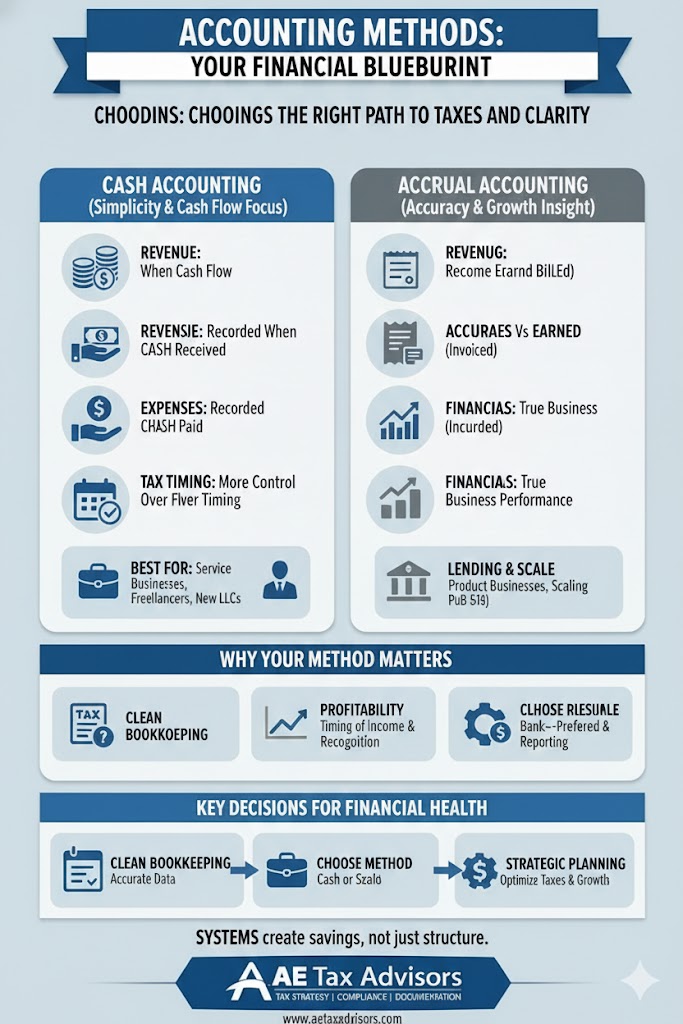
Why Your Accounting Method Controls Your Tax Bill and Financial Clarity
When it comes to the best bookkeeping systems and, understanding the fundamentals is key. Most business owners never think about their accounting method. They let QuickBooks choose the default setting or assume cash basis is always easier. But your accounting method impacts your taxes, your profitability reporting, your ability to borrow, your long term planning, and how predictable your cash flow becomes. This guide covers real estate bookkeeping and what it means for your tax situation.
Choosing between cash basis and accrual basis is a strategic decision. It influences how income is recognized, how expenses are deducted, and how your CPA can plan your tax strategy. This article explains both methods in depth so you can choose the system that fits your goals.
If you want a deeper understanding of why clean bookkeeping matters before choosing a method, see Why Clean Books Matter for High Income Business Owners.
For foundational bookkeeping structure, review The Ultimate Guide to Bookkeeping for Small Business Owners Who Want Lower Taxes.
What Cash Basis Accounting Really Means
Cash basis is the simplest approach. You record income when money hits your bank account, and you record expenses when money leaves your account. The method follows actual cash movement, which is why it’s popular with small service based businesses.
Under cash basis:
Income is recognized when you get paid
Expenses are recognized when you pay them
No unpaid invoices are tracked
No outstanding bills are reported
No advanced matching of revenue and expenses is required
Cash basis works well when your business has:
Simple transactions
No inventory
No large receivables
Minimal prepaid expenses
Straightforward billing cycles
It helps you manage taxes more flexibly since delaying invoices or pushing expenses into the current year can shift your tax bill.
Benefits of Cash Basis for Small Business Owners
Cash basis is easy to understand and ideal for owners who need simplicity.
Advantages include:
Simple monthly bookkeeping
Lower administrative workload
Clear alignment between bank balance and profit
Easier tax planning for new businesses
Less interpretation required
Faster month end closes
It is also the preferred method for businesses under the IRS threshold for mandatory accrual reporting. Most small service companies qualify for cash basis unless they sell products or carry inventory.
Limitations of Cash Basis That Owners Overlook
Cash basis has weaknesses that become more obvious as your business grows.
Limitations include:
Unreliable profit tracking
No visibility into unpaid invoices
No forecasting from accounts receivable
No tracking of outstanding bills
Unclear financial position for lenders
Potentially distorted margins
Difficulty managing seasonal swings
As revenue increases, these blind spots create financial confusion. If you want strong reporting, cash basis may eventually hold you back.
What Accrual Accounting Really Means
Accrual accounting recognizes revenue when you earn it, not when the money arrives, and expenses when incurred, not when paid. It provides a clearer snapshot of business reality because it links work completed to revenue produced.
Under accrual:
Invoices are recorded as revenue even if unpaid
Vendor bills are recorded even if not yet paid
Revenue matches the work done
Expenses match the month they occur
Profit reflects real performance, not bank timing
This method gives you a more accurate picture of your financial health.
Benefits of Accrual Basis for Growing Businesses
Accrual accounting helps you understand profitability in real time. It shows the truth behind your numbers instead of waiting for payments to clear.
Accrual basis provides:
Clear profit tracking
Better margin measurement
Stronger financial reports for lenders
Improved forecasting
Accurate matching of revenue and expenses
Clean visibility across months and quarters
Stronger tax projection data
If you plan to grow, hire employees, scale to multiple six figures, or pursue lending, accrual becomes extremely valuable.
Limitations of Accrual That Owners Need To Understand
Accrual accounting is more complex. It takes more work to maintain and requires a stronger bookkeeping system.
Challenges include:
More detailed monthly closes
Additional accounts to manage
More involvement from your CPA
Extra steps to reconcile receivables and payables
Potential tax timing differences
Even so, it offers better clarity for financial decisions.
How Your Accounting Method Affects Taxes
Your accounting method determines when income becomes taxable and when expenses become deductible.
Under cash basis:
Income is taxable when paid
Expenses reduce taxes when paid
Timing strategies are easier
Under accrual basis:
Income is taxable when invoiced
Expenses reduce taxes when incurred
Timing requires more tracking
Neither method is automatically better for taxes. The best method depends on your industry, growth goals, seasonality, and cash flow needs.
If you want to understand how proper categorization affects taxes regardless of method, review Monthly Bookkeeping Checklist for Staying Compliant and Ready for Tax Season.
How the IRS Determines Which Method You Can Use
Most small businesses can choose either method. The IRS requires accrual accounting if you:
Maintain inventory
Exceed the IRS revenue threshold
Operate certain types of corporations
Use certain hybrid models
If you are unsure which applies to you, AE Tax Advisors can evaluate your business structure and help you select the best approach.
How To Choose the Right Method for Your Business
Use cash basis if you want:
Simple tracking
Lower bookkeeping costs
Easier tax timing control
A clear link between cash and profit
Use accrual basis if you want:
Accurate profitability
Better financial reports
More predictable performance
Cleaner metrics for growth
More reliable budgeting
Data for lending or refinancing
Your business may start with cash basis and transition to accrual as you scale.
How AE Tax Advisors Helps You Choose and Set Up the Right Method
Our team evaluates:
Your industry
Your cash flow patterns
Your revenue structure
Your receivables
Your inventory
Your growth plan
Your lending needs
We then build a bookkeeping structure that aligns with your tax plan and long term business goals. Every accounting method has strengths. The goal is choosing the one that supports your future, not just today.
What Happens When You Switch Methods
Switching from cash to accrual or accrual to cash requires adjustments. The IRS often requires a formal method change, known as Form 3115. AE Tax Advisors handles this process for you and rebuilds your books so the transition is smooth and compliant.
Adjustments may include:
Accounts receivable
Accounts payable
Prepaid expenses
Deferred revenue
Inventory adjustments
This is one of the most overlooked areas of bookkeeping and tax planning. Making the switch correctly prevents reporting errors that could lead to IRS questions later.
Understanding real estate bookkeeping is essential for maximizing your tax savings as a real estate investor.
When it comes to real estate bookkeeping, working with a specialized tax advisor makes all the difference.
Many investors overlook real estate bookkeeping, but it can be one of the most impactful strategies in your tax plan.
At AE Tax Advisors, we help clients navigate real estate bookkeeping to keep more of what they earn.
Real estate bookkeeping is one of the most important concepts for real estate investors to understand. When properly implemented, real estate bookkeeping can lead to significant tax savings that compound over time.
Many high-income earners miss out on real estate bookkeeping opportunities simply because their CPA lacks the specialized knowledge. A proactive approach to real estate bookkeeping can mean the difference between overpaying and optimizing your tax position.
At AE Tax Advisors, our team specializes in real estate bookkeeping for real estate investors and W-2 professionals. We have helped hundreds of clients use real estate bookkeeping to reduce their tax burden by $50,000 or more annually.
The key to successful real estate bookkeeping implementation is working with an advisor who understands real estate taxation. Every real estate bookkeeping decision should be part of a comprehensive, multi-year tax plan.
Final Thoughts
Related services from AE Tax Advisors: entity structuring for rental portfolios and mid-term rental tax planning.
Your accounting method shapes your entire financial picture. It influences taxes, profit, strategy, and clarity. Cash basis works well for simplicity and early stage businesses. Accrual basis works well for growth, accuracy, and long term planning. Choosing the right method helps you understand your numbers, stay compliant, and give your CPA the tools needed to create a year round tax plan.
For more information, refer to the IRS.