

 This guide covers entity restructuring tax and what it means for your tax situation.
Understanding The 3-entity Structure Every Business in 2026
The biggest tax and legal mistakes entrepreneurs make usually stem from having only one entity. They run everything through a single LLC or S-Corp and hope for protection and efficiency — but in reality, they’re often exposed to both tax inefficiency and liability risk.
At AE Tax Advisors, we teach clients how to structure their businesses the way high-net-worth entrepreneurs do: with multiple entities that each serve a distinct purpose. The “3-Entity Structure” isn’t a loophole — it’s a compliant, IRS-recognized framework that integrates legal protection, tax efficiency, and financial control.
This article builds directly on How to Use a Family Management Company for Tax Efficiency and The Business Owner’s Blueprint: How to Build, Protect, and Multiply Wealth Through Entity Strategy, tying those principles together into a complete operational system.
Why Entity Structure Matters
Your business structure determines how you pay taxes, protect assets, and grow long-term wealth. According to IRS Publication 535, every entity type has unique rules for deducting expenses, allocating income, and handling payroll.
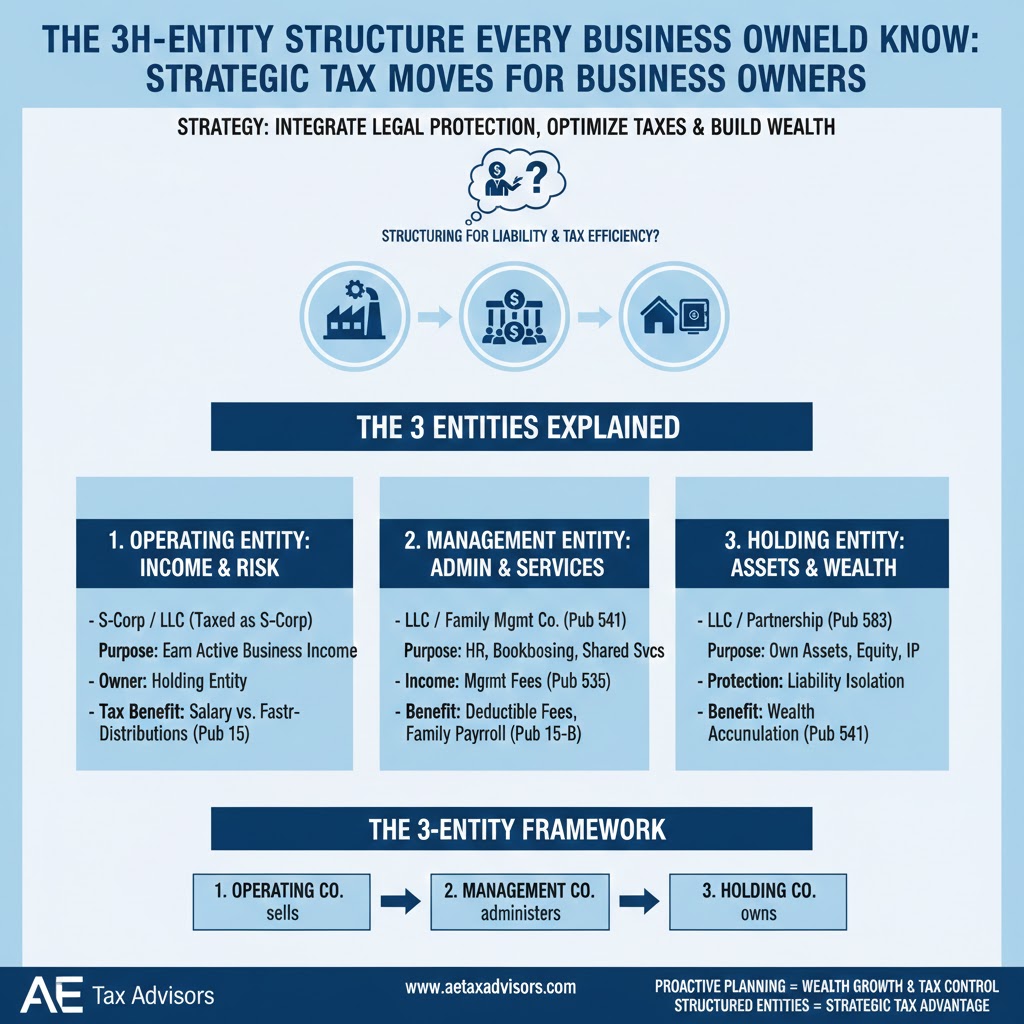
A single-entity setup often blends operations, ownership, and management — creating confusion and unnecessary tax exposure. The 3-Entity Structure fixes this by separating activities into their proper lanes, ensuring each entity performs one clear role:
- Operating Entity (S-Corp or LLC taxed as S-Corp)
- Management Entity (LLC or Family Management Company)
- Holding Entity (LLC or Partnership)
AE Tax Advisors builds these structures to ensure every dollar flows through the right channel — compliant, deductible, and protected.
The 3 Entities Explained
1. The Operating Entity: Where Income Is Earned
Your operating company is the front-facing business — the one that sells products, delivers services, and interacts with customers. It generates income and bears the greatest day-to-day risk.
Typical setup:
- Entity type: S-Corporation or LLC electing S-Corp taxation
- Purpose: Generate active business income
- Owner: The holding entity or individual owner
Tax benefits:
- Ability to split income between salary and profit distributions (reducing self-employment tax).
- Deduction of all ordinary and necessary business expenses under Publication 535.
- Payroll reporting compliance under Publication 15.
AE Tax Advisors helps clients structure reasonable salaries, manage payroll tax exposure, and track expenses properly — the same principles covered in How to Legally Pay Yourself from Your Business.
The operating entity is the income engine. But without separation, it also becomes a liability magnet. That’s why the second entity is critical.
2. The Management Entity: Where Administration Lives
The management company — often a Family Management Company — provides operational, administrative, and leadership services to the operating entity. It bills the operating company for management fees, which are deductible as long as they’re properly documented.
Entity type: LLC (single or multi-member), sometimes taxed as an S-Corp.
Purpose: Handle management, HR, marketing, bookkeeping, payroll, and compliance.
Income source: Service fees from the operating entity.
The management entity:
- Employs family members or staff under Publication 15-B guidelines.
- Owns shared assets (like computers, vehicles, or office equipment).
- Manages insurance, benefits, and retirement plans.
- Centralizes bookkeeping and tax reporting.
These arrangements are legitimate under Publication 535, as long as the services are real and the fees are at market value. AE Tax Advisors drafts management agreements between the entities that clearly outline roles and responsibilities.
This entity connects directly to How to Use a Family Management Company for Tax Efficiency and How to Build an Audit-Proof Tax Documentation System, where precision and separation create both legality and leverage.
Understanding entity restructuring tax is essential for maximizing your tax savings as a real estate investor.
When it comes to entity restructuring tax, working with a specialized tax advisor makes all the difference.
Many investors overlook entity restructuring tax, but it can be one of the most impactful strategies in your tax plan.
At AE Tax Advisors, we help clients navigate entity restructuring tax to keep more of what they earn.
3. The Holding Entity: Where Ownership and Wealth Accumulate
The holding company owns equity in the operating company — and sometimes owns real estate, equipment, or intellectual property used by the business.
Entity type: LLC or partnership (often multi-member).
Purpose: Hold ownership interests and assets; limit liability; control intercompany relationships.
Tax treatment: Pass-through income allocation under Publication 541 partnership rules.
The holding company provides several advantages:
- Liability isolation: Keeps valuable assets out of the high-risk operating entity.
- Wealth accumulation: Allows profits to be reinvested or distributed strategically.
- Flexibility: Simplifies future sales, succession, or tax restructuring.
AE Tax Advisors ensures the holding entity maintains its own books, EIN, and bank account in compliance with Publication 583 recordkeeping requirements.
This structure ties directly into The Family Office Formula: How Business Owners Turn Cash Flow into Generational Wealth, where holding entities become the foundation of multigenerational planning.
How the 3 Entities Work Together
The magic happens in the flow between entities:
- The Operating Entity earns income and pays deductible management fees to the Management Entity.
- The Management Entity pays salaries, handles administration, and may employ family members legitimately.
- The Holding Entity owns the Operating Entity (and possibly the Management Entity), receiving profits and retaining control.
Each step serves a compliant, functional purpose. The IRS recognizes intercompany payments as deductible when supported by contracts, invoices, and consistent market pricing — all structured under Publication 535 standards.
AE Tax Advisors builds intercompany service agreements that ensure these transactions meet both tax and legal criteria.
This three-way flow also mirrors corporate structures used by large companies and is consistent with the principles we outlined in How AE Tax Advisors Helps You Keep More of What You Earn.
The Tax Advantages
Properly implemented, the 3-Entity Structure offers:
- Reduced self-employment tax: S-Corp treatment lowers FICA exposure.
- Deductible management fees: Operating company expenses are offset by legitimate intercompany payments.
- Strategic income splitting: Compensation can be distributed across entities and family members in lower brackets.
- Asset protection: Real estate and equipment are isolated from operating liabilities.
- Simplified succession planning: Ownership interests can transfer through the holding company without disturbing operations.
AE Tax Advisors models these advantages for each client to ensure compliance and maximum efficiency under Publication 535 deduction rules.
This integrated benefit set links directly to How to Structure Depreciation for Maximum Tax Savings, where ownership and placement of assets determine deductions.
Legal and Compliance Requirements
To stay compliant, each entity must:
- Maintain separate EINs, bank accounts, and books.
- File independent tax returns or reports.
- Execute written agreements for intercompany transactions.
- Charge market-based fees and wages.
- Document all transfers and reimbursements.
Publication 583 stresses that recordkeeping is non-negotiable. AE Tax Advisors helps clients automate these requirements with accounting systems that tag intercompany entries for traceability.
This same rigor is reflected in How to Build an Audit-Proof Tax Documentation System and How to Plan for Quarterly Taxes Without Stress.
Common Mistakes to Avoid
Even sophisticated business owners mismanage entity setups. The most common errors include:
- Failing to document intercompany payments.
- Using one bank account for multiple entities.
- Paying personal expenses from business funds.
- Creating redundant entities without real purpose.
- Overcomplicating payroll and tax filings without oversight.
AE Tax Advisors prevents these mistakes with quarterly compliance reviews and unified accounting oversight, ensuring every entity maintains clear legal and financial boundaries.
This process embodies the same practical precision found in How to Prepare for Year-End Tax Planning Like a Pro.
AE Tax Advisors’ 3-Entity Framework
- Operating Entity: Generates revenue, manages customer-facing activity.
- Management Entity: Handles admin, family payroll, and intercompany services.
- Holding Entity: Owns assets, controls equity, and protects wealth.
Each entity plays a role in reducing taxes, protecting assets, and supporting long-term growth — all within the IRS’s framework for ordinary and necessary business expenses.
Example: Putting the 3-Entity Model in Action
Consider a small construction business:
- Operating Entity: “Precision Builders, LLC” earns $800,000 in annual revenue.
- Management Entity: “Oakridge Management LLC” oversees payroll, marketing, and admin, billing Precision Builders $120,000 annually.
- Holding Entity: “Oakridge Holdings LLC” owns both entities and leases office space to the management company.
Each payment — payroll, rent, management fee — is deductible and compliant. The structure isolates liability, balances income, and provides clean documentation for every transaction.
AE Tax Advisors designs this same model for doctors, consultants, contractors, and digital business owners alike, adapting to each profession’s needs.
Conclusion: One Structure, Three Functions, Unlimited Control
The 3-Entity Structure is the difference between being self-employed and being a business architect. It gives you the same framework used by large corporations — but scaled for individual entrepreneurs.
Related services from AE Tax Advisors: cost segregation studies and mid-term rental tax planning.
At AE Tax Advisors, we use IRS Publications 535, 541, and 583 to ensure your entities are compliant, efficient, and fully defensible. With proper structure, you can protect assets, reduce taxes, and manage your wealth like a family office — all within the bounds of the law.
Entity restructuring tax is one of the most important concepts for real estate investors to understand. When properly implemented, entity restructuring tax can lead to significant tax savings that compound over time.
Many high-income earners miss out on entity restructuring tax opportunities simply because their CPA lacks the specialized knowledge. A proactive approach to entity restructuring tax can mean the difference between overpaying and optimizing your tax position.
At AE Tax Advisors, our team specializes in entity restructuring tax for real estate investors and W-2 professionals. We have helped hundreds of clients use entity restructuring tax to reduce their tax burden by $50,000 or more annually.
The key to successful entity restructuring tax implementation is working with an advisor who understands real estate taxation. Every entity restructuring tax decision should be part of a comprehensive, multi-year tax plan.
If you are not actively using entity restructuring tax as part of your tax strategy, you are likely leaving money on the table. Contact AE Tax Advisors to learn how entity restructuring tax can work for your specific situation.
For official IRS guidance, visit the IRS Newsroom.