
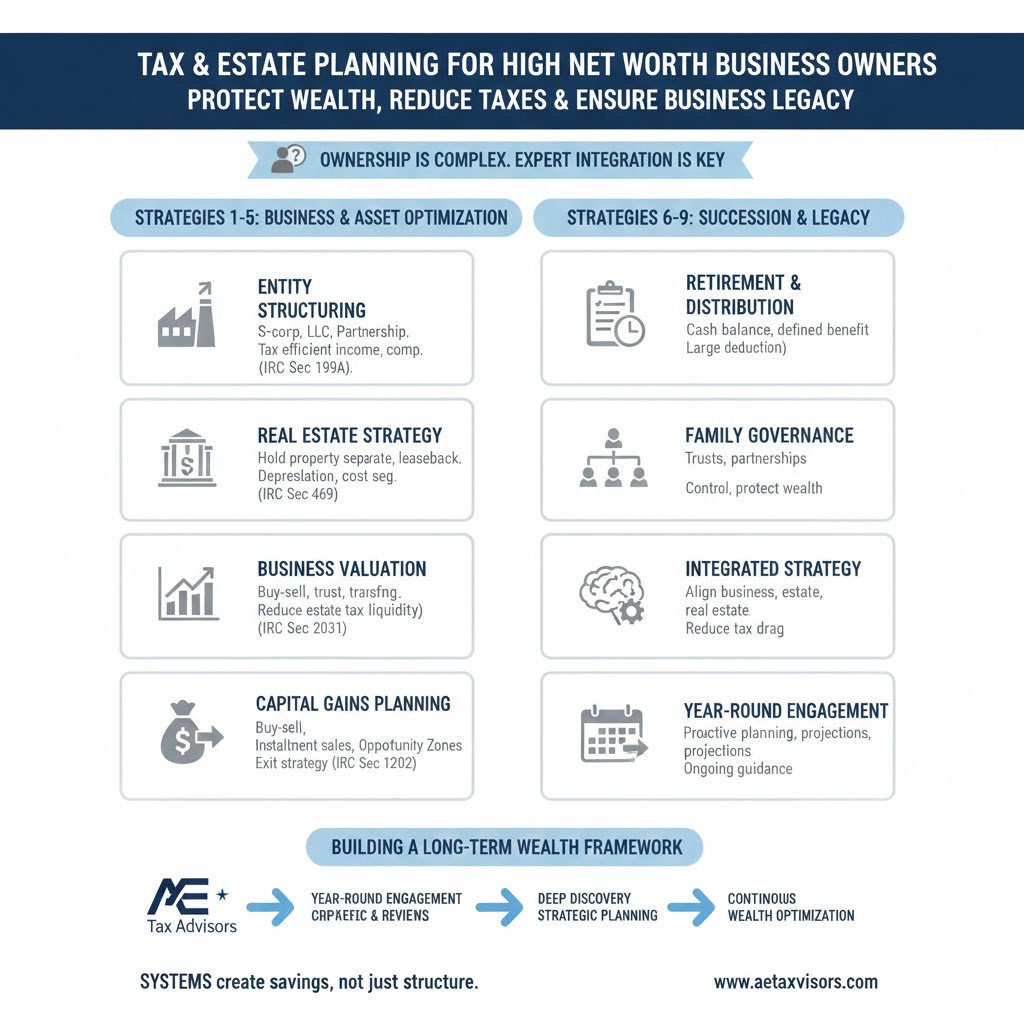
 This guide covers tax estate planning high and what it means for your tax situation.
Understanding Tax And Estate Planning For in 2026
High net worth business owners operate at the intersection of personal wealth, business income, and long term estate concerns. Their tax and estate planning needs are far more complex than those of the typical household. Business profits, equity value, real estate assets, intellectual property, and multigenerational goals all interact to create significant tax exposure. Without a coordinated plan, business owners risk losing wealth to taxes, market timing, or poorly structured succession events.
This guide outlines the advanced tax and estate planning strategies high net worth business owners should use to protect wealth, reduce tax liability, and ensure a smooth transition of both business and personal assets. AE Tax Advisors builds comprehensive frameworks that align business decisions with long term family stability.
Understanding the Dual Tax Landscape
Business owners face both personal and business tax exposure. This includes income tax, self employment tax, capital gains tax, depreciation rules, payroll tax, and estate tax implications tied to business value. The interaction between business income and personal estate planning creates complexity that requires long term thinking. Successful business owners use multi entity structures and strategic planning to reduce tax exposure across both domains.
Entity Structuring for Tax Efficiency
The foundation of advanced planning begins with the entity selection. High net worth business owners benefit from strategic combinations such as S corporations, LLCs, partnerships, holding companies, and management entities. Each structure supports different tax treatments for income, deductions, fringe benefits, and ownership transfers. Proper entity design allows owners to minimize self employment taxes, structure compensation efficiently, and prepare for future estate planning moves.
Using Real Estate to Reduce Tax Exposure
Real estate plays a central role for business owners. Many owners benefit from holding their commercial space in a separate real estate entity and leasing it back to their operating business. This structure creates tax efficient rental income, accelerates depreciation through cost segregation, and reduces operating income. For owners with larger real estate portfolios, the combination of depreciation and long term appreciation provides a powerful estate planning and tax reduction tool.
Business Valuation and Estate Tax Planning
Business value often constitutes the majority of a high net worth owner’s estate. This creates estate tax exposure that must be managed early. Planning includes obtaining accurate valuations, transferring ownership interests gradually, using gifting strategies, building trust structures, and preparing for liquidity needs. Valuation discounts available through family partnerships can significantly reduce the taxable value of ownership interests transferred to heirs.
Succession Planning and Ownership Transfer
One of the biggest mistakes business owners make is delaying succession planning. Succession is not just a business decision. It is a tax and estate decision. Without a plan, heirs may face tax liabilities or operational challenges that force the sale of the business. Succession strategy includes buy sell agreements, management continuity plans, trust coordination, and ownership transfer strategy. AE Tax Advisors helps business owners design succession frameworks that preserve value and reduce tax exposure.
Capital Gains Planning for Business Exit
When business owners sell, the tax bill can be enormous. Proper planning before exit is essential. Strategies include installment sales, charitable remainder trusts, opportunity zone investments, and timing gains to align with lower tax years or offsetting deductions. Coordinating the sale with retirement planning, real estate strategy, and estate planning ensures tax efficiency across all aspects of the owner’s financial life.
Retirement and Distribution Strategy
Business owners often delay retirement savings because they reinvest profits into the company. However, high net worth owners can benefit from advanced retirement plans such as cash balance plans and defined benefit plans. These structures allow for large tax deductible contributions that reduce current income tax while building a long term retirement foundation. Coordinating distributions from business interests, retirement accounts, and real estate ensures tax efficient transitions later in life.
Family Governance and Multigenerational Planning
High net worth business owners must think in terms of legacy. Family governance, trust structure, and multi generational planning prevent conflict and ensure business continuity. Using family partnerships, dynasty trusts, and structured gifting strategies helps owners protect family wealth while maintaining control over how assets are used and passed down.
Integrating Business Strategy With Estate Strategy
True tax and estate planning for business owners requires integration. Business income, real estate, investments, succession plans, and estate considerations must operate together. AE Tax Advisors builds systems that align these components into one coordinated plan, ensuring that decisions in the business world do not create unintended tax consequences in the personal world.
Conclusion
High net worth business owners must navigate a complex landscape of taxes, valuations, succession decisions, and estate considerations. With coordinated planning, they can protect wealth, reduce tax exposure, preserve business value, and prepare their family for long term success. AE Tax Advisors provides the advanced planning needed to ensure that business owners move confidently toward a stable and tax efficient future.
Understanding tax estate planning high is essential for maximizing your tax savings as a real estate investor.
When it comes to tax estate planning high, working with a specialized tax advisor makes all the difference.
Many investors overlook tax estate planning high, but it can be one of the most impactful strategies in your tax plan.
At AE Tax Advisors, we help clients navigate tax estate planning high to keep more of what they earn.
Tax estate planning high is one of the most important concepts for real estate investors to understand. When properly implemented, tax estate planning high can lead to significant tax savings that compound over time.
Many high-income earners miss out on tax estate planning high opportunities simply because their CPA lacks the specialized knowledge. A proactive approach to tax estate planning high can mean the difference between overpaying and optimizing your tax position.
Understanding Tax estate planning high
Related services from AE Tax Advisors: 3-year tax lookback cleanup and real estate professional status support.
Tax estate planning high is a critical component of any comprehensive tax strategy for real estate investors. At AE Tax Advisors, we help clients navigate tax estate planning high to maximize their tax savings while maintaining full IRS compliance. Our proactive approach ensures you capture every available deduction and credit.
For more information, refer to the IRS.