

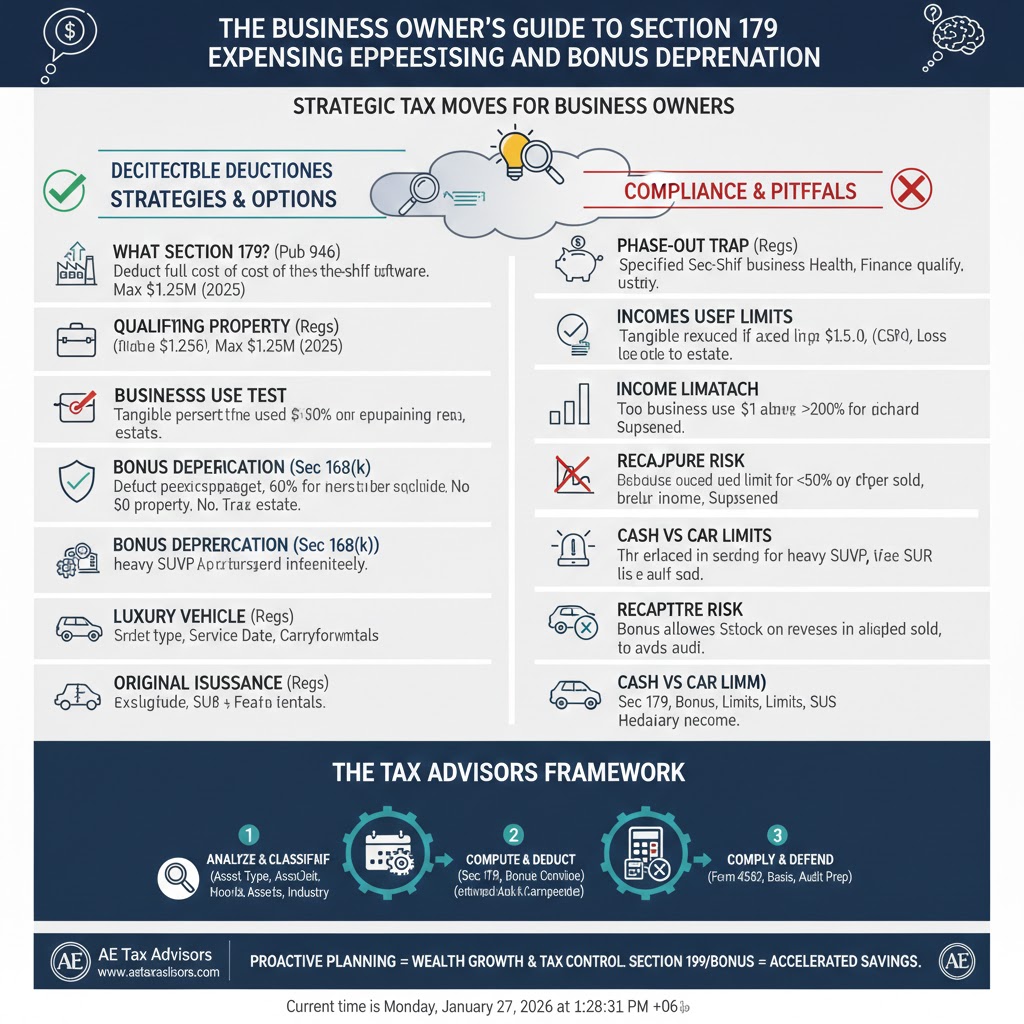
 This guide covers depreciation tax strategy and what it means for your tax situation.
Understanding The Business Owner’s Guide To in 2026
When it comes to tax planning for equipment purchases, vehicles, and business assets, the two most powerful tools are Section 179 and bonus depreciation. Together, they can dramatically accelerate deductions, reduce taxable income, and increase immediate cash flow — but using them correctly requires precision and strategic timing.
At AE Tax Advisors, we help business owners and investors combine Section 179 expensing with bonus depreciation to achieve the maximum allowable deduction while remaining fully compliant with IRS Publications 946, 535, and 544.
This article builds upon The Business Owner’s Guide to Section 163(j) Interest Deduction Limitation and Real Estate Election, The Business Owner’s Guide to Section 1250 Depreciation Recapture and Real Estate Tax Strategy, and The Complete Guide to Business Asset Disposal and Replacement.
What Is Section 179 Expensing?
Section 179 allows businesses to deduct the full purchase price of qualifying property in the year it’s placed in service, rather than depreciating it over several years.
For tax year 2025, the maximum Section 179 deduction is $1.25 million, with a phase-out threshold beginning at $2.5 million of total eligible purchases (adjusted annually for inflation).
AE Tax Advisors confirms property eligibility, calculates phase-out exposure, and applies strategic ordering to optimize immediate expensing.
Step 1: Qualifying Property for Section 179
Qualifying property includes:
- Tangible personal property used in business.
- Machinery, vehicles, computers, and office equipment.
- Certain qualified improvement property (QIP).
- Off-the-shelf software used for business.
Real property (buildings and land) does not qualify, except for specific improvements like HVAC systems, fire protection, or security systems.
AE Tax Advisors cross-references property types against Publication 946 Table B-1 for eligibility confirmation.
Step 2: Active Business Use Requirement
To qualify, property must be used more than 50% for business purposes.
If usage falls below 50% in a later year, prior deductions may be recaptured as income under Publication 544.
AE Tax Advisors tracks business-use percentages through detailed depreciation records and fixed-asset logs.
Step 3: The Section 179 Deduction Limits
- Dollar Limit: $1,250,000 (2025).
- Investment Limit: Deduction reduced dollar-for-dollar when total eligible purchases exceed $2,500,000.
- Taxable Income Limit: Deduction cannot exceed total taxable income from active trades or businesses.
Unused amounts can be carried forward indefinitely.
AE Tax Advisors coordinates deductions across multiple entities and consolidated groups to prevent waste of the election.
Step 4: What Is Bonus Depreciation?
Bonus depreciation allows a business to deduct a large percentage of an asset’s cost in the year it’s placed in service — even beyond the Section 179 limit.
For 2025, bonus depreciation is scheduled at 60%, decreasing annually from the 100% rate available before 2023.
AE Tax Advisors models depreciation schedules under Reg. §1.168(k)-1 to ensure phase-down optimization.
Step 5: Coordination Between Section 179 and Bonus Depreciation
While both accelerate deductions, they differ in how and when they apply:
| Category | Section 179 | Bonus Depreciation |
|---|---|---|
| Election | Optional, per asset | Automatic unless opted out |
| Limit | $1.25M cap | No dollar limit |
| Business Use | >50% required | >50% generally required |
| Income Limitation | Deduction limited by income | No income limit |
| Carryforward | Yes | No |
| Property Type | New or used | New or used (qualified property) |
AE Tax Advisors strategically sequences Section 179 before bonus depreciation to maximize benefits and avoid lost deductions due to income limits.
Step 6: Which Comes First — Section 179 or Bonus?
Under IRS rules, Section 179 is applied first, followed by bonus depreciation on remaining basis.
Example:
- Equipment cost: $100,000
- Section 179 deduction: $40,000
- Remaining basis: $60,000
- Bonus depreciation (60% of $60K): $36,000
- Total first-year deduction: $76,000
AE Tax Advisors uses this layering approach to achieve maximum front-loaded write-offs.
Step 7: Qualifying Property for Bonus Depreciation
Qualifying property includes:
- MACRS property with recovery period ≤20 years.
- Qualified improvement property (QIP).
- Certain film, television, and software production property.
Used property qualifies if not previously used by the taxpayer and acquired from an unrelated party.
AE Tax Advisors ensures assets meet all acquisition and use tests under Publication 946 Chapter 3.
Step 8: Luxury Vehicle and SUV Limits
Passenger vehicles are subject to annual depreciation caps, but Section 179 provides enhanced limits for heavy SUVs (>6,000 lbs GVWR) up to $28,900 for 2025.
AE Tax Advisors identifies optimal vehicle classifications and coordinates elections to comply with Reg. §1.280F-6 safe harbor.
Step 9: Entity-Level Considerations
- S Corporations and Partnerships: Deductions flow through to owners but limited to active income participation.
- C Corporations: Deduct fully at the entity level.
- Single-Member LLCs: Deduct on Schedule C or E depending on activity type.
AE Tax Advisors aligns entity depreciation with ownership structure and taxable income limits.
Step 10: Real Estate and Section 179
While real property doesn’t typically qualify, certain qualified improvement property (QIP) — improvements to the interior of nonresidential buildings — does.
Examples:
- Interior lighting.
- HVAC systems.
- Non-structural wall improvements.
AE Tax Advisors identifies and separates qualifying improvements during cost segregation studies.
Step 11: Depreciation Recapture
When Section 179 or bonus depreciation property is sold or converted to personal use, recapture applies.
AE Tax Advisors calculates recapture under Publication 544, reclassifying prior deductions as ordinary income to maintain compliance.
Step 12: Carryforwards and Future-Year Strategy
If Section 179 deductions exceed income limits, they carry forward.
AE Tax Advisors tracks carryforwards annually and coordinates with future purchase schedules to smooth deductions over multiple years.
Step 13: Timing Purchases Strategically
Assets must be placed in service — not just purchased — before year-end to qualify.
AE Tax Advisors coordinates timing with vendor delivery and project completion schedules to ensure deduction eligibility.
Step 14: Combining With 100% Deduction Strategies
Section 179 and bonus depreciation can integrate with other deductions, such as:
- Section 199A QBI deduction (pass-through income).
- Section 163(j) interest limitation elections.
- Cost segregation for property with mixed-use components.
AE Tax Advisors harmonizes these layers for optimal multi-code compliance and savings.
Step 15: Common Mistakes
- Expensing property not yet placed in service.
- Ignoring vehicle or listed property limits.
- Applying bonus depreciation before Section 179.
- Misclassifying improvements or repairs.
- Overstating deductions beyond income limitations.
AE Tax Advisors reviews fixed-asset schedules quarterly to prevent these compliance errors.
Step 16: Reporting Requirements
Both Section 179 and bonus depreciation are reported on Form 4562, “Depreciation and Amortization.”
AE Tax Advisors prepares full supporting schedules detailing asset description, cost, service date, and method of depreciation.
Step 17: Example — Equipment Purchase Coordination
A manufacturing company purchases $2.4 million of equipment.
- Section 179: $1.25M
- Bonus depreciation: 60% of remaining $1.15M = $690,000
- Total deduction = $1.94M
AE Tax Advisors ensures phase-out and basis rules align with Form 4562 and entity income levels.
Step 18: AE Tax Advisors Section 179 + Bonus Framework
- Identify all eligible purchases and service dates.
- Apply Section 179 expensing up to entity limit.
- Apply bonus depreciation on remaining basis.
- Adjust for taxable income limitations and carryforwards.
- Track future-year depreciation for audit readiness.
This framework follows IRS Publications 946, 535, and 544, ensuring compliance, accuracy, and maximized tax efficiency.
Step 19: Strategic Uses in Real Estate and Construction
AE Tax Advisors often uses Section 179 and bonus depreciation to accelerate deductions on:
- Contractor vehicles and tools.
- Construction equipment and furnishings.
- Property improvements and commercial fit-outs.
Combining cost segregation and real property elections (from Article 99) further enhances these deductions for real estate developers.
Conclusion: Accelerate Smart, Deduct Strategically
Section 179 and bonus depreciation can transform how a business manages growth and liquidity — when applied intelligently. The key is coordination: matching deductions to taxable income, future planning, and compliance with depreciation recapture rules.
At AE Tax Advisors, we build tax strategies that align your capital investments with maximum deduction timing. Whether you’re buying new equipment, upgrading property, or planning a multi-year investment strategy, our advisors ensure every dollar you spend delivers its full tax value.
Understanding depreciation tax strategy is essential for maximizing your tax savings as a real estate investor.
When it comes to depreciation tax strategy, working with a specialized tax advisor makes all the difference.
Many investors overlook depreciation tax strategy, but it can be one of the most impactful strategies in your tax plan.
At AE Tax Advisors, we help clients navigate depreciation tax strategy to keep more of what they earn.
Depreciation tax strategy is one of the most important concepts for real estate investors to understand. When properly implemented, depreciation tax strategy can lead to significant tax savings that compound over time.
Many high-income earners miss out on depreciation tax strategy opportunities simply because their CPA lacks the specialized knowledge. A proactive approach to depreciation tax strategy can mean the difference between overpaying and optimizing your tax position.
At AE Tax Advisors, our team specializes in depreciation tax strategy for real estate investors and W-2 professionals. We have helped hundreds of clients use depreciation tax strategy to reduce their tax burden by $50,000 or more annually.
The key to successful depreciation tax strategy implementation is working with an advisor who understands real estate taxation. Every depreciation tax strategy decision should be part of a comprehensive, multi-year tax plan.
Understanding Depreciation tax strategy
Depreciation tax strategy is a critical component of any comprehensive tax strategy for real estate investors. At AE Tax Advisors, we help clients navigate depreciation tax strategy to maximize their tax savings while maintaining full IRS compliance. Our proactive approach ensures you capture every available deduction and credit.
For more information, refer to the IRS Publication 946.