

 This guide covers real estate bookkeeping and what it means for your tax situation.
Understanding How Poor Bookkeeping Increases Your in 2026
Many business owners do not realize how much poor bookkeeping costs them. Missing receipts, incorrect categories, unreconciled accounts, and outdated records all lead to higher taxes and higher risk. Good bookkeeping is not about paperwork. It is about protecting your money, your compliance, and your future.
For background on what clean books should look like, refer to Why Clean Books Matter for High Income Business Owners.
Poor Bookkeeping Creates Higher Taxes
When your financials are sloppy, your tax bill goes up automatically. The IRS allows deductions only when they are documented, categorized, and supported. Missing data leads to missed write offs.
Examples include:
Meals categorized incorrectly
Subscriptions not captured
Vehicle expenses missed
Home office deductions unsupported
Repairs misclassified as assets
Owner reimbursements not tracked
Unclaimed depreciation
Clean books ensure every deduction is captured.
Poor Bookkeeping Causes Overreported Income
If deposits are double counted or not matched to invoices, your income appears higher than it actually is. Many business owners unknowingly pay taxes on money they never earned simply because the books were inaccurate.
Matching deposits is covered in detail in Monthly Bookkeeping Checklist for Staying Compliant and Ready for Tax Season.
Poor Bookkeeping Creates Audit Risk
The IRS looks for inconsistencies, missing documentation, and unusually high or low expense categories. Poor bookkeeping makes your return look sloppy and increases the likelihood of deeper review.
Areas most affected include:
Meals
Travel
Contract labor
Repairs
Vehicle expenses
Home office
Clean records reduce audit stress and protect your deductions.
Poor Bookkeeping Breaks Cash Flow
When your books are incorrect, your cash flow picture becomes distorted. You cannot see what you owe, what is owed to you, or how much you can safely allocate to payroll or owner pay.
Symptoms include:
Overdrafts
Late vendor payments
Missed invoices
Incorrect payroll
Unplanned tax surprises
Accurate books give you control over cash.
Poor Bookkeeping Blocks Tax Strategy
Every proactive tax move depends on accurate financials. Without clean numbers, your CPA cannot:
Estimate taxes correctly
Plan payroll
Calculate QBI
Match deductions
Approach year end strategy
Recommend entity changes
Good bookkeeping unlocks advanced tax planning.
For a complete setup guide, review The Ultimate Guide to Bookkeeping for Small Business Owners Who Want Lower Taxes.
Final Thoughts
Poor bookkeeping increases taxes, increases stress, and puts your business at risk. Clean books lower taxes, protect you from audits, and give you financial control. AE Tax Advisors helps business owners eliminate financial chaos and build a bookkeeping system that supports long term tax savings.
ARTICLE 6
Title: The Top Bookkeeping Mistakes Business Owners Make and How To Avoid Them
Slug: top-bookkeeping-mistakes
Meta description: Learn the most common bookkeeping mistakes business owners make and how to avoid them so your financials stay clean and tax ready all year.
Focus keyphrase: bookkeeping mistakes business owners make
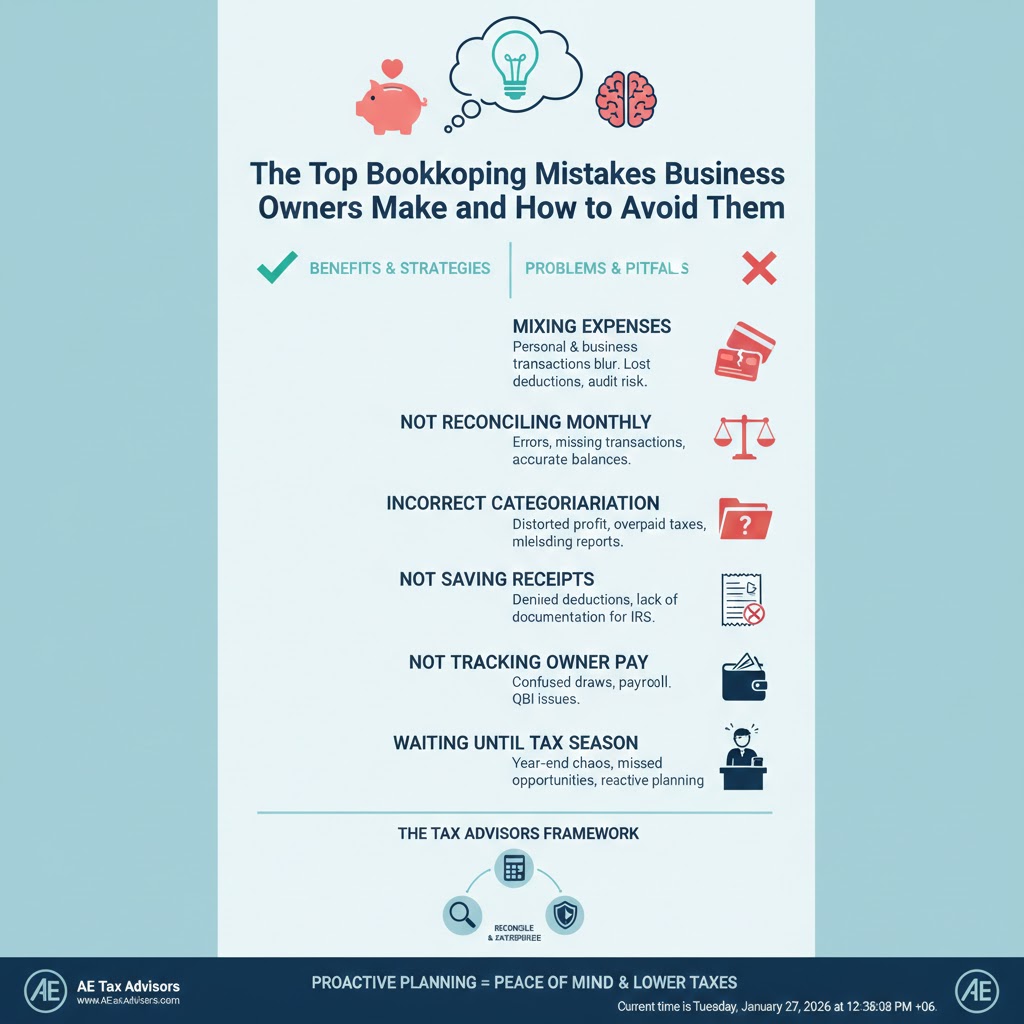
The Top Bookkeeping Mistakes Business Owners Make and How To Avoid Them
Bookkeeping mistakes add up quickly. A few miscategorized expenses, a missing receipt, or a month without reconciliation can create a ripple effect that impacts taxes, compliance, and cash flow. Understanding the most common bookkeeping mistakes helps you stay ahead and avoid costly problems.
To understand how clean books support long term planning, see Why Clean Books Matter for High Income Business Owners.
Mistake One Mixing Personal and Business Expenses
This is the most damaging and most common mistake. Mixing expenses creates disorganized books, blurs your deductions, and opens the door to potential audit issues.
Avoid this by keeping:
A dedicated business bank account
A dedicated business credit card
A clean separation of personal spending
You can fix mixed expenses by cleaning your books monthly, as outlined in Monthly Bookkeeping Checklist for Staying Compliant and Ready for Tax Season.
Mistake Two Not Reconciling Monthly
Without reconciliation, your books cannot be trusted. Missing transactions, double counted deposits, and incorrect balances destroy accuracy.
Monthly reconciliation ensures your books reflect real activity and supports your tax strategy.
Mistake Three Incorrect Categorization
Incorrect categories distort your profit, inflate your tax bill, and weaken your financial picture. Many business owners miscategorize:
Meals
Repairs
Marketing
Travel
Subscriptions
Software
Owner reimbursements
For a detailed categorization guide, refer to The Ultimate Guide to Bookkeeping for Small Business Owners Who Want Lower Taxes.
Mistake Four Not Saving Receipts
Missing receipts lead to denied deductions. Digital storage makes documentation simple, but many business owners neglect it.
Use tools like:
QuickBooks receipt capture
Google Drive
Dropbox
Expensify
Documentation protects your deductions if the IRS requests proof.
Mistake Five Not Tracking Owner Pay Correctly
Mixing draws, payroll, reimbursements, and personal spending creates confusion. Incorrect tracking affects QBI, payroll taxes, and end of year reporting.
A clean bookkeeping system keeps owner activity separate and accurate.
Mistake Six Waiting Until Tax Season
Year end cleanup creates stress, errors, and missed opportunities. Monthly bookkeeping gives you clarity all year, reduces tax surprises, and sets you up for proactive planning with AE Tax Advisors.
Final Thoughts
Avoiding these bookkeeping mistakes protects your financial health and supports lower taxes. Clean, consistent bookkeeping gives you clarity, reduces risk, and creates a strong foundation for long term growth
Understanding real estate bookkeeping is essential for maximizing your tax savings as a real estate investor.
When it comes to real estate bookkeeping, working with a specialized tax advisor makes all the difference.
Many investors overlook real estate bookkeeping, but it can be one of the most impactful strategies in your tax plan.
At AE Tax Advisors, we help clients navigate real estate bookkeeping to keep more of what they earn.
Real estate bookkeeping is one of the most important concepts for real estate investors to understand. When properly implemented, real estate bookkeeping can lead to significant tax savings that compound over time.
Many high-income earners miss out on real estate bookkeeping opportunities simply because their CPA lacks the specialized knowledge. A proactive approach to real estate bookkeeping can mean the difference between overpaying and optimizing your tax position.
Understanding Real estate bookkeeping
Related services from AE Tax Advisors: 1031 exchange coordination and 3-year tax lookback cleanup.
Real estate bookkeeping is a critical component of any comprehensive tax strategy for real estate investors. At AE Tax Advisors, we help clients navigate real estate bookkeeping to maximize their tax savings while maintaining full IRS compliance. Our proactive approach ensures you capture every available deduction and credit.
For more information, refer to the IRS.