

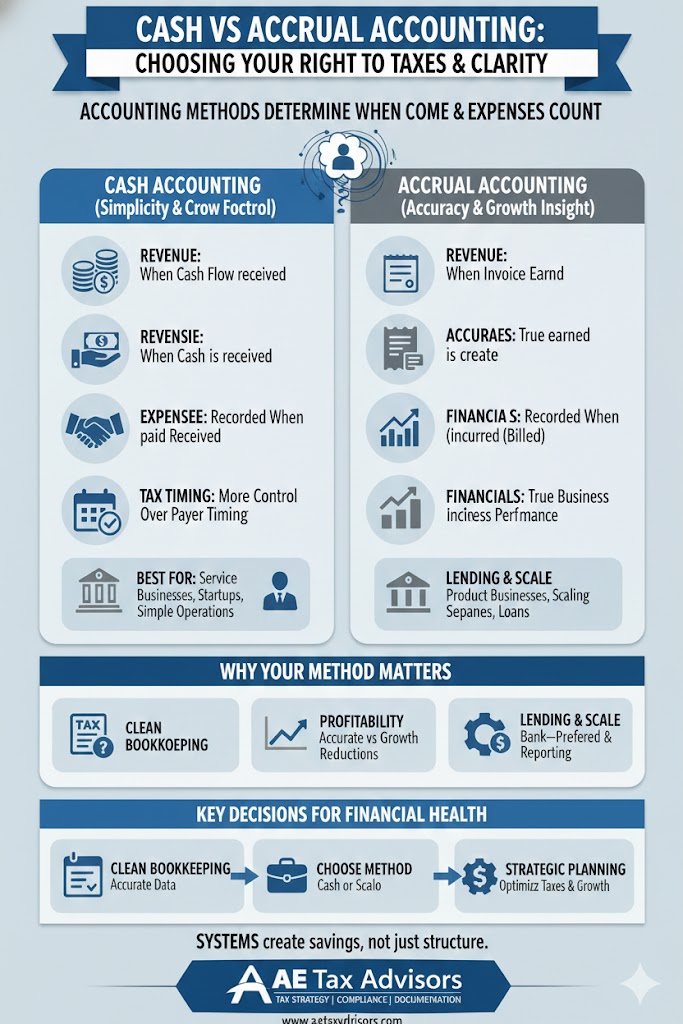
Why Your Accounting Method Matters More Than You Think
When it comes to quarterly bookkeeping tasks that save, understanding the fundamentals is key. Many business owners assume bookkeeping is just a matter of recording transactions, but your accounting method determines how you recognize revenue, track expenses, forecast cash flow, calculate taxes, and qualify for deductions. It is one of the most important financial decisions you will ever make. This guide covers real estate bookkeeping and what it means for your tax situation.
The method you choose impacts:
Tax liability
Profit reporting
Cash flow behavior
Expense timing
Eligibility for deductions
Financial projections
Quarterly tax estimates
Business lending
Year end tax planning
Before choosing, it is essential to understand the real differences and how each method interacts with your tax strategy, financial reporting, and growth goals.
For foundational bookkeeping strategy, see Why Clean Books Matter for High Income Business Owners and The Ultimate Guide to Bookkeeping for Small Business Owners Who Want Lower Taxes. These two articles explain why your method sits at the core of your overall financial system.
What Is Cash Method Accounting
Cash accounting recognizes income when money is received and recognizes expenses when money is paid. It is simple, straightforward, and used by many small businesses because it mirrors real world cash flow.
Businesses using cash method track:
Income only when the cash hits the account
Expenses only when money actually leaves the account
Profits based on inflows minus outflows
Simple deductions without adjustments
Straightforward reporting for year end taxes
Cash method provides clarity because it aligns with your bank balance. It shows how much cash you have, how much you spent, and how much profit remains.
It is ideal for:
Service based businesses
Contractors
Consultants
Freelancers
Single member LLCs
Sole proprietors
Low inventory companies
Businesses under the IRS cash method threshold
Cash accounting is easy to maintain and works well if you do not have significant accounts receivable or accounts payable.
What Is Accrual Method Accounting
Accrual accounting recognizes income when earned, even when the money has not arrived, and records expenses when incurred, even if unpaid.
Businesses using accrual method track:
Revenue when the work is completed
Invoices outstanding that still need to be collected
Expenses when billed
Bills that have not been paid
Future obligations
Liabilities and assets
Deferred expenses
Receivables and payables
Accrual method gives a more accurate picture of profit because it reflects economic activity instead of only cash flow.
It is ideal for:
Businesses with inventory
Growing companies
Ecommerce
Agencies
Construction firms
Medical practices
Manufacturing
Businesses with large payable or receivable cycles
Although accrual accounting takes more work, it gives you financial clarity far beyond cash method reporting.
How Accounting Method Impacts Your Taxes
Your accounting method directly affects your tax return, your deduction timing, your ability to defer income, and your approach to strategic tax planning.
Under cash method:
You only pay tax on income you actually received
You can accelerate expenses strategically
You can delay income if needed
Your year end tax plan is flexible
Your CPA can adjust your tax liability more easily
Under accrual method:
You may owe tax on income not yet collected
Expenses may be deductible before payment
Revenue recognition is less flexible
Cash flow does not match taxable profit
Tax estimates require deeper analysis
For proactive tax planning, clean books matter more than the method. Review Monthly Bookkeeping Checklist for Staying Compliant and Ready for Tax Season to understand how monthly financial maintenance supports both methods.
The IRS Rules Around Choosing Your Method
The IRS allows many small businesses to choose cash method as long as they fall under certain revenue thresholds and do not require inventory tracking.
The IRS requires accrual for:
Businesses with inventory under certain structures
C corporations with higher revenue
Certain manufacturing organizations
Businesses exceeding IRS cash method limits
Most service based firms can choose either method, but the decision should be intentional, not random.
AE Tax Advisors helps business owners choose the method that aligns with long term tax planning, cash flow, and compliance.
How Cash Method Impacts Real World Operations
Cash method makes your financials easy to follow because your books match your bank account. This helps you understand real world liquidity and makes tax planning simpler.
Benefits include:
Clearer cash flow visibility
Easier month to month tracking
Lower bookkeeping complexity
Better alignment with bank statements
Simplified tax preparation
However, cash method has limitations:
Your reported profit may not reflect actual workload
Large unpaid invoices distort financial truth
Expenses may not match revenue cycles
Lending may require accrual level detail
Cash method is great for staying lean, simple, and organized.
How Accrual Method Impacts Real World Operations
Accrual method gives you financial visibility across time. It separates cash movement from business activity, creating clearer reporting for long term decisions.
Accrual helps you:
Understand profitability more accurately
Forecast cash needs more precisely
Track obligations and future expenses
Manage receivables and payables
Support lending and financing requests
However, accrual requires:
Monthly reconciliations
Accounts receivable tracking
Accounts payable tracking
Higher bookkeeping consistency
More advanced financial reporting
Accrual gives you sophisticated numbers that support scaling.
How to Know Which Method Is Right for Your Business
Choosing the right method requires evaluating how your business earns revenue, how payments flow, and what level of financial clarity you need.
Cash method is often right if:
You want simplicity
You get paid immediately
Your business has no inventory
Your revenue is predictable
You want easier tax timing
Your business is new or growing slowly
Your bookkeeping needs are light
Accrual method is often right if:
You invoice clients
You have material receivables
You use contractors with long payment cycles
You carry inventory
You rely on lending, financing, or lines of credit
You plan to scale significantly
You want true profit measurement
Your business model determines which method provides the clarity you need.
How Accounting Method Affects Bookkeeping Systems
Your bookkeeping system must match your accounting method. Many businesses fail to align the two, which creates inaccurate reports, tax issues, and incorrect financial data.
Cash method bookkeeping requires:
Clear categorization
Simple reconciliation
Cash based reporting
Consistent expense documentation
Accrual method bookkeeping requires:
AR aging
AP aging
Accrual adjustments
Deferred revenue
Accrued expenses
Inventory adjustments
Closing entries
If your books are messy, read Why Clean Books Matter for High Income Business Owners for guidance on rebuilding your financial foundation.
How Accounting Method Affects Your CPA’s Tax Planning
Your CPA cannot run proactive tax projections unless your books reflect your accounting method correctly.
With cash method, your CPA can:
Plan income timing
Adjust expenses strategically
Guide year end purchases
Manage quarterly tax estimates
With accrual method, your CPA can:
Analyze real profitability
Forecast multi month obligations
Guide hiring decisions
Model revenue cycles
Either method can work if your books stay clean and consistent.
How to Switch from Cash to Accrual or Accrual to Cash
Changing methods requires IRS approval depending on your situation. A formal method change often involves Form 3115.
Reasons to switch to cash:
Simplify
Reduce taxable income
Align tax with real cash flow
Improve clarity
Reasons to switch to accrual:
Scale operations
Improve financial reporting
Support lending
Match revenue and expenses better
AE Tax Advisors handles method changes and ensures the transition is clean, compliant, and tax efficient.
When to Involve a Professional Bookkeeper
You should involve AE Tax Advisors when:
Your books are behind
You have receivables and payables
Your tax projections feel inaccurate
You need proactive planning
Your accountant requests accrual level detail
You want lower taxes with higher clarity
Keeping your books clean while managing cash or accrual adjustments is one of the most valuable financial upgrades you can make.
Understanding real estate bookkeeping is essential for maximizing your tax savings as a real estate investor.
When it comes to real estate bookkeeping, working with a specialized tax advisor makes all the difference.
Many investors overlook real estate bookkeeping, but it can be one of the most impactful strategies in your tax plan.
At AE Tax Advisors, we help clients navigate real estate bookkeeping to keep more of what they earn.
Real estate bookkeeping is one of the most important concepts for real estate investors to understand. When properly implemented, real estate bookkeeping can lead to significant tax savings that compound over time.
Many high-income earners miss out on real estate bookkeeping opportunities simply because their CPA lacks the specialized knowledge. A proactive approach to real estate bookkeeping can mean the difference between overpaying and optimizing your tax position.
At AE Tax Advisors, our team specializes in real estate bookkeeping for real estate investors and W-2 professionals. We have helped hundreds of clients use real estate bookkeeping to reduce their tax burden by $50,000 or more annually.
The key to successful real estate bookkeeping implementation is working with an advisor who understands real estate taxation. Every real estate bookkeeping decision should be part of a comprehensive, multi-year tax plan.
If you are not actively using real estate bookkeeping as part of your tax strategy, you are likely leaving money on the table. Contact AE Tax Advisors to learn how real estate bookkeeping can work for your specific situation.
Final Thoughts
Related services from AE Tax Advisors: 3-year tax lookback cleanup and real estate professional status support.
Your accounting method is more than a preference. It is a strategic financial decision that affects cash flow, tax liability, reporting accuracy, and long term planning. Whether cash or accrual is right for you depends on your revenue model, complexity, and growth goals.
For more information, refer to the IRS.