
Understanding International Tax Planning For High in 2026
International tax planning has become an essential part of wealth strategy for high net worth individuals who earn income, hold assets, or conduct business across borders. Global income creates both opportunity and risk, and without a coordinated plan, high earners can face double taxation, unexpected penalties, and structural inefficiencies that limit long term wealth growth. As the financial lives of affluent individuals expand internationally, the tax system becomes more complicated and requires a deliberate strategy that aligns compliance, investment planning, and cross border structuring.
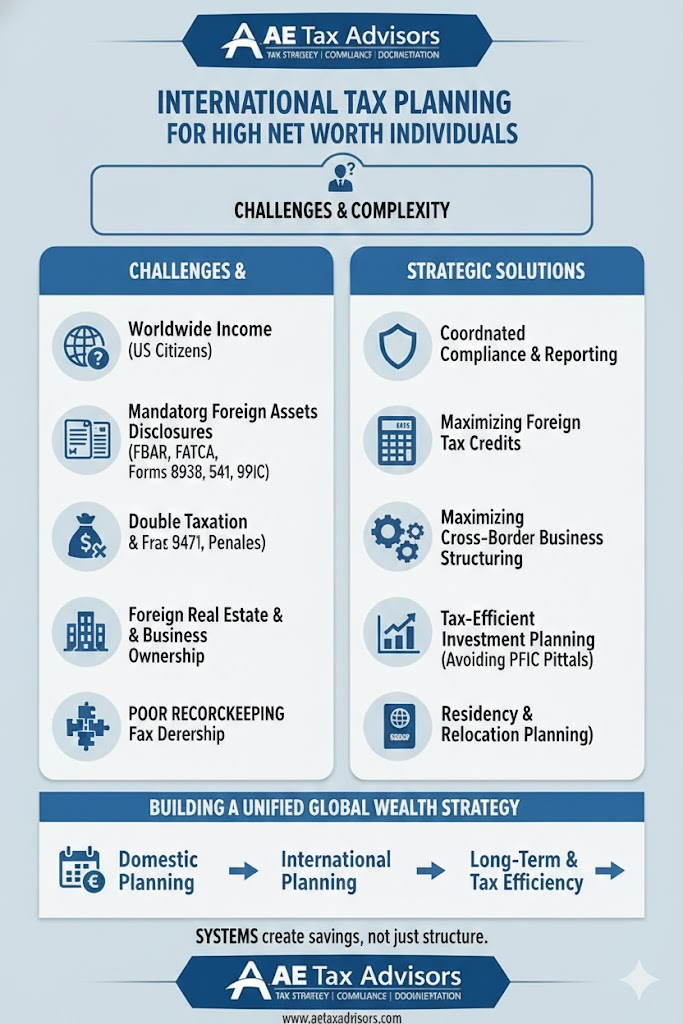
High net worth individuals often hold foreign real estate, operate international businesses, maintain overseas banking relationships, or invest in global funds. Each of these categories triggers its own set of reporting obligations. The United States taxes citizens on worldwide income, which means that even if the income is fully earned overseas, it must still be reported domestically. This creates a layer of complexity that most taxpayers never encounter. International tax planning ensures that all foreign income streams are aligned with United States rules while taking advantage of treaty benefits, foreign tax credits, and structural tools designed to minimize unnecessary tax exposure.
One of the biggest challenges wealthy individuals face is the wide range of required disclosures for foreign assets and accounts. Forms such as FBAR, FATCA, Form 8938, Form 5471, and PFIC reporting are not optional. They are mandatory, and the penalties for missing one can be severe. Many high net worth clients underestimate how easy it is to fall out of compliance when assets are scattered across multiple countries or held in structures not designed for U.S. reporting. Proper international planning organizes these assets, ensures accurate documentation, and removes the risk of costly errors.
Foreign tax credits play a major role in international tax planning. When income is taxed abroad, individuals may be eligible for credits that offset U.S. income tax liability. However, these credits are not automatic, and there are categories, limitations, and carryover rules that must be followed. High net worth individuals who earn foreign dividends, rental income, or active business income need a system that maximizes available credits without triggering limitations that reduce their benefit. A coordinated approach helps ensure that foreign taxes actually help reduce domestic liability rather than creating inefficiencies.
Foreign business ownership adds another layer of complexity. Controlled foreign corporation rules, global intangible income, and transfer pricing considerations require detailed planning. Wealthy individuals who operate cross border enterprises must understand which country has taxing rights, how profits are taxed before repatriation, and when structural changes can reduce long term tax burden. International corporate structuring is often one of the most effective ways to reduce global taxation, but it must be done correctly to avoid negative IRS implications.
Foreign real estate is another major area of opportunity. Real estate located abroad can generate rental income, capital gains, and depreciation, but the rules differ by country. Some countries impose withholding taxes on rental payments, others have mandatory depreciation systems, and many assess capital gains differently for foreign owners. A tax plan must coordinate local tax obligations with U.S. reporting so that the investor receives the full financial benefit without double taxation. When structured properly, foreign real estate can become a stable, tax efficient part of a diversified portfolio.
Many high net worth individuals also use foreign investment accounts, international funds, or alternative products offered outside the United States. These often trigger PFIC rules, which impose punitive taxation if not planned for in advance. PFIC exposure is one of the most common problems for wealthy global investors because many are unaware that even passive foreign mutual funds can be classified as PFICs. Avoiding PFIC pitfalls requires intentional investment selection and a clear understanding of how U.S. tax law treats foreign financial products.
Residency planning is another essential part of international tax strategy. Moving to another country, spending extended time abroad, or maintaining multi country residency ties can impact tax obligations. Residency affects both local taxation and U.S. rules, and without a plan, a high net worth individual can become unintentionally taxed in two jurisdictions at once. Proper residency planning helps individuals structure travel, investments, and business ties to maintain the most beneficial tax position.
The most important part of international tax planning is integration. Wealthy individuals must integrate foreign income strategy with domestic tax planning, real estate strategy, estate planning, retirement planning, and investment decisions. International planning cannot exist separately. It must be part of a larger system designed to create global tax efficiency and long term stability. AE Tax Advisors helps clients build this unified strategy so that both foreign and domestic assets work together.
Understanding tax planning strategy is essential for maximizing your tax savings as a real estate investor.
When it comes to tax planning strategy, working with a specialized tax advisor makes all the difference.
Many investors overlook tax planning strategy, but it can be one of the most impactful strategies in your tax plan.
At AE Tax Advisors, we help clients navigate tax planning strategy to keep more of what they earn.
Tax planning strategy is one of the most important concepts for real estate investors to understand. When properly implemented, tax planning strategy can lead to significant tax savings that compound over time.
Many high-income earners miss out on tax planning strategy opportunities simply because their CPA lacks the specialized knowledge. A proactive approach to tax planning strategy can mean the difference between overpaying and optimizing your tax position.
At AE Tax Advisors, our team specializes in tax planning strategy for real estate investors and W-2 professionals. We have helped hundreds of clients use tax planning strategy to reduce their tax burden by $50,000 or more annually.
Understanding Tax planning
Related services from AE Tax Advisors: multi-state real estate tax planning and mid-term rental tax planning.
Tax planning is a critical component of any comprehensive tax strategy for real estate investors. At AE Tax Advisors, we help clients navigate tax planning to maximize their tax savings while maintaining full IRS compliance. Our proactive approach ensures you capture every available deduction and credit.
For more information, refer to the IRS.