

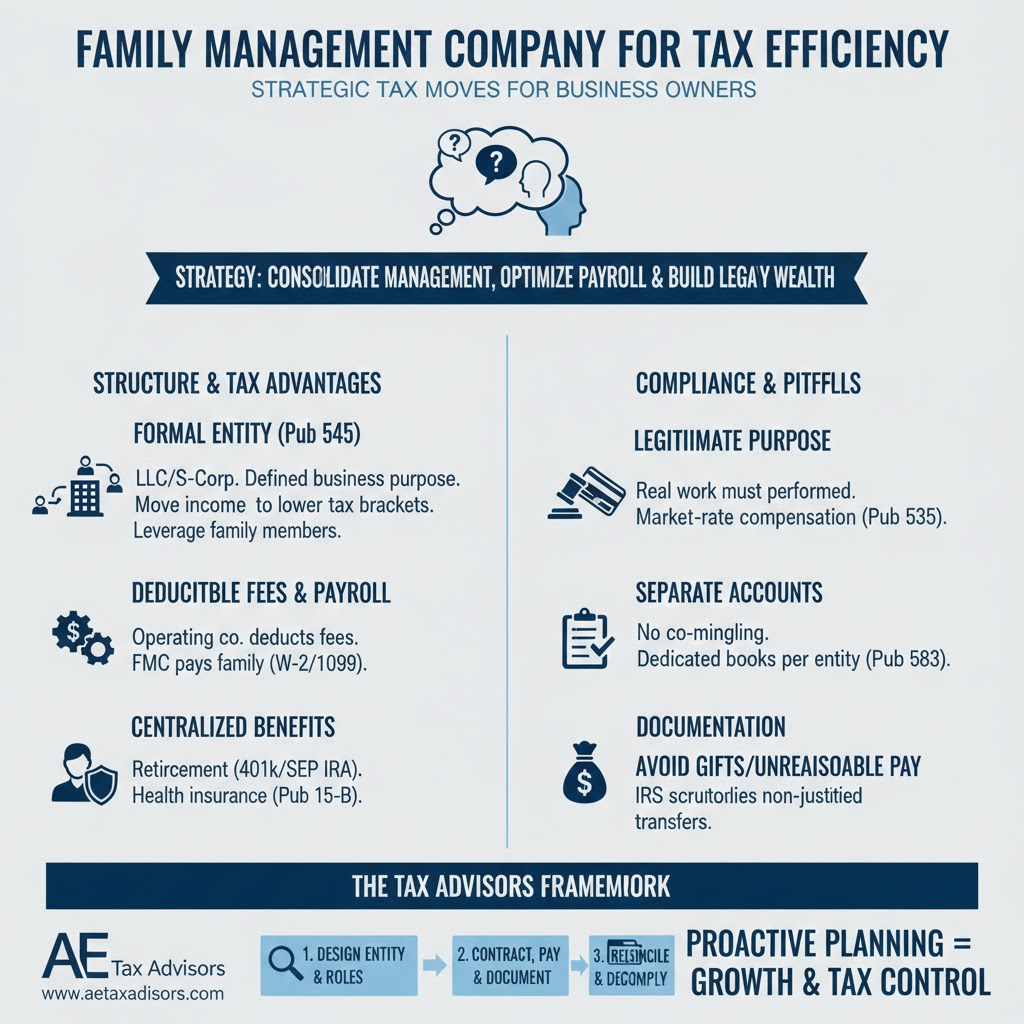
 This guide covers use family management company and what it means for your tax situation.
Understanding How To Use A Family in 2026
As business owners build wealth, managing family involvement becomes both an opportunity and a challenge. Payroll, administration, and household business activities can quickly overlap. The solution? A Family Management Company (FMC) — a structure that allows you to employ family members, consolidate management tasks, and reduce taxes legally.
At AE Tax Advisors, we help clients design FMC structures that keep compliance intact while optimizing tax efficiency. This article explains how the Family Management Company works, what makes it legal, and how to integrate it into your overall tax strategy.
It builds on How to Legally Pay Family Members Through Your Business and The Family Office Formula: How Business Owners Turn Cash Flow into Generational Wealth, demonstrating how formal structure transforms informal help into a legitimate, deductible business function.
What Is a Family Management Company?
A Family Management Company is typically a small limited liability company (LLC) or S-Corporation formed to manage administrative, management, and operational tasks for one or more family-owned entities.
Rather than paying family members directly from multiple businesses, the FMC acts as an employer and service provider. It handles payroll, administrative work, scheduling, bookkeeping, property management, and even marketing.
The key difference is that this company must have a legitimate business purpose, provide measurable services, and charge market-rate management fees to the operating entities it supports.
AE Tax Advisors designs FMC structures that meet all IRS “ordinary and necessary” standards under Publication 535 — ensuring that every payment between entities is justified and documented.
Why a Family Management Company Works
The FMC strategy leverages several legal and financial principles:
- Income shifting: By moving income from a higher-bracket business owner to lower-bracket family members performing legitimate work, you reduce overall household tax liability.
- Deductible management fees: Operating businesses can deduct payments made to the FMC as business expenses.
- Payroll flexibility: The FMC can employ spouses, children, or relatives under structured, compliant payroll.
- Centralized operations: All family-related administrative work flows through a single entity, simplifying records and compliance.
- Wealth preservation: By managing family compensation and benefits through one company, you can coordinate retirement plans, insurance, and expenses under a controlled framework.
These principles tie directly into the systems discussed in How to Structure Depreciation for Maximum Tax Savings and The Business Owner’s Blueprint: How to Build, Protect, and Multiply Wealth Through Entity Strategy.
Step 1: Establish a Legitimate Business Purpose
The IRS requires that every business entity exist for a legitimate business purpose. For an FMC, this means it must actually manage or perform services for other entities or individuals in the family group.
Examples of legitimate services include:
- Bookkeeping, scheduling, and administrative support.
- Marketing, invoicing, and customer coordination.
- Property management for family-owned rentals or real estate.
- HR, payroll, and benefits administration.
- Operations oversight for multiple companies.
AE Tax Advisors helps define and document the FMC’s purpose in its operating agreement, contracts, and invoices — the same standards that apply to any outside vendor relationship.
Step 2: Choose the Right Entity Type
Most Family Management Companies are formed as LLCs for flexibility and simplicity. Some may elect S-Corporation status to reduce self-employment taxes once income exceeds certain thresholds.
Under Publication 541, partnerships (multi-member LLCs) can also serve as FMCs, allocating income and deductions across family members in proportion to ownership.
AE Tax Advisors evaluates your structure and goals to determine whether single-member, partnership, or S-Corp election provides the best long-term efficiency.
This structural decision connects back to How AE Tax Advisors Helps You Keep More of What You Earn, where entity selection shapes your tax destiny.
Step 3: Define Service Agreements with Operating Companies
To ensure legal separation, the FMC must invoice other entities for management services. These service agreements should include:
- A description of services performed.
- Billing frequency and payment terms.
- Defined hourly or project-based rates.
- Documentation of how fees were calculated.
The operating businesses then deduct the payments as ordinary and necessary business expenses under Publication 535, while the FMC recognizes them as income.
AE Tax Advisors prepares management service agreements that meet these requirements, creating a clear trail that supports both deduction and income recognition in audit situations.
This contractual clarity mirrors the principles outlined in How to Build an Audit-Proof Tax Documentation System.
Step 4: Set Up Payroll for Family Members
Once the FMC is established, family members can be employed to perform legitimate administrative, marketing, or support work.
IRS Publication 15 governs payroll reporting, withholding, and employment taxes. AE Tax Advisors ensures:
- Each family member has a job description and time records.
- Payroll taxes are handled correctly based on relationship (e.g., spouse, child).
- W-2s and 1099s are filed properly at year-end.
This step builds directly on How to Legally Pay Family Members Through Your Business, expanding from individual family payroll to structured family employment within an entity.
Step 5: Use the FMC to Manage Shared Family Expenses
Certain family-related business expenses — such as home office costs, insurance, or administrative tools — may flow through the FMC when used for legitimate business activity.
Examples include:
- Home office rent paid to the FMC if it manages multiple business activities.
- Shared software subscriptions or cloud systems.
- Professional fees, bookkeeping, and marketing costs.
AE Tax Advisors helps clients document and allocate these expenses properly, ensuring each is linked to a clear business purpose under Publication 535 guidelines.
This concept reinforces what we discussed in How to Prepare for Year-End Tax Planning Like a Pro, where timing and categorization turn costs into savings.
Step 6: Establish a Management Fee Schedule
The FMC earns income by charging management fees to the operating companies. These fees should reflect market value for similar services and be consistent over time.
AE Tax Advisors calculates fair management rates using comparable industry data to prevent reclassification risks. Overcharging or inconsistent billing could cause the IRS to treat intercompany payments as disguised distributions or non-deductible transfers.
This principle aligns with How to Legally Pay Yourself from Your Business, where reasonableness protects every deduction.
Step 7: Keep Separate Books and Bank Accounts
Each entity — including the FMC — must maintain its own bank account and accounting records. Publication 583 requires that businesses record transactions independently, even if the entities are family-owned.
AE Tax Advisors structures bookkeeping systems to track:
- Invoiced management fees.
- Payroll to family members.
- Operating expenses.
- Transfers between entities.
This segregation prevents co-mingling and strengthens audit defense, a recurring theme from How to Build a Bulletproof Audit Defense Strategy for Your Business.
Step 8: Allocate Income Strategically
The FMC can distribute income to family members in lower tax brackets while still compensating the business owner for oversight. In a partnership or S-Corp model, these distributions can reduce overall household tax liability while staying fully compliant.
Publication 541 outlines the rules for partnership allocations — they must have economic substance and follow ownership percentages unless otherwise specified in the agreement.
AE Tax Advisors models these allocations to ensure every member’s share is defensible and consistent with actual business involvement.
Step 9: Integrate Retirement and Health Benefits
Because the FMC employs family members, it can also sponsor retirement and health plans. This allows contributions to 401(k)s, HSAs, or defined-benefit plans — creating additional deductions and long-term wealth transfer benefits.
This integrated approach connects with How to Build a Tax-Advantaged Retirement Plan for Business Owners, where entity-based benefit structures magnify both savings and control.
Step 10: Audit-Proof Documentation and Reporting
Every invoice, payroll record, and management fee must be supported by corresponding documentation. AE Tax Advisors maintains digital folders for:
- Contracts between entities.
- Payroll logs and tax filings.
- Proof of payments and bank transfers.
- Meeting minutes and management reports.
This transparency not only satisfies IRS expectations but also mirrors the best practices described in How to Build an Audit-Proof Tax Documentation System.
Step 11: Common Mistakes to Avoid
Family Management Companies fail when they lack substance. Common errors include:
- Charging management fees without service documentation.
- Paying family members without time or task logs.
- Failing to maintain separate accounting systems.
- Using the FMC to pay purely personal expenses.
- Setting unrealistic or inconsistent management fees.
AE Tax Advisors prevents these issues by building structured systems — from contracts to cloud-based bookkeeping — that make compliance automatic.
Step 12: The AE Tax Advisors Family Management Framework
- Form a legitimate, service-based LLC or S-Corp.
- Define services and create intercompany agreements.
- Employ family members with real job roles and payroll compliance.
- Bill operating companies market-rate management fees.
- Maintain independent accounts and documentation.
- Use the FMC to coordinate retirement, insurance, and benefits.
This framework transforms family involvement into a legal, deductible, and tax-efficient enterprise.
Conclusion: From Family Business to Family Enterprise
A Family Management Company formalizes what many families already do — it gives structure, legality, and tax efficiency to the way you manage your shared financial life.
At AE Tax Advisors, we use IRS Publications 535 and 541 as the foundation for designing compliant, strategic FMC structures. When set up properly, your Family Management Company becomes more than a tax tool — it becomes a financial operating system for your legacy.
Understanding use family management company is essential for maximizing your tax savings as a real estate investor.
When it comes to use family management company, working with a specialized tax advisor makes all the difference.
Many investors overlook use family management company, but it can be one of the most impactful strategies in your tax plan.
At AE Tax Advisors, we help clients navigate use family management company to keep more of what they earn.
Use family management company is one of the most important concepts for real estate investors to understand. When properly implemented, use family management company can lead to significant tax savings that compound over time.
Many high-income earners miss out on use family management company opportunities simply because their CPA lacks the specialized knowledge. A proactive approach to use family management company can mean the difference between overpaying and optimizing your tax position.
At AE Tax Advisors, our team specializes in use family management company for real estate investors and W-2 professionals. We have helped hundreds of clients use use family management company to reduce their tax burden by $50,000 or more annually.
The key to successful use family management company implementation is working with an advisor who understands real estate taxation. Every use family management company decision should be part of a comprehensive, multi-year tax plan.
If you are not actively using use family management company as part of your tax strategy, you are likely leaving money on the table. Contact AE Tax Advisors to learn how use family management company can work for your specific situation.
Understanding Use family management company
Related services from AE Tax Advisors: multi-state real estate tax planning and cost segregation studies.
Use family management company is a critical component of any comprehensive tax strategy for real estate investors. At AE Tax Advisors, we help clients navigate use family management company to maximize their tax savings while maintaining full IRS compliance. Our proactive approach ensures you capture every available deduction and credit.
For official IRS guidance, visit the IRS Newsroom.