

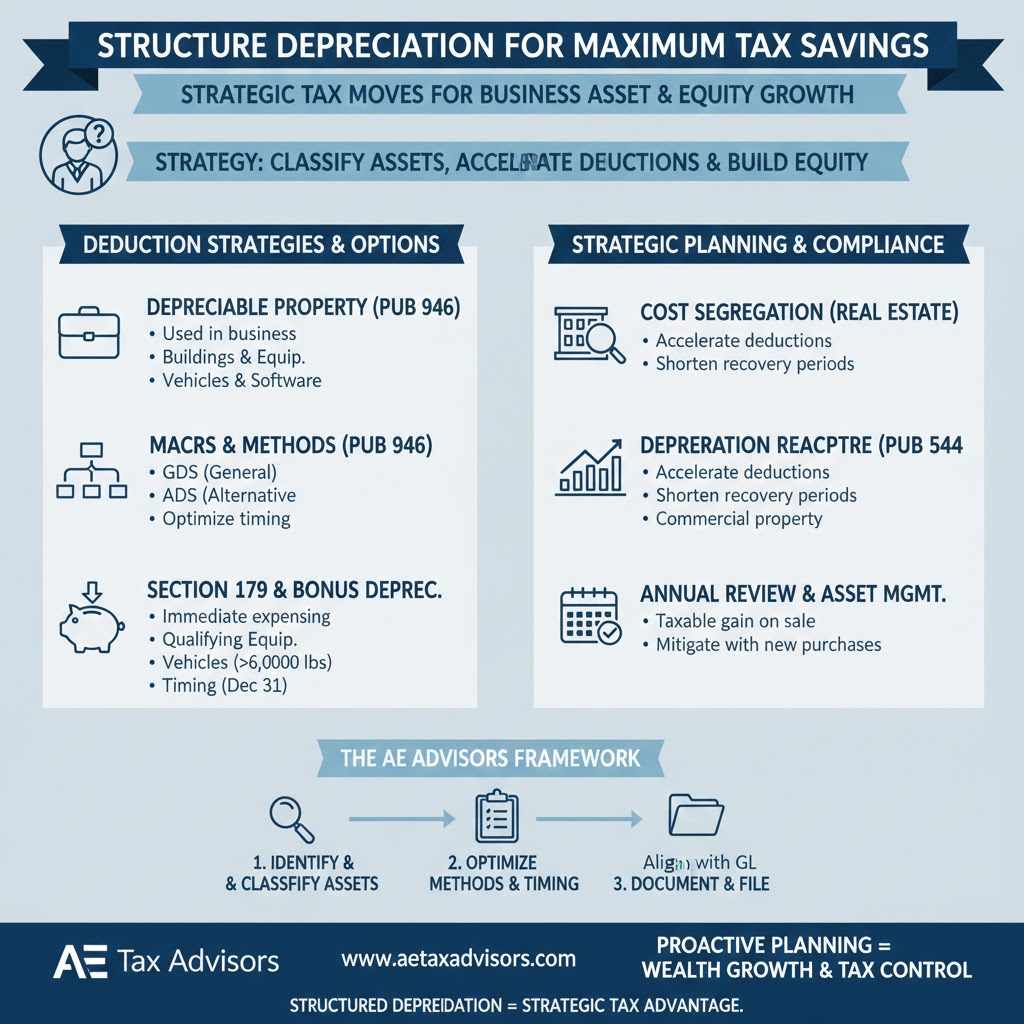
 This guide covers depreciation tax strategy and what it means for your tax situation.
Understanding How To Structure Depreciation For in 2026
Depreciation is one of the most powerful — and most overlooked — tools in the tax code. It allows you to recover the cost of property or equipment over time while reducing taxable income each year.
At AE Tax Advisors, we help business owners use depreciation strategically — not just as a routine accounting entry, but as a proactive tax planning mechanism. When applied correctly, depreciation converts fixed assets into ongoing tax deductions that can reshape your profit-and-loss statement.
This guide builds on The Smart Way to Handle Business Vehicle Deductions and How to Prepare for Year-End Tax Planning Like a Pro, connecting how asset purchases, entity type, and timing work together to reduce taxes and increase long-term equity.
What Depreciation Really Is
Depreciation is the gradual deduction of the cost of tangible property — buildings, vehicles, furniture, or equipment — used in your business. Instead of deducting the full cost upfront (unless qualified for Section 179 or bonus depreciation), the IRS allows you to spread deductions across the property’s useful life.
IRS Publication 946 defines depreciation as “an annual allowance for the wear and tear, deterioration, or obsolescence of property used in a trade or business.”
AE Tax Advisors turns this accounting rule into a planning opportunity. By managing depreciation schedules, you can influence taxable income year after year — an essential part of long-term strategy discussed in The Business Owner’s Blueprint: How to Build, Protect, and Multiply Wealth Through Entity Strategy.
Step 1: Identify Depreciable Property
Not every purchase can be depreciated. To qualify, property must:
- Be used for business or income-producing activity.
- Have a determinable useful life greater than one year.
- Lose value over time due to wear, age, or obsolescence.
Common examples include:
- Buildings and leasehold improvements
- Machinery and equipment
- Office furniture
- Vehicles (business use only)
- Computer hardware and software
Land is not depreciable, since it doesn’t wear out or lose value.
AE Tax Advisors reviews each client’s balance sheet to ensure every eligible item is properly categorized under Publication 535 guidelines for business expenses.
This classification process ties directly to The Top Tax Write-Offs Most Small Businesses Miss, where misclassification often leads to lost deductions.
Step 2: Determine the Correct Depreciation Method
The IRS offers several depreciation methods, but most businesses use the Modified Accelerated Cost Recovery System (MACRS) — the default system under Publication 946.
There are two main variations:
- GDS (General Depreciation System): The most common, providing shorter recovery periods and larger deductions in early years.
- ADS (Alternative Depreciation System): Used for certain property types or when required by law, offering longer recovery periods with smaller annual deductions.
AE Tax Advisors analyzes which system maximizes your savings without triggering alternative minimum tax (AMT) issues or violating IRS usage rules.
This level of strategic precision aligns with How AE Tax Advisors Helps You Keep More of What You Earn, where every dollar of timing matters.
Step 3: Apply Section 179 Expensing
Under Section 179, you can deduct the full cost of qualifying property in the year it’s placed in service, rather than depreciating it over time.
For 2025, the deduction limit is $1,220,000, phasing out when total purchases exceed $3,050,000. The property must be used more than 50% for business.
Eligible items include:
- Equipment and machinery
- Furniture and computers
- Certain vehicles over 6,000 pounds GVWR
- Off-the-shelf software
AE Tax Advisors evaluates each asset purchase to determine whether Section 179 offers a better return than standard MACRS depreciation. When used strategically, it can drastically reduce taxable income in high-profit years.
This immediate deduction strategy builds on the logic discussed in How to Prepare for Year-End Tax Planning Like a Pro, where timing determines impact.
Step 4: Leverage Bonus Depreciation
Bonus depreciation allows a deduction for a percentage of the cost of qualified property in the year it’s placed in service — on top of or instead of Section 179.
For assets placed in service through 2026, the percentage gradually phases down (60% in 2025). Unlike Section 179, bonus depreciation applies automatically unless you elect out.
Publication 946 confirms that bonus depreciation can apply to both new and used property, provided it’s the taxpayer’s first use.
AE Tax Advisors frequently combines Section 179 with bonus depreciation to accelerate deductions while staying within IRS thresholds. This approach is particularly effective for businesses upgrading vehicles, equipment, or computers at year-end.
This planning layer connects to The Smart Way to Handle Business Vehicle Deductions, since heavy vehicles and certain qualified assets may receive substantial immediate write-offs.
Step 5: Segment Real Property Using Cost Segregation
For real estate owners, depreciation offers long-term tax efficiency — but a cost segregation study can accelerate it dramatically.
Cost segregation separates components of a building (e.g., electrical systems, flooring, HVAC, landscaping) into shorter depreciation categories. Instead of a 39-year recovery period for commercial property, certain components can be depreciated over 5, 7, or 15 years.
AE Tax Advisors partners with engineering firms to conduct IRS-compliant studies, reallocating costs for maximum front-loaded deductions. This can generate tens or hundreds of thousands of dollars in immediate tax savings.
This approach complements Real Estate Inside the Business: The Overlooked Wealth Strategy of the 1%, where property ownership and depreciation form the backbone of business wealth.
Step 6: Understand Depreciation Recapture
When you sell or dispose of an asset, you may have to “recapture” depreciation — meaning some of the prior deductions become taxable as ordinary income.
Under Publication 544 and Publication 946, depreciation recapture applies to gains from selling business property that had previously generated depreciation deductions.
AE Tax Advisors structures transactions and timing to minimize recapture impact, often offsetting gains with new Section 179 purchases or reinvestments through like-kind exchanges (where applicable).
This principle echoes the forward-looking mindset from The Family Office Formula: How Business Owners Turn Cash Flow into Generational Wealth, emphasizing tax deferral and reinvestment.
Step 7: Maintain Accurate Depreciation Schedules
Depreciation schedules document each asset’s cost, method, recovery period, and accumulated depreciation. Accurate schedules are essential for compliance and audit defense.
AE Tax Advisors reconciles depreciation reports quarterly, ensuring they align with your general ledger, tax software, and current asset usage. We also handle mid-year asset additions and disposals to maintain continuity.
This attention to documentation links directly to How to Build a Bulletproof Audit Defense Strategy for Your Business, where complete records make deductions unassailable.
Step 8: Coordinate Depreciation with Entity Structure
Entity type determines how depreciation flows through your tax return:
- Sole Proprietorships/Single-Member LLCs: Depreciation passes through Schedule C.
- Partnerships and Multi-Member LLCs: Deductions are allocated to partners via Schedule K-1.
- S-Corporations: Deductions reduce corporate profit and shareholder basis.
- C-Corporations: Deductions reduce taxable income directly at the corporate level.
AE Tax Advisors ensures depreciation strategy aligns with compensation planning, distributions, and owner equity tracking. This synchronization reflects the principles outlined in How to Legally Pay Yourself from Your Business.
Step 9: Match Depreciation to Your Income Cycle
Accelerated depreciation isn’t always the best move. In some years, deferring deductions can reduce taxes more strategically. For example, spreading depreciation over multiple years helps smooth income in stable-growth businesses.
AE Tax Advisors models both accelerated and straight-line approaches using your projected cash flow and tax brackets, ensuring your deductions align with your financial strategy.
This adaptive method connects with How to Plan for Quarterly Taxes Without Stress, where cash flow management determines long-term tax stability.
Step 10: Use Depreciation to Lower Self-Employment and State Taxes
Depreciation reduces taxable business income, which in turn lowers self-employment tax for sole proprietors and partners. In many states, it also lowers taxable income for state returns.
AE Tax Advisors calculates multi-level impact, ensuring deductions are maximized federally and locally. For clients operating in multiple states, we prepare reconciliations that comply with varying depreciation conformity laws.
This comprehensive planning style parallels Advanced Strategies for Reducing Self-Employment Tax, ensuring each deduction hits at every possible level.
Step 11: Common Depreciation Mistakes to Avoid
Even sophisticated businesses can mismanage depreciation. Common errors include:
- Using incorrect recovery periods or methods.
- Forgetting to record partial-year acquisitions.
- Overstating Section 179 deductions beyond income limits.
- Failing to adjust for assets taken out of service.
- Mixing personal and business property records.
AE Tax Advisors eliminates these errors with strict monthly reconciliation, automated depreciation tracking, and professional oversight.
AE Tax Advisors Depreciation Framework
- Identify all depreciable property.
- Assign proper asset classifications and recovery periods.
- Optimize timing between Section 179, bonus depreciation, and MACRS.
- Maintain detailed schedules aligned with IRS publications.
- Reconcile annually and plan for recapture when selling assets.
This framework ensures every deduction is legitimate, optimized, and audit-ready.
Conclusion: Turn Depreciation into a Wealth Strategy
Depreciation isn’t just a bookkeeping formality — it’s a tax planning weapon when used correctly. Every asset you buy can become a future deduction, every property improvement can create accelerated savings, and every decision can align with your broader tax and business strategy.
At AE Tax Advisors, we use IRS Publications 946 and 535 as our technical foundation. By structuring depreciation intelligently — and aligning it with your income, entity, and timing — we turn routine accounting into strategic wealth creation.
Depreciation is proof that the tax code rewards those who plan ahead. Use it wisely, and your assets will do more than hold value — they’ll generate it.
Understanding depreciation tax strategy is essential for maximizing your tax savings as a real estate investor.
When it comes to depreciation tax strategy, working with a specialized tax advisor makes all the difference.
Many investors overlook depreciation tax strategy, but it can be one of the most impactful strategies in your tax plan.
At AE Tax Advisors, we help clients navigate depreciation tax strategy to keep more of what they earn.
Depreciation tax strategy is one of the most important concepts for real estate investors to understand. When properly implemented, depreciation tax strategy can lead to significant tax savings that compound over time.
Many high-income earners miss out on depreciation tax strategy opportunities simply because their CPA lacks the specialized knowledge. A proactive approach to depreciation tax strategy can mean the difference between overpaying and optimizing your tax position.
At AE Tax Advisors, our team specializes in depreciation tax strategy for real estate investors and W-2 professionals. We have helped hundreds of clients use depreciation tax strategy to reduce their tax burden by $50,000 or more annually.
The key to successful depreciation tax strategy implementation is working with an advisor who understands real estate taxation. Every depreciation tax strategy decision should be part of a comprehensive, multi-year tax plan.
If you are not actively using depreciation tax strategy as part of your tax strategy, you are likely leaving money on the table. Contact AE Tax Advisors to learn how depreciation tax strategy can work for your specific situation.
Understanding Depreciation tax strategy
Related services from AE Tax Advisors: entity structuring for rental portfolios and tax strategy consultation.
Depreciation tax strategy is a critical component of any comprehensive tax strategy for real estate investors. At AE Tax Advisors, we help clients navigate depreciation tax strategy to maximize their tax savings while maintaining full IRS compliance. Our proactive approach ensures you capture every available deduction and credit.
For official IRS guidance, visit the IRS Newsroom.