

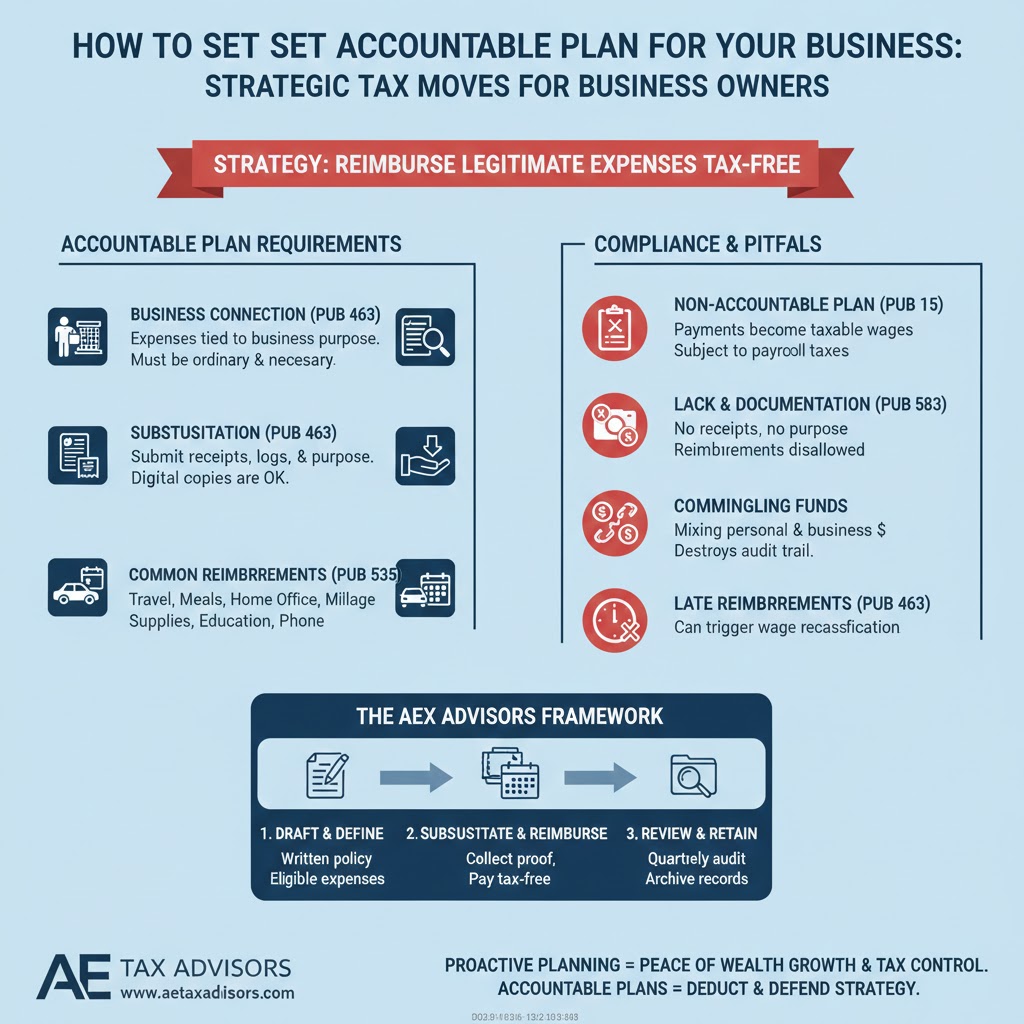
 This guide covers set accountable plan business and what it means for your tax situation.
Understanding How To Set Up An in 2026
An accountable plan is one of the cleanest, most underused tax-saving tools for small business owners. It allows your company to reimburse owners and employees for legitimate business expenses without treating the reimbursement as taxable income — if it meets specific IRS requirements.
At AE Tax Advisors, we help business owners design accountable plans that satisfy every rule outlined in IRS Publications 463, 535, and 15, ensuring reimbursements are 100% compliant and fully deductible.
This article builds on How to Deduct Your Home Office Correctly, The Ultimate Guide to Hiring Family Members in Your Business, and How to Build an Audit-Proof Recordkeeping System.
What Is an Accountable Plan?
An accountable plan is an IRS-approved reimbursement arrangement that allows a business to repay employees — including owners — for expenses incurred on behalf of the company without creating taxable income.
To qualify as accountable under Publication 463, three conditions must be met:
- The expenses have a business connection.
- The employee substantiates the expenses with records and receipts.
- The employee returns excess reimbursements within a reasonable time.
If any of these conditions are not met, the plan becomes non-accountable, and payments must be treated as taxable wages subject to payroll taxes.
AE Tax Advisors designs written accountable plan policies that spell out these rules clearly to protect clients in audits.
Why Accountable Plans Matter
Without an accountable plan, reimbursing expenses to yourself or employees can create unnecessary tax exposure.
Example:
If you’re an S-Corp owner paying personal funds for business travel and taking owner draws for reimbursement, those draws aren’t deductible. But under an accountable plan, those same reimbursements become legitimate business deductions.
That means:
- The business deducts the expense.
- You avoid reporting the reimbursement as income.
- Both sides remain compliant under Publication 535.
AE Tax Advisors uses accountable plans to help business owners recover hidden deductions like home office, mileage, phone, and supplies that they already pay personally.
Step 1: Draft a Written Accountable Plan
The IRS doesn’t require written documentation — but it’s strongly recommended. A written plan demonstrates intent and compliance, especially during audits.
Your plan should include:
- Purpose of the plan and scope of reimbursable expenses.
- Requirement for receipts and business purpose documentation.
- Procedure for submitting reimbursement requests.
- Timeline for returning excess funds.
AE Tax Advisors prepares written accountable plans customized to each entity type, ensuring they align with corporate governance and state law.
This connects with The Business Owner’s Blueprint: How to Build, Protect, and Multiply Wealth Through Entity Strategy.
Step 2: Identify Eligible Expenses
Under Publication 535, only ordinary and necessary business expenses are reimbursable. Common examples include:
- Travel, lodging, and 50% of business meals (Publication 463).
- Mileage or vehicle expenses.
- Home office usage.
- Supplies, tools, and small equipment.
- Continuing education and certifications.
- Professional dues and licenses.
- Cell phone and internet for business use.
AE Tax Advisors helps categorize expenses correctly, often combining accountable plans with reimbursement for family employees as described in The Ultimate Guide to Hiring Family Members in Your Business.
Step 3: Establish a Reimbursement Process
Every reimbursement must be documented with:
- Date, amount, and business purpose of the expense.
- Receipts or mileage logs.
- Reimbursement request submitted within a reasonable period (typically 60 days).
Publication 463 allows electronic documentation, including digital scans of receipts, emails confirming business meetings, or credit card statements.
AE Tax Advisors sets up digital reimbursement forms that can be completed and signed online, streamlining recordkeeping while maintaining compliance.
Step 4: Require Return of Excess Funds
If an employee or owner receives more reimbursement than the actual expense, the excess must be returned promptly — generally within 120 days, per Publication 463.
AE Tax Advisors builds these provisions into the written plan, specifying the repayment process and time limits clearly. This prevents reclassification of reimbursements as taxable wages.
Step 5: Implement Payroll Integration
Under Publication 15, accountable plan reimbursements are not reported on W-2s and are exempt from income, Social Security, and Medicare taxes.
Non-accountable payments, however, must be treated as wages.
AE Tax Advisors integrates accountable plan reimbursements into payroll systems to keep them distinct from salary, ensuring no errors in reporting or tax withholding.
This framework complements The Ultimate Guide to S-Corporation Salary Optimization.
Step 6: Reimburse Home Office and Utilities
The accountable plan is one of the most compliant ways to claim the home office deduction, especially for S-Corp owners who can’t take it directly on Schedule C.
AE Tax Advisors uses a monthly reimbursement model:
- Calculate square footage and percentage of home used for business.
- Apply utility, rent, or mortgage interest percentages.
- Reimburse yourself monthly via business check or transfer.
This transforms the home office deduction from a personal tax position into a corporate-level expense, consistent with Publication 587 rules.
Step 7: Reimburse Vehicle and Mileage Expenses
Mileage reimbursements under an accountable plan are tax-free to employees and deductible to the business.
Follow Publication 463 guidance:
- Maintain mileage logs with date, destination, and purpose.
- Use the current IRS mileage rate (67 cents per mile for 2025).
- Submit monthly reimbursement forms with total miles driven.
AE Tax Advisors integrates vehicle reimbursements into digital templates that calculate totals automatically and preserve compliance.
This connects directly to How to Deduct Your Vehicle the Right Way.
Step 8: Include Other Common Reimbursements
Accountable plans can cover any expense paid personally that benefits the business. Examples include:
- Internet and phone use.
- Continuing education courses.
- Professional memberships and subscriptions.
- Small tools or supplies used in operations.
Each reimbursement category must meet Publication 535’s ordinary and necessary rule and be properly substantiated.
AE Tax Advisors creates master lists of eligible categories tailored to each client’s industry.
Step 9: Keep Audit-Proof Records
All reimbursements must be supported by documentation under Publication 583. Keep:
- Receipts or digital copies.
- Approved reimbursement forms.
- Copies of payments made to employees or owners.
- Evidence that excess funds were returned when applicable.
AE Tax Advisors sets up quarterly review systems to confirm all reimbursements remain compliant.
This best practice ties to How to Build an Audit-Proof Recordkeeping System.
Step 10: Integrate with Your Tax Planning Strategy
Accountable plans work best when combined with proactive planning. AE Tax Advisors incorporates them into quarterly tax reviews to balance:
- S-Corp owner reimbursements.
- Family employee reimbursements.
- Vehicle and home office allocations.
- Travel and client entertainment deductions.
This ensures all expenses flow through one unified reimbursement system — easy to track, justify, and defend.
Common Accountable Plan Mistakes
- No written policy: While not required, it’s the easiest way to prove intent.
- Late reimbursements: Missing timeframes turn compliant payments into taxable wages.
- Missing receipts: Every expense must be substantiated.
- Personal expenses disguised as business: Will trigger reclassification.
- Failure to separate payroll and reimbursements: Creates reporting errors.
AE Tax Advisors audits every plan annually to prevent these mistakes and ensure consistent application.
AE Tax Advisors Accountable Plan Framework
- Draft a clear written accountable plan.
- List eligible reimbursement categories.
- Require receipts and written justification.
- Return excess funds promptly.
- Keep all reimbursements outside payroll.
- Store all documentation digitally and securely.
- Review and update annually for IRS compliance.
This framework aligns fully with IRS Publications 463, 535, and 15, ensuring every reimbursement is defensible and tax-efficient.
Conclusion: Pay Yourself Back, the Right Way
An accountable plan isn’t just an administrative policy — it’s a powerful financial strategy. When structured correctly, it lets business owners pay themselves back for legitimate expenses without increasing taxable income, while keeping the business fully compliant.
At AE Tax Advisors, we specialize in building compliant accountable plans that integrate seamlessly with payroll, home office, and vehicle deductions. The result is simple: cleaner books, lower taxes, and complete peace of mind.
Understanding set accountable plan business is essential for maximizing your tax savings as a real estate investor.
When it comes to set accountable plan business, working with a specialized tax advisor makes all the difference.
Many investors overlook set accountable plan business, but it can be one of the most impactful strategies in your tax plan.
At AE Tax Advisors, we help clients navigate set accountable plan business to keep more of what they earn.
Set accountable plan business is one of the most important concepts for real estate investors to understand. When properly implemented, set accountable plan business can lead to significant tax savings that compound over time.
Many high-income earners miss out on set accountable plan business opportunities simply because their CPA lacks the specialized knowledge. A proactive approach to set accountable plan business can mean the difference between overpaying and optimizing your tax position.
At AE Tax Advisors, our team specializes in set accountable plan business for real estate investors and W-2 professionals. We have helped hundreds of clients use set accountable plan business to reduce their tax burden by $50,000 or more annually.
The key to successful set accountable plan business implementation is working with an advisor who understands real estate taxation. Every set accountable plan business decision should be part of a comprehensive, multi-year tax plan.
Understanding Set accountable plan business
Related services from AE Tax Advisors: S-Corp and real estate coordination and 3-year tax lookback cleanup.
Set accountable plan business is a critical component of any comprehensive tax strategy for real estate investors. At AE Tax Advisors, we help clients navigate set accountable plan business to maximize their tax savings while maintaining full IRS compliance. Our proactive approach ensures you capture every available deduction and credit.
For official IRS guidance, visit the IRS Newsroom.