

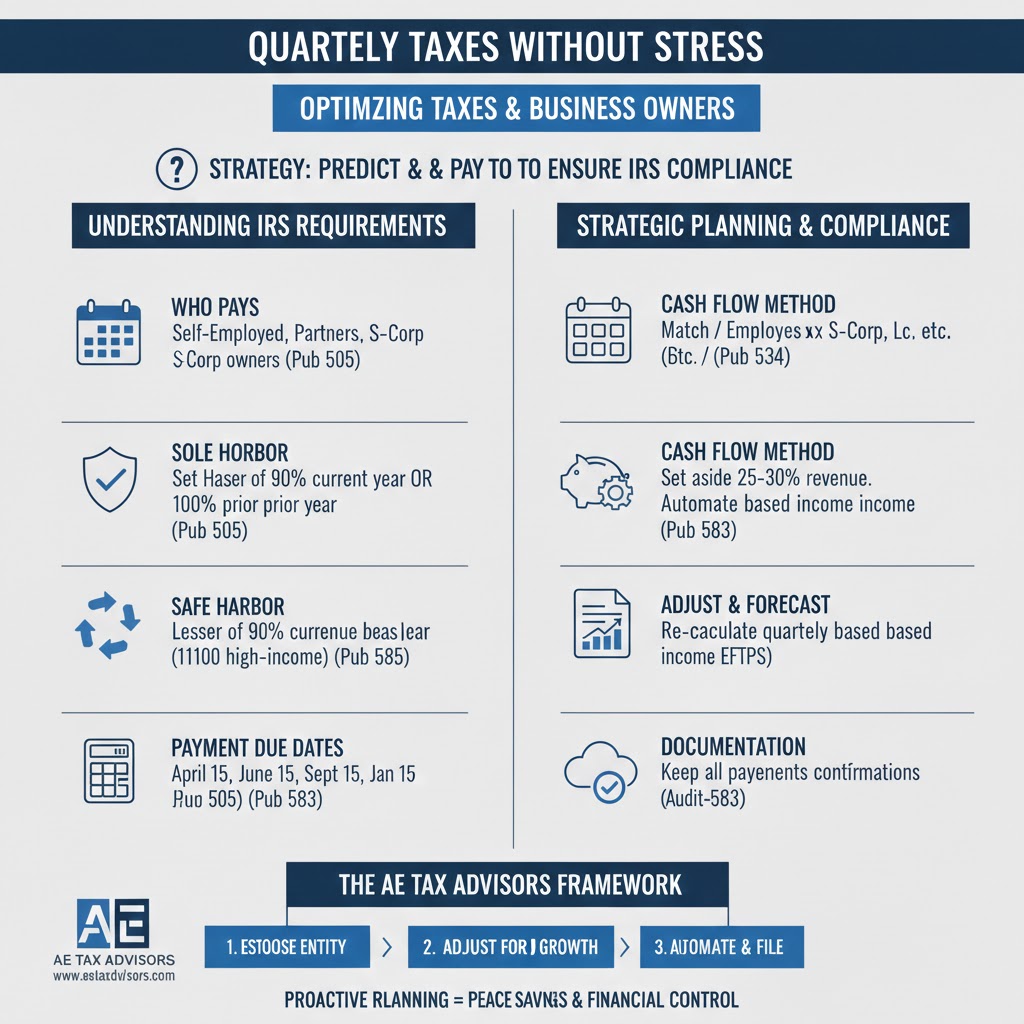
 This guide covers plan quarterly taxes without and what it means for your tax situation.
Understanding How To Plan For Quarterly in 2026
Quarterly taxes can feel like a never-ending cycle for business owners. Every few months, it’s time to write another check to the IRS — often with uncertainty about how much to pay or whether it’s even correct.
At AE Tax Advisors, we transform that chaos into clarity. Quarterly taxes don’t have to be stressful when they’re built into a predictable system. The key is to understand how the IRS calculates them, how to plan cash flow around them, and how to use them strategically to stay compliant while avoiding overpayment.
This topic connects directly to Advanced Strategies for Reducing Self-Employment Tax and How to Legally Pay Yourself from Your Business, where timing, documentation, and structure reduce both stress and taxes.
Why Quarterly Taxes Exist
The U.S. tax system runs on “pay as you go.” Instead of one big payment at year-end, the IRS expects taxpayers — including self-employed individuals, partners, and S-Corp owners — to pay taxes as income is earned throughout the year.
IRS Publication 505 explains that estimated tax payments cover not only income tax but also self-employment tax, Social Security, and Medicare. These quarterly payments ensure you meet the IRS’s “safe harbor” rules and avoid underpayment penalties.
AE Tax Advisors teaches clients how to turn these payments into a simple cash management rhythm that works in tandem with their business cycles.
Who Needs to Pay Quarterly Taxes
If you expect to owe more than $1,000 in tax when you file, you must make estimated payments unless you have enough tax withheld through payroll or other income sources. This includes:
- Sole proprietors
- Independent contractors
- Partners in a partnership
- S-Corp shareholders who receive distributions
- LLC owners taxed as any of the above
In How to Choose the Right Entity Type for Your Business, we showed how your entity affects how you pay yourself. The same principle applies to quarterly taxes — your entity determines how payments are made and what they cover.
Understanding IRS Safe Harbor Rules
Safe harbor rules prevent penalties as long as you pay the lesser of:
- 90% of the current year’s total tax liability, or
- 100% of the previous year’s tax liability (110% if adjusted gross income exceeds $150,000).
AE Tax Advisors calculates both benchmarks for each client and recommends the more conservative approach depending on income volatility. This method ensures you never underpay while maintaining optimal liquidity.
This system ties directly to How to Build a Bulletproof Audit Defense Strategy for Your Business, since accuracy and consistency in payments build long-term IRS credibility.
How to Calculate Quarterly Payments
Quarterly payments are based on your expected income, deductions, credits, and self-employment tax for the year. IRS Publication 505 provides worksheets, but AE Tax Advisors simplifies it with a proprietary formula that incorporates prior-year data, entity type, and mid-year performance.
We help clients forecast quarterly payments through three simple steps:
- Estimate total income and deductions for the year.
- Calculate total expected tax and divide by four.
- Adjust quarterly based on actual business performance.
This ongoing recalibration echoes the philosophy from Why Every Business Owner Needs a Tax Advisor Year-Round: tax planning is continuous, not seasonal.
Timing Your Payments
Quarterly taxes are due four times each year:
- April 15 (Q1)
- June 15 (Q2)
- September 15 (Q3)
- January 15 (Q4 of the previous year)
AE Tax Advisors encourages clients to automate payments through the Electronic Federal Tax Payment System (EFTPS) or IRS Direct Pay to prevent missed deadlines. These systems create digital confirmation receipts that also serve as audit documentation under Publication 583.
By integrating these into your bookkeeping software, you create automatic proof of compliance — one of the simplest ways to reduce future audit risk.
Managing Cash Flow Around Quarterly Payments
The biggest stress for business owners isn’t the payment itself — it’s the timing. Cash flow fluctuations make it difficult to set aside consistent amounts. AE Tax Advisors recommends a “percentage method”: automatically transferring a fixed percentage of revenue (often 25–30%) to a dedicated tax account each time funds are received.
This method, discussed in How AE Tax Advisors Helps You Keep More of What You Earn, ensures you never scramble to find funds when quarterly payments are due.
By treating taxes like a recurring business expense, you stabilize your operations and eliminate financial anxiety.
Using Entity Structure to Simplify Tax Payments
Your entity type determines how quarterly taxes are handled:
- Sole Proprietors/Single-Member LLCs: Pay quarterly using Form 1040-ES.
- Partnerships: Partners make individual quarterly payments on their K-1 share.
- S-Corps: The corporation withholds payroll taxes; shareholders pay estimated taxes on distributions.
- C-Corps: Make quarterly payments at the entity level using Form 1120-W.
AE Tax Advisors structures your entity and payroll system so payments flow automatically. In How to Legally Pay Yourself from Your Business, we explained that payroll withholding reduces quarterly payment pressure for S-Corp owners by handling much of the liability through wages.
Integrating Quarterly Taxes with Your Bookkeeping
The easiest way to ensure accuracy is to tie quarterly payments directly into your bookkeeping. Each payment should be recorded as a liability reduction or owner draw, depending on your structure.
AE Tax Advisors sets up chart-of-accounts categories that mirror IRS line items, simplifying year-end reconciliation and audit documentation. This process mirrors the precision we use in The Top Tax Write-Offs Most Small Businesses Miss — organization turns complexity into clarity.
Adjusting for Income Fluctuations
Seasonal businesses or variable-income professionals often overpay or underpay estimated taxes because they don’t update their projections. AE Tax Advisors reviews financials quarterly to adjust estimates dynamically.
When income rises, we increase payments to avoid underpayment penalties. When income drops, we scale back to preserve cash flow. This adaptive strategy keeps clients in control year-round.
This approach builds on the adaptive forecasting model discussed in Advanced Strategies for Reducing Self-Employment Tax, where timing and planning drive efficiency.
Leveraging Retirement and Deductions to Offset Quarterly Taxes
If your quarterly taxes feel too high, the problem may not be the payments — it’s the lack of deductions. Contributions to retirement plans (under Publication 560) and pre-tax health accounts can reduce your quarterly tax base.
AE Tax Advisors aligns these contributions with payment schedules, helping clients coordinate cash flow and tax savings simultaneously. For example, making a large SEP IRA contribution before your Q4 estimate can reduce both income tax and self-employment tax immediately.
This integration also crosslinks with How to Build a Tax-Advantaged Retirement Plan for Business Owners, where retirement strategy and quarterly planning intersect perfectly.
Avoiding Common Quarterly Tax Mistakes
- Forgetting to pay Q4 in January: Many owners assume it’s due in December.
- Failing to adjust for growth: Sticking to outdated estimates leads to penalties.
- Overpaying without reviewing deductions: Causes unnecessary cash strain.
- Ignoring state estimated taxes: Several states require separate filings.
- Mixing business and personal accounts: Creates recordkeeping confusion under Publication 583.
AE Tax Advisors audits every client’s prior-year payment pattern to ensure all amounts are documented and credited correctly to avoid duplication or missed payments.
How AE Tax Advisors Simplifies the Process
We combine compliance, automation, and education:
- Compliance: All calculations follow Publication 505 standards.
- Automation: EFTPS scheduling eliminates manual errors.
- Education: Clients understand why each payment matters.
Our system keeps your tax payments aligned with your business performance, not arbitrary guesses.
This model is an extension of the principle from The Difference Between Tax Preparation and Tax Planning: smart systems eliminate stress before it begins.
Documentation That Protects You
Every quarterly payment should be documented with the confirmation number, date, and amount. AE Tax Advisors maintains cloud-based folders that sync with bookkeeping systems, ensuring complete traceability.
During audits or financial reviews, these records demonstrate consistent compliance and payment history—often closing inquiries before they escalate.
This step parallels the audit readiness process outlined in How to Build a Bulletproof Audit Defense Strategy for Your Business.
The AE Tax Advisors Quarterly Tax Planning Framework
- Estimate total income for the year based on current data.
- Calculate expected tax using prior-year and year-to-date results.
- Apply IRS safe harbor rules to avoid penalties.
- Automate payments via EFTPS or payroll withholding.
- Review and adjust quarterly based on performance.
- Maintain full digital documentation for every transaction.
This disciplined process removes the guesswork and ensures you’re always one step ahead of IRS deadlines.
Conclusion: Turn Quarterly Taxes into a Predictable System
Quarterly taxes aren’t random—they’re routine. When managed strategically, they become just another line item in your business budget, not a recurring source of anxiety.
At AE Tax Advisors, we use IRS Publications 505 and 583 as the foundation for your quarterly tax plan. By aligning structure, timing, and documentation, we make tax season predictable — not painful.
Whether you’re a new business owner or a seasoned entrepreneur, consistent quarterly planning is the difference between stress and stability. When your taxes are handled with precision, your business runs smoother, your records stay cleaner, and your confidence grows stronger with every quarter.
Understanding plan quarterly taxes without is essential for maximizing your tax savings as a real estate investor.
When it comes to plan quarterly taxes without, working with a specialized tax advisor makes all the difference.
Many investors overlook plan quarterly taxes without, but it can be one of the most impactful strategies in your tax plan.
At AE Tax Advisors, we help clients navigate plan quarterly taxes without to keep more of what they earn.
Plan quarterly taxes without is one of the most important concepts for real estate investors to understand. When properly implemented, plan quarterly taxes without can lead to significant tax savings that compound over time.
Many high-income earners miss out on plan quarterly taxes without opportunities simply because their CPA lacks the specialized knowledge. A proactive approach to plan quarterly taxes without can mean the difference between overpaying and optimizing your tax position.
At AE Tax Advisors, our team specializes in plan quarterly taxes without for real estate investors and W-2 professionals. We have helped hundreds of clients use plan quarterly taxes without to reduce their tax burden by $50,000 or more annually.
The key to successful plan quarterly taxes without implementation is working with an advisor who understands real estate taxation. Every plan quarterly taxes without decision should be part of a comprehensive, multi-year tax plan.
If you are not actively using plan quarterly taxes without as part of your tax strategy, you are likely leaving money on the table. Contact AE Tax Advisors to learn how plan quarterly taxes without can work for your specific situation.
Understanding Plan quarterly taxes without
Related services from AE Tax Advisors: entity structuring for rental portfolios and 1031 exchange coordination.
Plan quarterly taxes without is a critical component of any comprehensive tax strategy for real estate investors. At AE Tax Advisors, we help clients navigate plan quarterly taxes without to maximize their tax savings while maintaining full IRS compliance. Our proactive approach ensures you capture every available deduction and credit.
For official IRS guidance, visit the IRS Newsroom.