

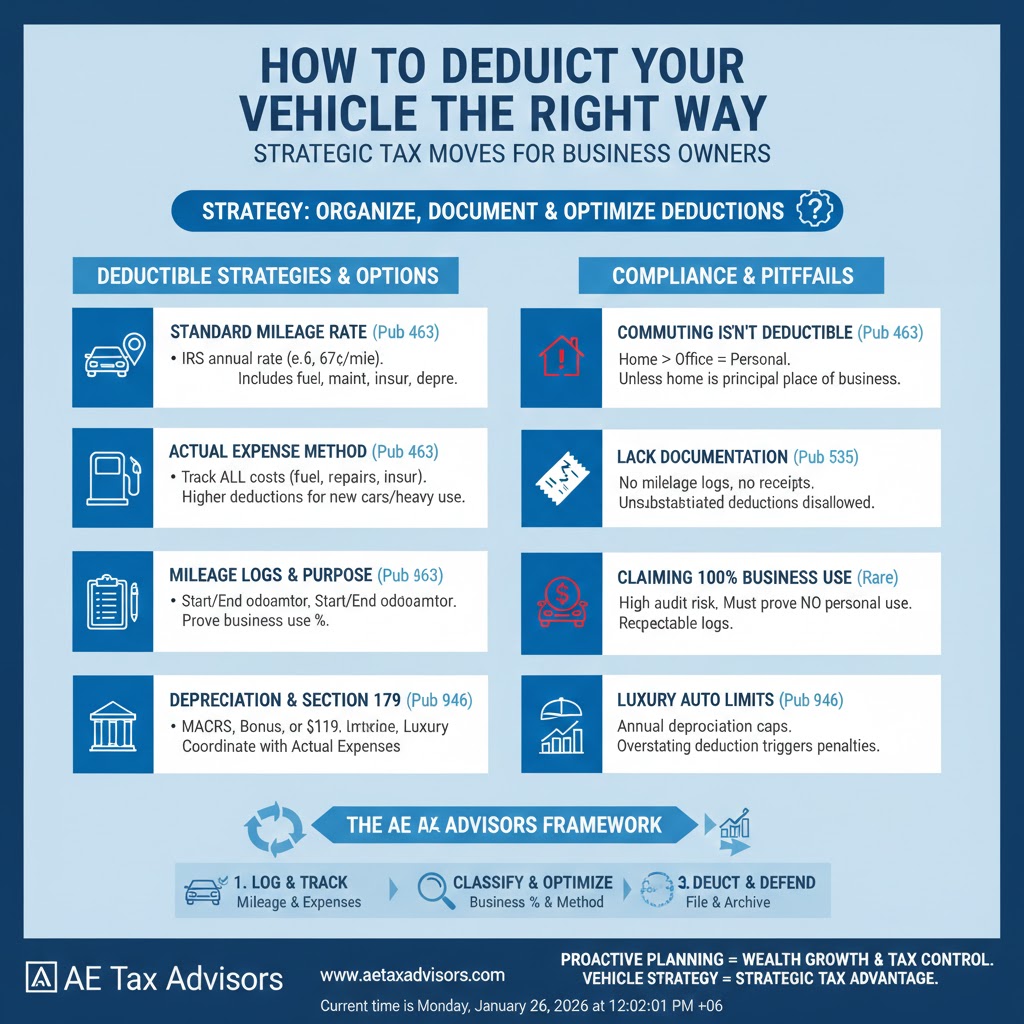
 This guide covers deduct vehicle right way and what it means for your tax situation.
Understanding How To Deduct Your Vehicle in 2026
A business vehicle can be one of the most valuable tax tools for entrepreneurs — if you do it right. The IRS allows generous deductions for vehicles used in business, but the rules are specific and documentation-heavy. One mistake in how you track or claim these expenses can lead to disallowed deductions or worse, penalties.
At AE Tax Advisors, we help business owners navigate the exact IRS standards for vehicle deductions — including mileage tracking, depreciation methods, and the difference between personal and business use.
This article ties into How to Legally Deduct Meals, Travel, and Entertainment, Top 25 Deductions Most Small Business Owners Miss, and How to Build an Audit-Proof Recordkeeping System.
The Two Legal Methods for Vehicle Deductions
The IRS provides two primary options for deducting business vehicle costs under Publication 463:
- Standard Mileage Rate:
You multiply business miles driven by the annual IRS rate (for 2025, it’s expected to remain near 67 cents per mile). This method simplifies recordkeeping and includes depreciation, fuel, maintenance, insurance, and repairs. - Actual Expense Method:
You track every cost — gas, maintenance, insurance, registration, repairs, and depreciation — and deduct the business-use percentage.
AE Tax Advisors helps clients calculate both options to determine which yields the higher deduction. For newer vehicles or those with heavy business use, actual expenses plus depreciation under Publication 946 often provide greater savings.
Step 1: Determine Business Use Percentage
You can only deduct expenses proportionate to business use. To prove this, you must keep a mileage log recording:
- Date and destination of each trip.
- Purpose of the trip (client meeting, delivery, inspection, etc.).
- Starting and ending mileage for each day.
Publication 463 requires these logs to substantiate the deduction. AE Tax Advisors offers digital tracking tools that sync directly with accounting software, eliminating manual entry.
For example, if you drive 15,000 miles in a year and 10,500 are for business, 70% of your total vehicle costs are deductible.
Step 2: Understand What Qualifies as Business Use
Common deductible uses include:
- Driving to meet clients or customers.
- Visiting job sites or business properties.
- Picking up supplies or making bank deposits.
- Attending off-site meetings or conferences.
Commuting from home to your regular workplace does not count as business mileage, per Publication 463. However, if your home qualifies as your principal place of business (as defined in Publication 587), then driving from home to clients can qualify.
This clarification connects directly to How AE Tax Advisors Helps You Keep More of What You Earn.
Step 3: Track and Substantiate Every Expense
If you choose the actual expense method, record and keep receipts for:
- Gas, oil, and maintenance.
- Tires and parts.
- Insurance and registration fees.
- Lease payments or loan interest.
- Parking and tolls (100% deductible for business).
- Depreciation or Section 179 deduction.
AE Tax Advisors structures clients’ expense tracking through categorized ledgers that mirror IRS documentation standards from Publication 535, ensuring each expense is defensible during an audit.
Step 4: Apply Depreciation Rules Correctly
Vehicles used for business can be depreciated under Publication 946, which defines recovery periods and deduction limits. You can choose from:
- MACRS depreciation over 5 years.
- Section 179 expensing up to the annual limit (typically over $25,000).
- Bonus depreciation for new or qualifying used vehicles.
However, luxury auto limits apply — the IRS caps the annual depreciation based on vehicle type and cost. AE Tax Advisors calculates these limits precisely to prevent overstatement while maximizing write-offs.
This step connects directly to How to Structure Depreciation for Maximum Tax Savings.
Step 5: Document Personal vs. Business Use
If you use the same vehicle for both personal and business purposes, only the business-use percentage is deductible.
Example:
- Total miles: 12,000
- Business miles: 9,000
- Business use = 75%
If your annual expenses total $10,000, you can deduct $7,500.
AE Tax Advisors encourages clients to maintain separate vehicles for business and personal use when possible, simplifying recordkeeping and strengthening compliance.
Step 6: Consider Leasing vs. Buying
Both lease and purchase options offer strong tax advantages, but the benefits differ:
- Leasing: You deduct the business-use portion of lease payments, insurance, and maintenance. However, if the car’s value exceeds a threshold, you may need to reduce deductions using the IRS “lease inclusion amount” under Publication 463.
- Buying: You can take Section 179 and bonus depreciation, but depreciation ends once the vehicle is sold or traded.
AE Tax Advisors compares both paths annually for clients, ensuring deductions align with cash flow and long-term strategy.
Step 7: Include Electric and Hybrid Vehicle Credits
Electric vehicles (EVs) may qualify for additional credits under IRC Section 30D, reducing tax liability directly. While not part of Publication 463, the IRS lists qualifying EVs each year. AE Tax Advisors integrates these credits with your depreciation and expense schedules to maximize combined benefit.
This connects with The Tax-Free Empire: How to Build Wealth Without Paying More Than You Legally Owe.
Step 8: Avoid Common Audit Triggers
Vehicle deductions are among the most audited business expenses. Avoid these errors:
- Missing mileage logs: The IRS denies unsubstantiated mileage, even if estimates seem reasonable.
- Commuting disguised as business use: Only client or job site trips qualify.
- Claiming 100% business use: Extremely rare and often challenged.
- Deducting luxury car payments beyond limits: Must adhere to depreciation caps in Publication 946.
- No receipts for actual expenses: All costs must be supported by documentation.
AE Tax Advisors trains clients to review vehicle expenses quarterly to ensure consistency before filing.
Step 9: Reimburse Employee Use Properly
If employees use personal cars for business, reimburse them using the standard mileage rate under an accountable plan. These reimbursements are deductible for the business and non-taxable to the employee, as long as proper logs are maintained.
Publication 463 details accountable plan rules. AE Tax Advisors structures these plans for corporations to reduce payroll tax exposure.
This ties into The Ultimate Guide to S-Corporation Salary Optimization.
Step 10: Record Retention and Audit Readiness
Vehicle records should be retained for at least three years after filing, though AE Tax Advisors recommends five. Keep:
- Mileage logs.
- Receipts and invoices.
- Loan or lease agreements.
- Proof of payment for registration and insurance.
- Depreciation schedules and Section 179 election forms.
Publication 583 reinforces these retention timelines for all business assets.
AE Tax Advisors integrates vehicle data into your digital recordkeeping system, ensuring IRS-ready transparency at any time.
Example: Comparing Deduction Methods
Let’s compare a simple scenario:
Vehicle Cost: $50,000
Business Use: 80%
Annual Mileage: 20,000 (16,000 business miles)
Standard Mileage Method:
16,000 x 67¢ = $10,720 deduction.
Actual Expense Method:
Fuel, insurance, maintenance: $6,000
Depreciation (Section 179): $10,000
Total = $16,000 x 80% = $12,800 deduction.
AE Tax Advisors runs these comparisons each year to ensure clients take the better option based on evolving IRS rates.
AE Tax Advisors Vehicle Deduction Framework
- Track mileage daily with a log or digital app.
- Record every expense and keep supporting receipts.
- Calculate business-use percentage quarterly.
- Choose between mileage or actual expense methods.
- Apply depreciation correctly using Publication 946.
- Retain all records for at least five years.
- Review deductions annually with your advisor.
This system aligns fully with IRS Publications 463, 946, and 535, creating compliance and maximum savings.
Conclusion: Drive Your Deduction Strategically
Your vehicle isn’t just transportation — it’s a legitimate business asset that, when documented correctly, reduces your tax bill year after year.
At AE Tax Advisors, we help business owners calculate, document, and optimize vehicle deductions with precision. From mileage logs to depreciation schedules, every mile and every dollar should count — legally, efficiently, and strategically.
Understanding deduct vehicle right way is essential for maximizing your tax savings as a real estate investor.
When it comes to deduct vehicle right way, working with a specialized tax advisor makes all the difference.
Many investors overlook deduct vehicle right way, but it can be one of the most impactful strategies in your tax plan.
At AE Tax Advisors, we help clients navigate deduct vehicle right way to keep more of what they earn.
Deduct vehicle right way is one of the most important concepts for real estate investors to understand. When properly implemented, deduct vehicle right way can lead to significant tax savings that compound over time.
Many high-income earners miss out on deduct vehicle right way opportunities simply because their CPA lacks the specialized knowledge. A proactive approach to deduct vehicle right way can mean the difference between overpaying and optimizing your tax position.
At AE Tax Advisors, our team specializes in deduct vehicle right way for real estate investors and W-2 professionals. We have helped hundreds of clients use deduct vehicle right way to reduce their tax burden by $50,000 or more annually.
The key to successful deduct vehicle right way implementation is working with an advisor who understands real estate taxation. Every deduct vehicle right way decision should be part of a comprehensive, multi-year tax plan.
Understanding Deduct vehicle right way
Related services from AE Tax Advisors: short-term rental tax planning and discover how AE Tax Advisors can help.
Deduct vehicle right way is a critical component of any comprehensive tax strategy for real estate investors. At AE Tax Advisors, we help clients navigate deduct vehicle right way to maximize their tax savings while maintaining full IRS compliance. Our proactive approach ensures you capture every available deduction and credit.
For official IRS guidance, visit the IRS Newsroom.