

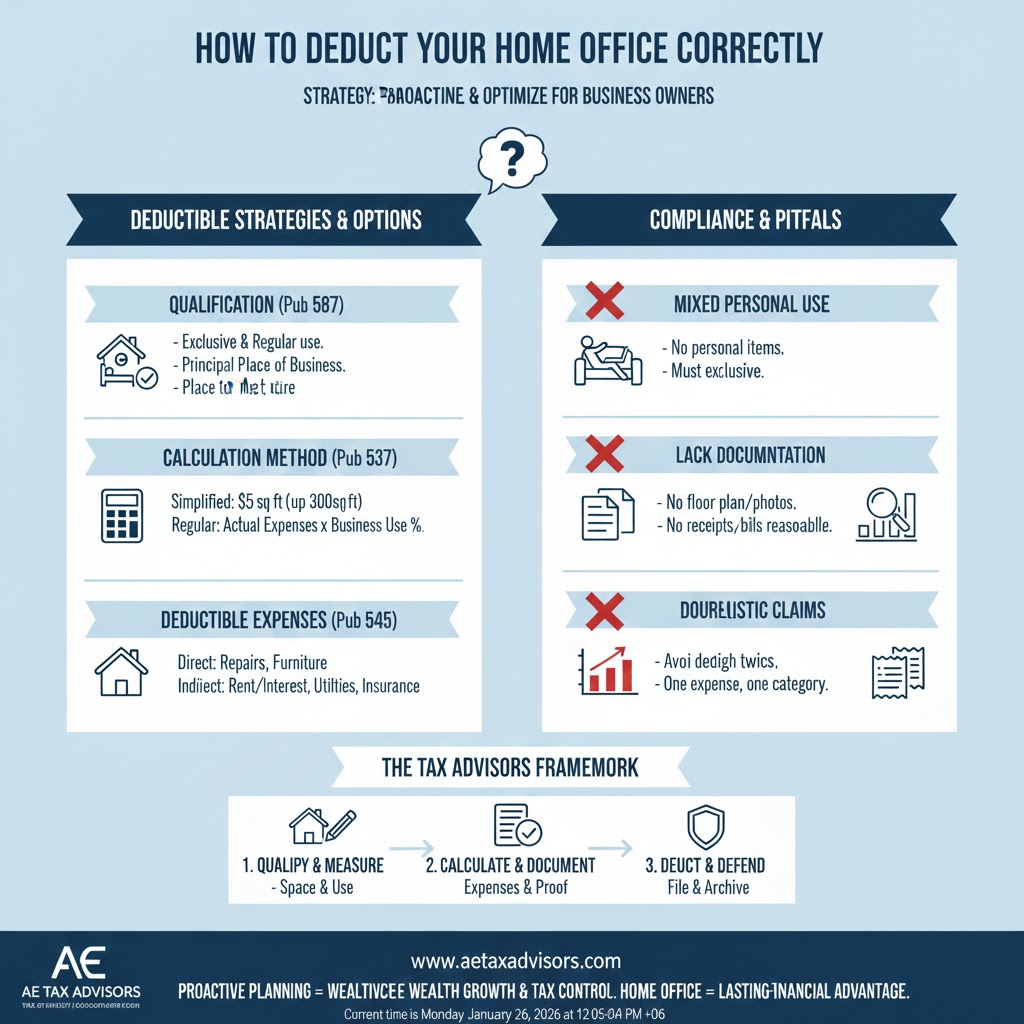
 This guide covers deduct home office correctly and what it means for your tax situation.
Understanding How To Deduct Your Home in 2026
For millions of small business owners, the home office deduction represents one of the most powerful yet misunderstood tax opportunities. When applied properly, it can turn ordinary household expenses—like rent, utilities, and repairs—into legitimate business deductions. When applied incorrectly, it can trigger red flags.
At AE Tax Advisors, we help clients apply the home office deduction the right way: compliant, consistent, and fully backed by IRS standards. This article will show you how to calculate it, document it, and integrate it into your overall business tax plan safely.
This article builds on How to Deduct Your Vehicle the Right Way, Top 25 Deductions Most Small Business Owners Miss, and How to Build an Audit-Proof Recordkeeping System.
Why the Home Office Deduction Exists
The IRS recognizes that many small businesses operate partially or entirely from home. Publication 587 allows a deduction for business use of a home if a portion is used exclusively and regularly for business purposes.
The key phrase is “exclusive and regular use.” Occasional or mixed personal use disqualifies the space. The rule ensures fairness by distinguishing legitimate business operations from personal living space.
AE Tax Advisors helps clients document the exclusive use test through photos, floor plans, and utility tracking to ensure their deduction stands up under scrutiny.
Step 1: Determine If You Qualify
To qualify under Publication 587, your home office must meet one of the following criteria:
- Principal place of business: You conduct administrative or management tasks there (billing, scheduling, bookkeeping).
- Place to meet clients or customers: You physically see clients at your home.
- Separate structure: A detached garage, studio, or workshop used exclusively for business.
AE Tax Advisors reviews your business model to confirm qualification before calculating the deduction.
This ties into The Business Owner’s Blueprint: How to Build, Protect, and Multiply Wealth Through Entity Strategy.
Step 2: Choose Your Calculation Method
There are two ways to calculate the deduction under Publication 587:
Simplified Method:
- $5 per square foot, up to 300 square feet (maximum $1,500).
- No need to track detailed expenses.
- Ideal for sole proprietors and small offices.
Regular Method:
- Calculate actual expenses and multiply by the business-use percentage of your home.
- Requires tracking utilities, rent, insurance, and maintenance.
- Potentially much higher deduction but requires documentation.
AE Tax Advisors runs both calculations to determine which method maximizes savings while maintaining audit safety.
Step 3: Measure Your Business Space
If using the regular method, measure the portion of your home used exclusively for business. For example:
- Total home size: 2,000 sq. ft.
- Office size: 200 sq. ft.
- Business use percentage: 10%.
That 10% applies to allowable expenses. AE Tax Advisors helps clients document this with floor plans and photographic proof in case of audit questions.
Step 4: Identify Deductible Expenses
Publication 587 divides home office expenses into two categories:
Direct expenses: Costs exclusively for the office space (painting, repairs, or new furniture). Deductible in full.
Indirect expenses: Costs for the entire home, prorated by business-use percentage. This includes:
- Rent or mortgage interest
- Utilities (electricity, gas, water, trash)
- Insurance
- Repairs and maintenance
- Internet and phone service
Publication 535 confirms these expenses as deductible when related to business use.
AE Tax Advisors builds spreadsheets to track and allocate each expense consistently throughout the year.
Step 5: Include Depreciation for Owned Homes
If you own your home, you may also deduct depreciation for the business-use portion. Publication 946 explains how to calculate depreciation over 39 years for residential property.
For example:
- Home value (excluding land): $300,000
- Office use: 10%
- Depreciable basis: $30,000
- Annual deduction: $769 (approximate using straight-line depreciation).
AE Tax Advisors calculates these figures precisely and integrates them with your real estate and entity strategy, discussed in Real Estate Inside the Business: The Overlooked Wealth Strategy of the 1%.
Step 6: Keep Detailed Documentation
Documentation is what protects you. To support your deduction under Publication 583, retain:
- Floor plan with office area labeled.
- Receipts and utility bills.
- Photos showing exclusive business use.
- Logs of work activities performed in the space.
AE Tax Advisors maintains digital client folders with all supporting evidence, ensuring complete audit readiness.
Step 7: Include Shared Use Items
Some expenses may be partially deductible, such as:
- Internet service (estimate business vs. personal use).
- Cell phone (if used for business calls).
- Cleaning services (apply business-use percentage).
AE Tax Advisors ensures consistency by applying the same allocation ratio across all categories, which the IRS looks for in compliance reviews.
Step 8: Avoid Common Mistakes
The home office deduction is legal and common, but errors can lead to disallowance. Avoid:
- Mixed-use rooms — no personal furniture, TVs, or beds in the office.
- Double-dipping — don’t deduct the same expense twice under business and personal categories.
- No records — undocumented claims are automatically disallowed.
- Unrealistic percentages — claiming 50% of your home for business will invite scrutiny.
- Failure to adjust annually — your space and expenses may change; update yearly.
AE Tax Advisors runs annual reviews to validate square footage and new expense levels for returning clients.
Step 9: Coordinate with Entity Structure
If your business is an S-Corporation or partnership, you can still deduct home office expenses through an accountable plan. The business reimburses you personally for the use of your home.
This strategy maintains compliance with Publication 463 and Publication 535, allowing the business to claim the deduction while you avoid reporting the reimbursement as income.
AE Tax Advisors sets up formal reimbursement policies that satisfy both IRS and state-level requirements.
This method aligns with The Ultimate Guide to S-Corporation Salary Optimization.
Step 10: Recalculate When You Move or Remodel
If you move homes or modify your workspace, you must recalculate your square footage and expenses. The IRS considers each location change a new deduction start date under Publication 587.
AE Tax Advisors updates all calculations and depreciation schedules mid-year to maintain accuracy and compliance.
Step 11: Combine With Other Business Deductions
The home office deduction complements other major write-offs:
- Vehicle deductions: trips from your home office to clients are now business mileage.
- Utilities and supplies: consistent recordkeeping streamlines reporting.
- Depreciation: combined schedules show a full picture of your asset use.
AE Tax Advisors integrates all of these into a single recordkeeping framework, ensuring your home office deduction aligns with your broader business structure.
This links directly to How to Deduct Your Vehicle the Right Way and How to Build an Audit-Proof Recordkeeping System.
AE Tax Advisors Home Office Compliance Framework
- Confirm qualification through exclusive and regular use.
- Measure the workspace accurately and record proof.
- Choose between simplified or regular calculation.
- Track and allocate all indirect expenses consistently.
- Document all evidence, from receipts to photos.
- Adjust annually or after any move.
- Integrate reimbursement if structured as an S-Corp.
This framework aligns with IRS Publications 587, 535, and 946, ensuring compliance and audit resilience.
Conclusion: The Home Office Is a Legitimate Business Tool
The home office deduction isn’t a loophole—it’s recognition that modern business often starts at home. When handled properly, it’s one of the cleanest, most defensible deductions in the entire tax code.
At AE Tax Advisors, we help business owners calculate, document, and defend this deduction every year. With the right records and structure, your home can serve double duty—as a productive workspace and a tax-saving asset.
Understanding deduct home office correctly is essential for maximizing your tax savings as a real estate investor.
When it comes to deduct home office correctly, working with a specialized tax advisor makes all the difference.
Many investors overlook deduct home office correctly, but it can be one of the most impactful strategies in your tax plan.
At AE Tax Advisors, we help clients navigate deduct home office correctly to keep more of what they earn.
Deduct home office correctly is one of the most important concepts for real estate investors to understand. When properly implemented, deduct home office correctly can lead to significant tax savings that compound over time.
Many high-income earners miss out on deduct home office correctly opportunities simply because their CPA lacks the specialized knowledge. A proactive approach to deduct home office correctly can mean the difference between overpaying and optimizing your tax position.
At AE Tax Advisors, our team specializes in deduct home office correctly for real estate investors and W-2 professionals. We have helped hundreds of clients use deduct home office correctly to reduce their tax burden by $50,000 or more annually.
The key to successful deduct home office correctly implementation is working with an advisor who understands real estate taxation. Every deduct home office correctly decision should be part of a comprehensive, multi-year tax plan.
Understanding Deduct home office correctly
Related services from AE Tax Advisors: 3-year tax lookback cleanup and real estate professional status support.
Deduct home office correctly is a critical component of any comprehensive tax strategy for real estate investors. At AE Tax Advisors, we help clients navigate deduct home office correctly to maximize their tax savings while maintaining full IRS compliance. Our proactive approach ensures you capture every available deduction and credit.
For official IRS guidance, visit the IRS Newsroom.