

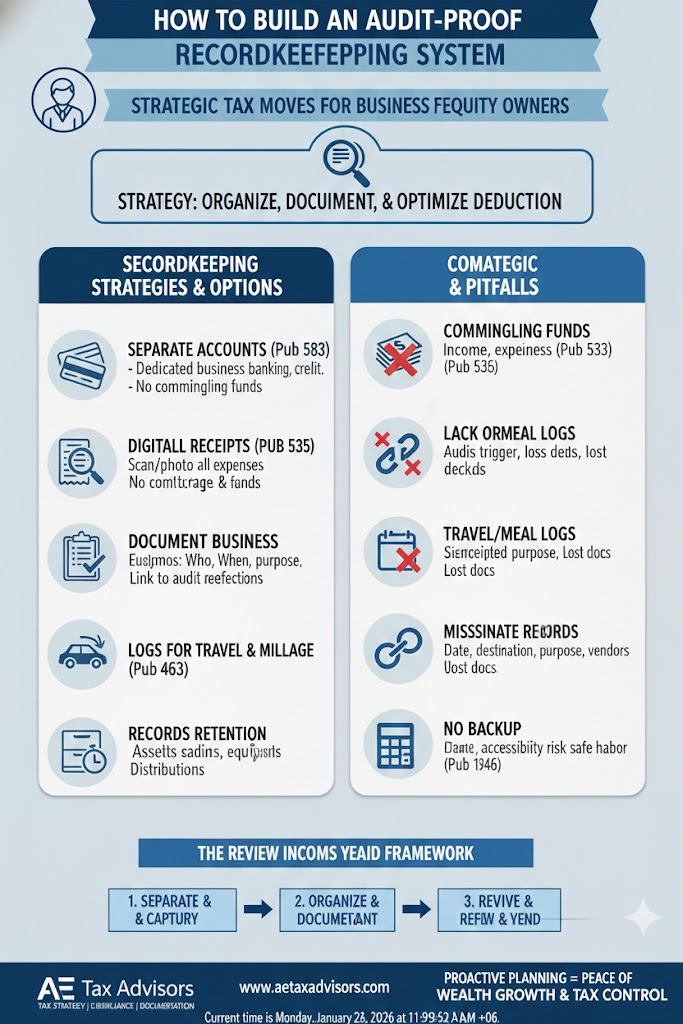
 This guide covers build audit-proof recordkeeping system and what it means for your tax situation.
Understanding How To Build An Audit-proof in 2026
When the IRS audits a business, the question isn’t whether you claimed the right deductions — it’s whether you can prove them. Documentation is everything. Without it, even legitimate write-offs can be denied.
At AE Tax Advisors, we teach clients how to create audit-proof recordkeeping systems that not only meet IRS standards but actually make filing easier and more profitable. This isn’t about fear — it’s about control. An organized system turns your records into your best defense and your strongest financial tool.
This article builds on The Ultimate Tax Checklist for Small Business Owners and Top 25 Deductions Most Small Business Owners Miss, bringing the AE Tax Advisors compliance philosophy into focus: document, defend, and deduct.
Why Recordkeeping Matters More Than Ever
The IRS audits a small percentage of businesses each year, but those with incomplete documentation face a high risk of adjustment. IRS Publication 583 sets the standard for business recordkeeping, stating that taxpayers must keep records that “clearly show income, deductions, and credits.”
The purpose is simple: your books should tell the story of your business. Every transaction must have a paper or digital trail — not only for the IRS but for lenders, investors, and even future buyers.
AE Tax Advisors helps clients design systems that meet both compliance and operational needs. With proper organization, your tax return becomes a reflection of verified business activity — not guesswork.
Step 1: Separate Business and Personal Accounts
The first rule of audit-proofing is separation. Never mix personal and business funds.
- Open dedicated business checking and savings accounts.
- Use a business credit card exclusively for business expenses.
- Deposit all business income into business accounts only.
Publication 583 emphasizes this separation as foundational to proving business intent. AE Tax Advisors audits client account activity quarterly to ensure this rule is never broken — because commingling funds can unravel even the cleanest return.
This principle aligns directly with How to Use a Holding Company to Protect and Grow Your Wealth and The 3-Entity Structure Every Business Owner Should Know.
Step 2: Digitize Everything
The IRS accepts digital copies of receipts and records. Paper fades; data doesn’t. Build a system that stores everything electronically.
- Use cloud platforms like Google Drive, Dropbox, or QuickBooks Online.
- Scan receipts immediately or snap photos using mobile apps.
- Keep PDFs of bank statements, contracts, invoices, and payroll reports.
Publication 583 explicitly allows digital records as long as they’re legible and accessible. AE Tax Advisors implements naming conventions (e.g., “2025-01-12_OfficeSupplies_Staples_$42.99”) to make every file searchable.
Step 3: Document the Business Purpose
For every deduction, the business purpose must be clear. This rule comes from Publication 535, which defines deductible expenses as those “ordinary and necessary” in your trade or business.
AE Tax Advisors encourages clients to add a short memo when saving receipts — for example:
- “Client lunch with John Smith to discuss Q2 marketing.”
- “Airfare to Dallas for vendor negotiation.”
- “Subscription renewal for CRM software used in daily operations.”
If the business connection is obvious from context, you’re protected. If it’s ambiguous, that small note can make all the difference.
This step complements The Difference Between Tax Preparation and Tax Planning, where intent and timing turn expenses into strategic deductions.
Step 4: Maintain Transaction-Level Detail
Each income and expense item should have four layers of documentation:
- Proof of payment (bank or credit card statement).
- Invoice or receipt showing details.
- Business purpose note.
- Accounting entry matching the transaction.
AE Tax Advisors sets up digital folders for each year with subfolders for Income, Expenses, Payroll, Assets, and Legal. This structure mirrors Publication 583 guidelines for small business bookkeeping systems.
Step 5: Keep Logs for Travel, Meals, and Vehicles
Travel and mileage deductions are common audit triggers. Under Publication 463, you must record:
- Date, destination, and purpose of each trip.
- Odometer readings (if deducting mileage).
- Receipts for airfare, lodging, and meals.
AE Tax Advisors supplies clients with standardized travel logs and integrates them into accounting systems so expenses flow directly into year-end summaries.
This process connects with Top 25 Deductions Most Small Business Owners Miss and How AE Tax Advisors Helps You Keep More of What You Earn.
Step 6: Track Assets and Depreciation
Businesses must maintain records for assets like equipment, property, and vehicles until the asset is fully depreciated and later sold.
Each record should include:
- Date placed in service.
- Purchase price and vendor.
- Depreciation method and recovery period.
- Sale or disposal date and proceeds.
Publication 946 covers depreciation details, but Publication 583 stresses that asset documentation is required to support deductions and calculate gain or loss on sale. AE Tax Advisors creates depreciation schedules that update automatically through your accounting system.
This ties directly to How to Structure Depreciation for Maximum Tax Savings.
Step 7: Maintain Payroll and Contractor Records
Under Publication 15, employers must keep payroll records for at least four years, including:
- W-2s, W-3s, and 941 filings.
- Proof of tax deposits.
- Time sheets or pay calculations.
For contractors, retain W-9 forms, contracts, and 1099-NEC filings. AE Tax Advisors reconciles these records quarterly to prevent mismatches between forms and tax filings — one of the most common audit red flags.
This process supports best practices discussed in The Ultimate Guide to S-Corporation Salary Optimization.
Step 8: Save All Legal and Financial Documents
Beyond receipts, keep copies of:
- Articles of Organization and Operating Agreements.
- EIN and tax election filings.
- Licenses, permits, and insurance policies.
- Contracts and lease agreements.
- Loan and financing documents.
Publication 583 recommends retaining these indefinitely as they establish ownership, basis, and authority. AE Tax Advisors organizes them in a “Corporate Records” folder within your main archive.
This structure connects with How to Build, Protect, and Multiply Wealth Through Entity Strategy.
Step 9: Back Up Everything
An audit-proof system must survive data loss. Implement both cloud and offline backups.
- Cloud backup: Google Drive, OneDrive, or QuickBooks Online.
- Local backup: external hard drive stored securely offsite.
IRS regulations allow electronic records as long as they’re accessible for inspection. AE Tax Advisors sets up automatic weekly backups for all digital files to meet retention standards.
Step 10: Follow Record Retention Timelines
The IRS generally requires you to keep records for at least three years from the filing date, but certain documents must be retained longer:
- 7 years for bad debt or worthless securities.
- 6 years if you underreported income by more than 25%.
- Indefinitely for asset basis, entity formation, or ownership records.
Publication 583 provides the full retention chart. AE Tax Advisors customizes retention policies for each client based on entity type and state laws.
Step 11: Automate Categorization and Review Quarterly
Automation ensures consistency. AE Tax Advisors configures accounting software rules that auto-categorize recurring expenses like rent, utilities, and software subscriptions. Quarterly reviews confirm everything aligns with Publication 535 deductibility standards.
This step ties to The Difference Between Tax Preparation and Tax Planning and How AE Tax Advisors Helps You Keep More of What You Earn.
Step 12: Conduct a Pre-Audit Review
An internal review before filing can uncover missing documentation or duplicate entries. AE Tax Advisors performs these pre-audits every year to confirm:
- Every deduction has matching proof.
- All high-risk categories (travel, meals, entertainment) are properly substantiated.
- Records match income reported on bank deposits.
These internal audits simulate what the IRS would look for, reducing stress and surprise if your return is ever reviewed.
AE Tax Advisors Recordkeeping Framework
- Separate business and personal finances.
- Digitize and organize receipts immediately.
- Record business purpose for every transaction.
- Maintain detailed logs for travel and mileage.
- Keep payroll and contractor documentation.
- Retain legal and ownership documents permanently.
- Back up all files securely and regularly.
- Conduct quarterly reviews and annual pre-audits.
This framework transforms reactive bookkeeping into proactive protection, aligning with IRS Publications 583, 463, and 535.
Conclusion: Documentation Is Your Best Defense
Audits aren’t about fear—they’re about proof. The IRS rewards organization and punishes ambiguity. Every deduction, credit, and expense can work for you if your records support it.
At AE Tax Advisors, we help clients create digital ecosystems that meet every compliance standard while streamlining their tax season workflow. An audit-proof system isn’t just about safety—it’s about strategy. When your records are clean, your deductions are secure, and your wealth grows predictably.
Understanding build audit-proof recordkeeping system is essential for maximizing your tax savings as a real estate investor.
When it comes to build audit-proof recordkeeping system, working with a specialized tax advisor makes all the difference.
Many investors overlook build audit-proof recordkeeping system, but it can be one of the most impactful strategies in your tax plan.
At AE Tax Advisors, we help clients navigate build audit-proof recordkeeping system to keep more of what they earn.
Build audit-proof recordkeeping system is one of the most important concepts for real estate investors to understand. When properly implemented, build audit-proof recordkeeping system can lead to significant tax savings that compound over time.
Many high-income earners miss out on build audit-proof recordkeeping system opportunities simply because their CPA lacks the specialized knowledge. A proactive approach to build audit-proof recordkeeping system can mean the difference between overpaying and optimizing your tax position.
At AE Tax Advisors, our team specializes in build audit-proof recordkeeping system for real estate investors and W-2 professionals. We have helped hundreds of clients use build audit-proof recordkeeping system to reduce their tax burden by $50,000 or more annually.
The key to successful build audit-proof recordkeeping system implementation is working with an advisor who understands real estate taxation. Every build audit-proof recordkeeping system decision should be part of a comprehensive, multi-year tax plan.
Understanding Build audit-proof recordkeeping system
Related services from AE Tax Advisors: 1031 exchange coordination and rental tax filing cleanup.
Build audit-proof recordkeeping system is a critical component of any comprehensive tax strategy for real estate investors. At AE Tax Advisors, we help clients navigate build audit-proof recordkeeping system to maximize their tax savings while maintaining full IRS compliance. Our proactive approach ensures you capture every available deduction and credit.
For official IRS guidance, visit the IRS Newsroom.