

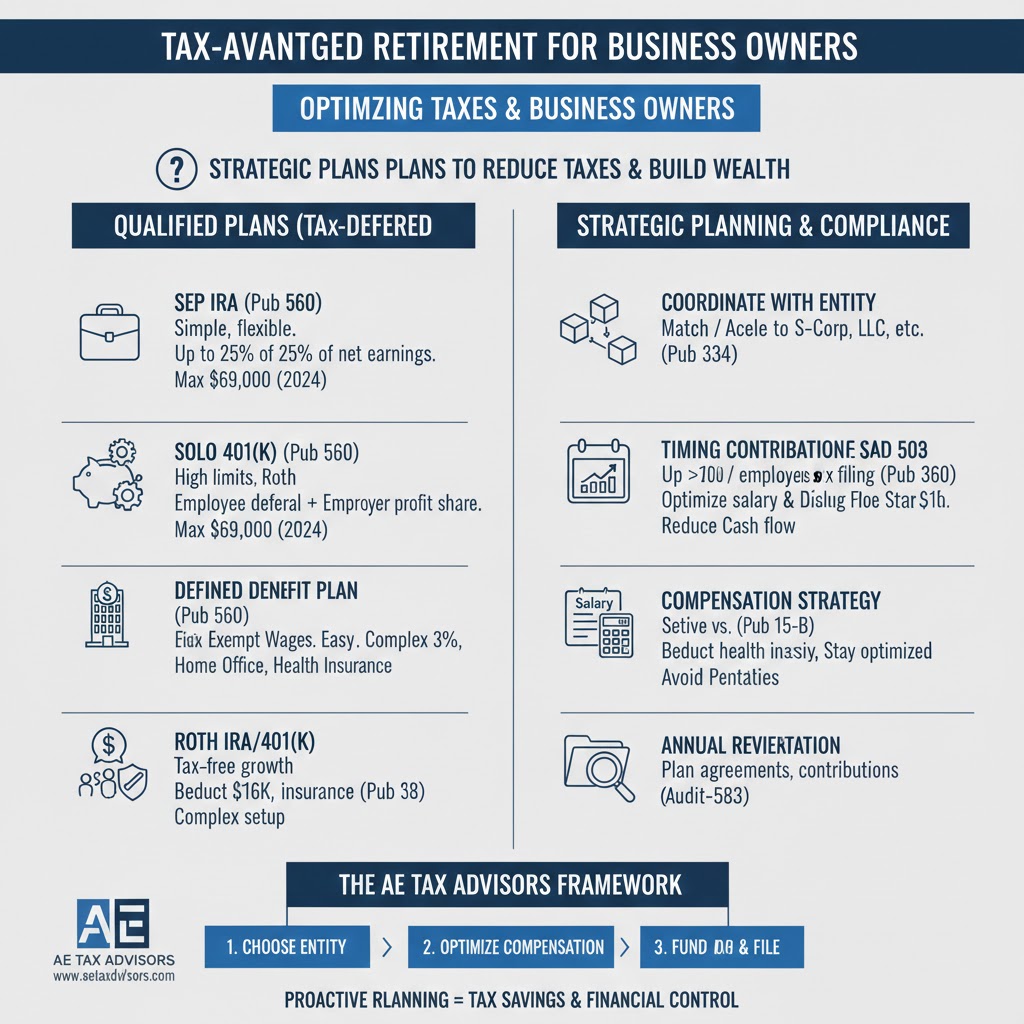
 This guide covers build tax-advantaged retirement plan and what it means for your tax situation.
Understanding How To Build A Tax-advantaged in 2026
When you run a business, you have more control over your retirement than any employee ever will. Yet most entrepreneurs don’t use that control strategically. They rely on savings accounts or investments that lack the tax advantages designed specifically for business owners.
At AE Tax Advisors, we help business owners create retirement systems that do two things at once: reduce today’s taxes and build tomorrow’s wealth. The secret isn’t a complex loophole—it’s the tax code itself. The IRS rewards business owners who use qualified plans correctly.
This guide builds on Advanced Strategies for Reducing Self-Employment Tax and How to Legally Pay Yourself from Your Business, showing exactly how to turn your business income into a tax-deferred or tax-free retirement engine.
Why Retirement Planning Is a Tax Strategy
Most people think of retirement plans as investments. In reality, they’re tax tools first. A qualified plan moves income from “taxed today” to “taxed later” or, in the case of Roth options, to “never taxed again.”
According to IRS Publication 560, business owners can deduct contributions to qualified plans for themselves and their employees, reducing taxable income in the year contributions are made. The result is immediate tax relief and long-term compounding growth.
AE Tax Advisors integrates retirement planning into each client’s broader entity and compensation strategy, ensuring that every dollar you contribute lowers your current tax burden and strengthens your future position.
The Three Pillars of Business Owner Retirement
- Qualified Plans (tax-deferred) – SEP IRAs, SIMPLE IRAs, and Solo 401(k)s.
- Roth Accounts (tax-free growth) – Roth IRAs and Roth 401(k)s.
- Defined-Benefit or Cash Balance Plans (high-contribution vehicles).
Each serves a different purpose. AE Tax Advisors helps clients layer them strategically depending on income, age, and business structure.
SEP IRAs: The Simplest Option for Self-Employed Professionals
A Simplified Employee Pension (SEP IRA) allows you to contribute up to 25% of net earnings from self-employment, up to $69,000 for 2024. Contributions are deductible, reducing both income and self-employment tax.
Publication 560 defines SEPs as ideal for solo businesses or small employers who want flexibility—no annual filing requirements and variable contributions each year.
For clients who started as sole proprietors or single-member LLCs, AE Tax Advisors often begins with a SEP IRA before transitioning to a Solo 401(k) as income grows.
This progression builds naturally on the planning rhythm described in How to Choose the Right Entity Type for Your Business, where structural flexibility supports evolving goals.
Solo 401(k): The Powerhouse Plan for Small Businesses
A Solo 401(k), also called an Individual 401(k), is designed for business owners with no employees other than a spouse. It allows for both employee and employer contributions, giving maximum control over deferrals and deductions.
For 2024, you can contribute:
- Up to $23,000 as an employee deferral (plus $7,500 catch-up if over 50).
- Up to 25% of net earnings as an employer contribution.
Combined, the total can reach $69,000 per year ($76,500 with catch-up).
AE Tax Advisors structures Solo 401(k)s so that owner contributions are coordinated with payroll if you operate as an S-Corp, ensuring compliance with Publication 505 withholding and compensation rules.
What sets the Solo 401(k) apart is the ability to add a Roth sub-account. This allows tax-free growth on after-tax contributions—an advantage we often pair with traditional pre-tax deferrals for tax diversification.
SIMPLE IRAs: Streamlined for Smaller Employers
The SIMPLE IRA (Savings Incentive Match Plan for Employees) fits businesses with fewer than 100 employees. Contributions are easy to manage, and the plan can serve as a bridge between startup simplicity and future growth.
Employees can defer up to $16,000 in 2024, and employers match up to 3% of compensation. Under Publication 560, contributions are deductible for the business and excluded from employee taxable income.
AE Tax Advisors helps employers establish SIMPLE IRAs when they want to start offering retirement benefits without the administrative complexity of a full 401(k).
This incremental growth mindset mirrors what we outlined in Why Every Business Owner Needs a Tax Advisor Year-Round—tax planning evolves as your business scales.
Defined-Benefit and Cash Balance Plans
For high-income business owners looking to supercharge tax deductions, defined-benefit and cash balance plans offer the highest contribution limits—often over $250,000 per year, depending on age and income.
Under Publication 560, contributions are actuarially determined, allowing massive pre-tax funding while building a guaranteed retirement benefit. These plans are ideal for mature businesses with consistent profits.
AE Tax Advisors collaborates with actuaries to set up and administer these plans correctly, ensuring compliance with contribution calculations and filing requirements under Form 5500.
This approach directly connects to The Family Office Formula: How Business Owners Turn Cash Flow into Generational Wealth, where disciplined structure transforms cash flow into legacy assets.
Roth IRAs and Roth 401(k)s: Building Tax-Free Wealth
While traditional plans defer taxes, Roth accounts eliminate them on the back end. Contributions are made with after-tax dollars, but qualified withdrawals are tax-free under Publications 590-A and 590-B.
Business owners often overlook Roths because their income exceeds direct contribution limits. AE Tax Advisors designs backdoor Roth strategies—making nondeductible traditional IRA contributions and converting them to Roth status—to achieve tax-free growth legally.
This technique aligns perfectly with Advanced Strategies for Reducing Self-Employment Tax, as Roth distributions in retirement are not subject to those taxes.
Coordinating Retirement Plans with Entity Type
Entity selection determines what retirement plans you can use and how much you can contribute:
- Sole proprietors and single-member LLCs can use SEP IRAs or Solo 401(k)s.
- S-Corp owners can use Solo 401(k)s or defined-benefit plans based on W-2 wages.
- C-Corp owners can use 401(k)s, profit-sharing plans, or cash balance plans with higher contribution flexibility.
AE Tax Advisors models each scenario, ensuring that your entity structure and retirement plan complement one another rather than conflict. This integration ties back to The Business Owner’s Blueprint: How to Build, Protect, and Multiply Wealth Through Entity Strategy.
The Timing of Contributions
When you contribute matters. Contributions to SEP and Solo 401(k) plans can be made up to your tax filing deadline (including extensions). AE Tax Advisors coordinates this timing to optimize cash flow and minimize current-year tax liability.
We also help clients model whether deferring contributions to the following tax year offers a better bracket management strategy—a key principle discussed in How to Legally Lower Your Tax Bill Before December 31.
Common Retirement Planning Mistakes
Business owners often make predictable errors that reduce their tax benefits:
- Forgetting to establish plans before year-end (required for 401(k)s).
- Exceeding contribution limits without proper coordination.
- Missing Form 5500 filing requirements.
- Mixing business and personal funds for contributions.
- Failing to adjust plans as business income changes.
AE Tax Advisors conducts annual retirement reviews to recalibrate contributions, verify compliance, and align investment strategies with current income and tax projections.
Combining Retirement with Other Tax Strategies
Retirement planning doesn’t exist in isolation—it’s part of a larger ecosystem. Combining qualified plans with other strategies amplifies results:
- Pairing a Solo 401(k) with an HSA for double tax deductions.
- Using Roth conversions in low-income years to reduce lifetime taxes.
- Coordinating charitable donations with appreciated-asset sales for offsetting deductions.
These strategies echo themes from The Tax-Free Empire: How to Build Wealth Without Paying More Than You Legally Owe, where long-term wealth management begins with intentional tax layering.
AE Tax Advisors’ Retirement Planning Framework
- Identify entity type and income consistency.
- Choose the right qualified plan based on contribution limits.
- Model salary, distributions, and pre-tax contributions.
- Coordinate Roth and pre-tax balances for diversification.
- Implement contribution timing for maximum deduction.
- Reassess annually to stay compliant and optimized.
Each client’s plan is customized—not just to save taxes, but to create a foundation for lifetime financial independence.
Documentation and Compliance
Retirement plan documentation must always meet IRS requirements. Publication 560 emphasizes the need for formal adoption agreements, contribution logs, and timely deposits. AE Tax Advisors ensures every plan is properly documented, filed, and reconciled with tax filings to avoid disqualification.
In audits, complete documentation transforms retirement plans from liabilities into evidence of compliance and prudence—a point reinforced in How to Build a Bulletproof Audit Defense Strategy for Your Business.
Conclusion: Use Your Business to Fund Your Freedom
Your business is more than an income source—it’s your retirement engine. When structured correctly, it funds your future while reducing today’s taxes. The best retirement plans aren’t generic—they’re engineered for your entity type, income level, and long-term goals.
At AE Tax Advisors, we help business owners use IRS Publications 560, 590-A, and 590-B as blueprints for wealth. We design plans that grow tax-free or tax-deferred, integrate seamlessly with your payroll and entity setup, and ensure that when you finally stop working, your money doesn’t.
Understanding build tax-advantaged retirement plan is essential for maximizing your tax savings as a real estate investor.
When it comes to build tax-advantaged retirement plan, working with a specialized tax advisor makes all the difference.
Many investors overlook build tax-advantaged retirement plan, but it can be one of the most impactful strategies in your tax plan.
At AE Tax Advisors, we help clients navigate build tax-advantaged retirement plan to keep more of what they earn.
Build tax-advantaged retirement plan is one of the most important concepts for real estate investors to understand. When properly implemented, build tax-advantaged retirement plan can lead to significant tax savings that compound over time.
Many high-income earners miss out on build tax-advantaged retirement plan opportunities simply because their CPA lacks the specialized knowledge. A proactive approach to build tax-advantaged retirement plan can mean the difference between overpaying and optimizing your tax position.
At AE Tax Advisors, our team specializes in build tax-advantaged retirement plan for real estate investors and W-2 professionals. We have helped hundreds of clients use build tax-advantaged retirement plan to reduce their tax burden by $50,000 or more annually.
The key to successful build tax-advantaged retirement plan implementation is working with an advisor who understands real estate taxation. Every build tax-advantaged retirement plan decision should be part of a comprehensive, multi-year tax plan.
If you are not actively using build tax-advantaged retirement plan as part of your tax strategy, you are likely leaving money on the table. Contact AE Tax Advisors to learn how build tax-advantaged retirement plan can work for your specific situation.
Understanding Build tax-advantaged retirement plan
Related services from AE Tax Advisors: entity structuring for rental portfolios and S-Corp and real estate coordination.
Build tax-advantaged retirement plan is a critical component of any comprehensive tax strategy for real estate investors. At AE Tax Advisors, we help clients navigate build tax-advantaged retirement plan to maximize their tax savings while maintaining full IRS compliance. Our proactive approach ensures you capture every available deduction and credit.
For official IRS guidance, visit the IRS Newsroom.