

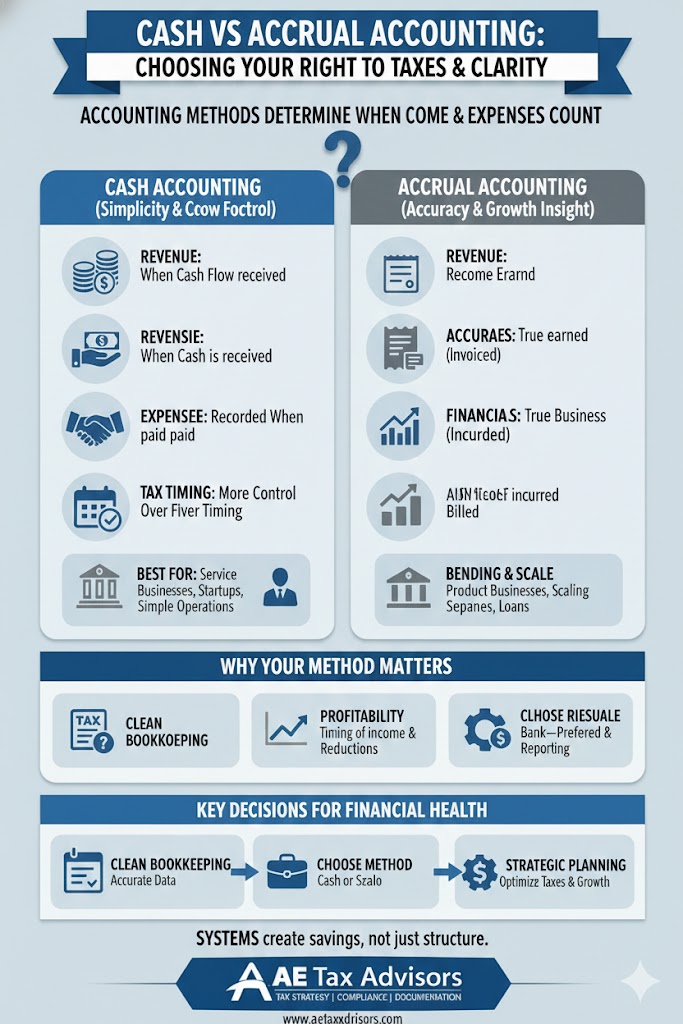
Why Your Accounting Method Matters More Than You Think
When it comes to cash vs accrual accounting: how, understanding the fundamentals is key. Choosing between cash and accrual accounting is one of the most important bookkeeping decisions a business owner makes. Your accounting method determines when income is recognized, when expenses count, how your tax liability is calculated, how clean your books appear, and how lenders evaluate your financials. It shapes not only your numbers but the story your numbers tell. This guide covers cash accrual accounting choose and what it means for your tax situation.
At AE Tax Advisors, we work with high income earners, real estate operators, entrepreneurs, and service based businesses who need accurate bookkeeping tied directly to long term tax strategy. Cash vs accrual is not a simple preference. It is a strategic decision with real consequences.
If you have not read the earlier articles Why Clean Books Matter for High Income Business Owners or The Ultimate Guide to Bookkeeping for Small Business Owners, review those next. They explain how accurate bookkeeping supports tax strategies and proactive financial planning.
Understanding the Cash Method: Simple, Fast, and Popular
The cash basis method is the simplest form of bookkeeping. Revenue is reported when money actually hits your account. Expenses are recorded when you pay them. This method mirrors your cash flow and is often easier for small businesses to manage.
How Cash Accounting Works
If a client pays an invoice in March, you recognize income in March.
If you pay a contractor’s invoice in June, you recognize the expense in June.
There is no tracking of unpaid invoices or outstanding bills.
Everything revolves around cash movement, which makes the system easy to understand and maintain.
Who Cash Accounting Is Best For
Cash basis accounting is ideal for:
Service based businesses
Consultants
Coaches
Solo entrepreneurs
Businesses with minimal inventory
High income earners with simple expense flows
Businesses under the IRS threshold for cash method eligibility
Because it is simple, cash accounting offers clean, straightforward reporting that many business owners prefer while they are growing.
Tax Advantages of Cash Accounting
Cash basis bookkeeping can minimize tax liability by giving owners more control over the timing of deductions. Because expenses count when paid, and income counts only when received, you can strategically:
Delay income
Accelerate expenses
Control year end tax exposure
But this only works if your bookkeeping is accurate and up to date. If you are behind, sloppy, or inconsistent, timing advantages disappear. This is another reason AE Tax Advisors emphasizes clean monthly books and reconciliation.
Understanding the Accrual Method: Detailed, Structured, and Required for Many Businesses
Accrual accounting creates a more complete financial picture because income and expenses are recorded when earned or incurred, not when cash moves.
How Accrual Accounting Works
If you invoice a client in May but they pay in July, income is recognized in May.
If you receive a bill in March but pay in April, the expense belongs to March.
This method tracks accounts receivable, accounts payable, deferred revenue, and other timing differences that help you understand true profitability.
Who Should Use Accrual Accounting
Accrual accounting is best for:
Growing companies
Businesses seeking financing
Companies with significant accounts receivable
Real estate firms
Construction companies
Product based businesses with inventory
Businesses planning to scale or sell
Any business exceeding the IRS revenue thresholds
Lenders, investors, and large organizations expect accrual reports because they reflect economic reality, not just bank balances.
Tax Implications of Accrual Accounting
Accrual accounting removes the ability to delay taxes by manipulating timing. Revenue counts when earned, which can raise taxable income if your receivables are high. On the other hand, expenses count when incurred, even if not yet paid, which can create timing advantages for strategic purchases.
The key is that accrual provides more accurate data for forecasting and tax projection. AE Tax Advisors uses accrual reporting for high growth companies because it aligns with long term planning and entity optimization.
Cash vs Accrual: The Real Differences Business Owners Need to Know
Most guides oversimplify these two methods. At AE Tax Advisors, we help owners understand the deeper impact each choice makes on tax strategy, cash flow clarity, and business positioning.
Revenue Recognition
Cash method: when paid
Accrual method: when earned
This difference affects year end planning, quarterly tax estimates, and how your books reflect seasonality.
Expense Timing
Cash method: when you spend the money
Accrual method: when the expense occurs
Accrual can increase accuracy for businesses with materials, labor, or recurring costs.
Tax Planning Flexibility
Cash offers more control over timing.
Accrual offers more precision and consistency.
The right choice depends on your income level, stability, and long term goals.
Reporting Accuracy
Cash works for simplicity.
Accrual works for financial clarity, investor confidence, and accurate valuations.
If your business plans to scale, enter new markets, or apply for financing, accrual gives you a stronger financial profile.
How AE Tax Advisors Helps You Choose the Right Method
Choosing a method is not about guesswork. At AE Tax Advisors, we evaluate:
Your revenue patterns
Whether your income is predictable or seasonal
How many invoices remain unpaid each month
Whether you have inventory
How quickly you are growing
Your long term tax plan
Your entity structure
Your cash flow stability
Your financing needs
We then determine whether cash or accrual aligns with your goals, growth, and compliance requirements.
Switching from Cash to Accrual: What You Need to Know
Many businesses outgrow the cash method. If your revenue climbs, your receivables grow, or you expand into new service lines, accrual becomes the logical next step.
Switching requires:
Rebuilding your chart of accounts
Adding accounts receivable and payable
Adjusting prior period entries
Recording deferred revenue
Implementing monthly close procedures
Reconciling with accurate documentation
This transition must be done carefully to avoid IRS issues or financial reporting errors. AE Tax Advisors handles these transitions so the books remain clean, accurate, and tax ready.
How Accounting Method Impacts Your Tax Return
Your method affects:
Schedule C reporting
S corporation profits
K1 accuracy
Payroll timing
Estimated taxes
Year end planning
Depreciation schedules
Profit forecasting
A wrong method leads to inflated income, distorted tax bills, or bookkeeping mismatches that create stress during tax season.
Our earlier article Monthly Bookkeeping Checklist for Staying Compliant and Ready for Tax Season explains why accurate monthly reporting matters no matter which method you choose.
The Best Method for Real Estate Investors
Real estate operators often benefit from accrual reporting because:
Expenses frequently occur before rental income
Debt and depreciation require timeline accuracy
Repairs, capital improvements, and escrows cross months
Rent collection varies in timing
Clean accrual reporting helps with refinances, underwriting, and long term tax strategy. Cash based reporting may work for very small landlords but becomes limiting as properties scale.
The Best Method for Service Based Businesses
Service businesses with simple operations typically start with cash accounting. But as they grow, hire contractors, or begin offering multi month services, accrual often becomes necessary for clean monthly financials.
AE Tax Advisors evaluates your service pipeline, billing cycles, and delivery process to determine the best system.
Long Term Growth Requires Accurate Reporting
If your business plans to:
Hire employees
Expand to new markets
Acquire another business
Seek financing
Sell in the future
Build a tax optimized multi entity structure
Accrual bookkeeping usually supports stability and clarity. Cash basis may be fine for a small operation, but it rarely supports long term strategic planning.
Understanding cash accrual accounting choose is essential for maximizing your tax savings as a real estate investor.
When it comes to cash accrual accounting choose, working with a specialized tax advisor makes all the difference.
Many investors overlook cash accrual accounting choose, but it can be one of the most impactful strategies in your tax plan.
At AE Tax Advisors, we help clients navigate cash accrual accounting choose to keep more of what they earn.
Cash accrual accounting choose is one of the most important concepts for real estate investors to understand. When properly implemented, cash accrual accounting choose can lead to significant tax savings that compound over time.
Many high-income earners miss out on cash accrual accounting choose opportunities simply because their CPA lacks the specialized knowledge. A proactive approach to cash accrual accounting choose can mean the difference between overpaying and optimizing your tax position.
At AE Tax Advisors, our team specializes in cash accrual accounting choose for real estate investors and W-2 professionals. We have helped hundreds of clients use cash accrual accounting choose to reduce their tax burden by $50,000 or more annually.
The key to successful cash accrual accounting choose implementation is working with an advisor who understands real estate taxation. Every cash accrual accounting choose decision should be part of a comprehensive, multi-year tax plan.
If you are not actively using cash accrual accounting choose as part of your tax strategy, you are likely leaving money on the table. Contact AE Tax Advisors to learn how cash accrual accounting choose can work for your specific situation.
Final Thoughts
Cash vs accrual accounting is more than a technical decision. It influences tax strategy, financial accuracy, scalability, and long term wealth building. Cash offers simplicity and flexibility, while accrual provides clarity and precision. The right choice depends on your revenue model, growth stage, and long term goals.
Related services from AE Tax Advisors: real estate professional status support and mid-term rental tax planning.
AE Tax Advisors helps business owners build bookkeeping systems that support proactive tax planning, not reactive cleanup. With the right accounting method, your numbers become reliable, predictable, and powerful tools for financial growth.
For more information, refer to the IRS.