

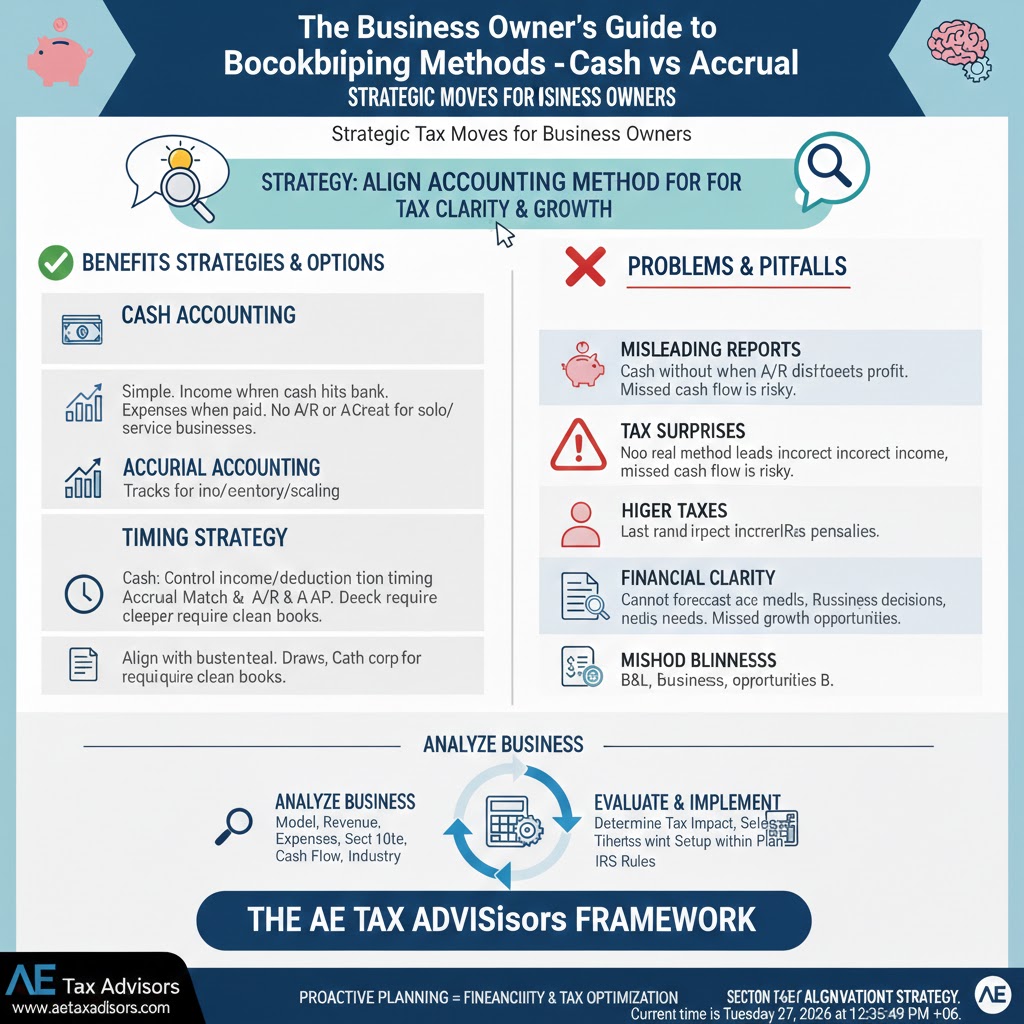
Why Your Accounting Method Matters More Than You Think
When it comes to the top bookkeeping mistakes business, understanding the fundamentals is key. Every business owner needs to choose an accounting method, and the choice determines how income, expenses, and profit show up on your books. Many small business owners default to cash accounting without understanding how it affects taxes, financial reporting, or planning. Others use accrual accounting because they think it is required, even when it complicates their books unnecessarily. This guide covers real estate bookkeeping and what it means for your tax situation.
Choosing the right method is one of the most important bookkeeping decisions you can make. It impacts tax strategy, your ability to qualify for financing, your monthly reporting accuracy, and the long term clarity of your financial picture.
For a deeper understanding of how bookkeeping connects to tax planning, review Why Clean Books Matter for High Income Business Owners and The Ultimate Guide to Bookkeeping for Small Business Owners Who Want Lower Taxes.
You can also reference our Monthly Bookkeeping Checklist to see how your accounting method ties into your month end close.
What Is Cash Accounting
Cash accounting records income when money is received and expenses when money is paid. It is simple, easy to maintain, and widely used by small businesses, independent contractors, and service providers.
Cash accounting works best for:
Service based businesses
Consultants
Freelancers
Small LLCs
Businesses with simple transactions
Owners who do not send invoices or maintain large receivable balances
Under cash accounting, if money hits your bank account, it becomes revenue. If money leaves your bank account, it becomes an expense. There is no tracking of income you have earned but not yet collected, or expenses you have incurred but not yet paid.
Advantages of Cash Accounting
Cash accounting offers clarity and simplicity. The numbers always reflect real money in and out.
Advantages include:
Easier bookkeeping
Lower administrative burden
Straightforward tracking
Simple tax reporting
Fewer adjustments
Better cash flow visibility
Ideal for businesses with no inventory
If you prefer minimal complexity and want a system that matches your bank account in real time, cash accounting is usually the better fit.
Disadvantages of Cash Accounting
While simpler, cash accounting can create blind spots.
Limitations include:
No tracking of unpaid invoices
No visibility into vendor bills
Revenue can appear inconsistent
Expenses may bunch together
Less accurate monthly financials
Harder to analyze profit patterns
Not ideal for scaling
Cash accounting can also distort profitability when income fluctuates heavily from month to month. For businesses that want long term clarity or plan to grow, accrual may offer better insight.
What Is Accrual Accounting
Accrual accounting records income when it is earned and expenses when they are incurred, not when cash changes hands.
This method is used by:
Contractors
Ecommerce businesses
Businesses with inventory
Companies issuing invoices
Larger or growing firms
Businesses preparing for financing
Accrual accounting gives a clearer picture of true performance. It matches revenue to the work performed and expenses to the period they belong to.
Advantages of Accrual Accounting
Accrual accounting creates more accurate financial reporting, which helps with planning and lending.
Benefits include:
Clearer profit and loss statements
More predictable trends
Stronger reporting for lenders
Better month over month comparisons
Cleaner financial forecasting
Accurate tracking of accounts receivable
Accurate tracking of accounts payable
Businesses that plan to scale or operate with delayed payments usually benefit from accrual.
Disadvantages of Accrual Accounting
Accrual offers clarity but adds administrative work.
Challenges include:
More complex bookkeeping
Higher likelihood of errors if unmanaged
Heavier documentation needs
Requires monthly reconciliation
Revenue may appear before you collect it
Expenses may appear before you pay them
Accrual requires more discipline and a solid monthly close process. If you want clarity but do not want to manage the system yourself, AE Tax Advisors can maintain it for you through monthly bookkeeping.
How To Decide Which Method Is Right for You
Choosing between cash and accrual depends on your business model, growth goals, cash flow structure, and how you prefer to view your financials.
You should choose cash accounting if:
Your business is simple
You have limited transactions
You do not invoice customers
You want easy, low maintenance books
Your margins are straightforward
You want tax simplicity
You should choose accrual accounting if:
You send invoices
You carry inventory
You have contractors or multiple vendors
You want cleaner reporting for lenders
You plan to grow rapidly
You want to track performance accurately
The choice is not permanent. AE Tax Advisors can help you change your accounting method when your business outgrows the old one.
How Your Accounting Method Affects Taxes
Your accounting method determines how and when income shows up on your return.
Cash method taxation:
You pay tax when money is received
You deduct expenses when you pay them
Tax planning is easier but less predictive
Accrual method taxation:
You pay tax when income is earned
You deduct expenses when they occur
Tax planning becomes more strategic
Your accounting method affects:
Estimated payments
Year end deductions
Revenue recognition
Payroll timing
Entity strategy
QBI eligibility
Long term planning
If you want a detailed walk through of how bookkeeping connects to tax strategy, revisit Why Clean Books Matter for High Income Business Owners.
How AE Tax Advisors Helps You Choose the Right Method
AE Tax Advisors evaluates your entire financial picture before recommending cash or accrual accounting. We look at:
Your business model
Your revenue structure
Your growth plans
Your tax strategy
Your industry
Your volume of transactions
We also maintain your books monthly, run projections, and make sure your accounting method supports your long term tax plan. Most business owners use the wrong method for years without realizing how much it affects their numbers. Our team fixes that.
Changing Your Accounting Method
Businesses can change their accounting method, but it must be done correctly. Your books need to be rebuilt to reflect the new system, and the IRS requires adjustments to be filed.
AE Tax Advisors handles:
Clean up
Rebuild
Reconciliation
Method conversion
IRS Form 3115 if required
Tax impact analysis
Once your books are standardized, reports become clearer and decision making becomes easier.
Final Thoughts
Choosing between cash and accrual accounting is one of the most important decisions in your bookkeeping system. The right method gives you clarity, lowers your tax liability, and supports long term business growth. The wrong method creates confusion, inconsistent numbers, and unnecessary complexity. AE Tax Advisors helps you make the best choice and maintain clean financials every month so your business stays tax ready at all times.
Understanding real estate bookkeeping is essential for maximizing your tax savings as a real estate investor.
When it comes to real estate bookkeeping, working with a specialized tax advisor makes all the difference.
Many investors overlook real estate bookkeeping, but it can be one of the most impactful strategies in your tax plan.
At AE Tax Advisors, we help clients navigate real estate bookkeeping to keep more of what they earn.
Real estate bookkeeping is one of the most important concepts for real estate investors to understand. When properly implemented, real estate bookkeeping can lead to significant tax savings that compound over time.
Many high-income earners miss out on real estate bookkeeping opportunities simply because their CPA lacks the specialized knowledge. A proactive approach to real estate bookkeeping can mean the difference between overpaying and optimizing your tax position.
At AE Tax Advisors, our team specializes in real estate bookkeeping for real estate investors and W-2 professionals. We have helped hundreds of clients use real estate bookkeeping to reduce their tax burden by $50,000 or more annually.
Understanding Real estate bookkeeping
Related services from AE Tax Advisors: depreciation review for rental properties and real estate professional status support.
Real estate bookkeeping is a critical component of any comprehensive tax strategy for real estate investors. At AE Tax Advisors, we help clients navigate real estate bookkeeping to maximize their tax savings while maintaining full IRS compliance. Our proactive approach ensures you capture every available deduction and credit.
For more information, refer to the IRS.