

Why Your Accounting Method Matters More Than You Think
When it comes to why every business needs a, understanding the fundamentals is key. Choosing between cash and accrual accounting affects your taxes, your financial reporting, and your long term strategy. Business owners often pick a method without understanding how it changes revenue timing, deduction timing, and the accuracy of their financials. The right method can simplify your taxes and support faster growth while the wrong method creates distorted numbers and missed opportunities. This guide covers business needs monthly close and what it means for your tax situation.
If you have not yet read the earlier articles in this series, you may want to review Why Clean Books Matter for High Income Business Owners and The Ultimate Guide to Bookkeeping for Small Business Owners Who Want Lower Taxes. Both explain how accurate records drive tax strategy. You can also reference Monthly Bookkeeping Checklist for Staying Compliant and Ready for Tax Season to see how your accounting method fits into your monthly routine.
What Cash Accounting Actually Means
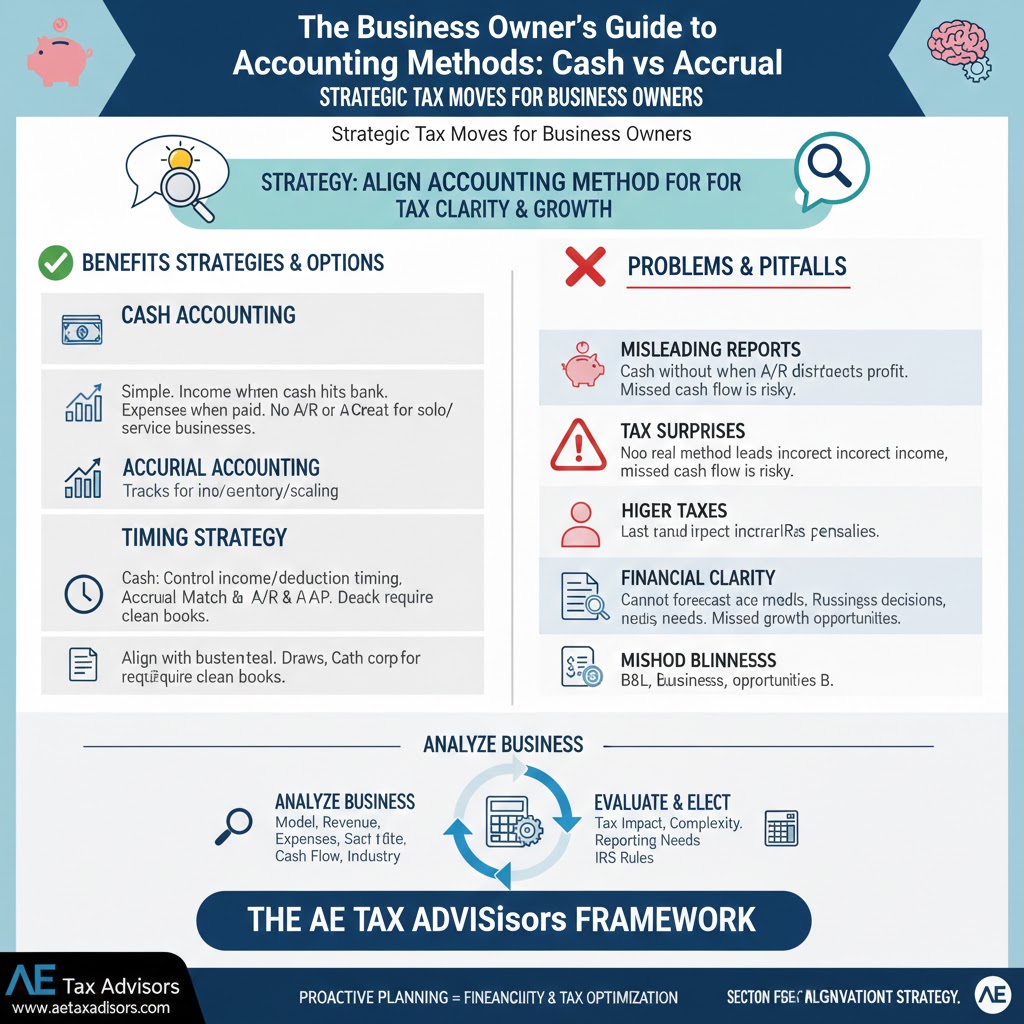
Cash accounting recognizes income when money hits your bank and counts expenses when money leaves your account. It is simple, easy to follow, and ideal for many service based businesses or new companies that want fast clarity.
Cash accounting works best for:
Consultants
Coaches
Freelancers
Contractors
Solo business owners
Service companies with minimal inventory
It gives a real time snapshot of your cash flow. When money comes in, you record income. When you pay a bill, you record an expense. Nothing is logged before or after cash actually moves.
Pros of Cash Accounting
The simplicity makes it attractive. Cash accounting helps you:
Understand real cash flow instantly
Reduce bookkeeping complexity
Avoid tracking invoices or unpaid bills
See available money with less analysis
Keep taxes straightforward
Because it tracks cash only, it can also simplify your tax liability because you only pay taxes on money you actually received during the year.
Cons of Cash Accounting
Cash accounting can create misleading reports if your business is growing fast or deals with delayed payments.
Common issues include:
No visibility into unpaid invoices
No tracking of unpaid vendor bills
Revenue looks low when invoices are outstanding
Expenses look low when bills are pending
Profit margins appear inaccurate
If you need precise financial statements for lending, investors, or large contracts, cash accounting may not show the full picture.
What Accrual Accounting Actually Means
Accrual accounting recognizes income when it is earned and expenses when they are incurred, regardless of when money moves. This gives a complete financial snapshot that reflects real performance.
Accrual accounting works best for:
Product businesses
Companies with inventory
Agencies with recurring invoices
Businesses with long payment cycles
Companies preparing for investors or lending
Growing businesses that need accurate financial forecasting
Under accrual accounting:
If you invoice a customer, income is recorded immediately.
If you receive a bill, the expense is recorded immediately.
Cash timing does not control reporting.
Accrual shows the true operational health of your business even when payments come later.
Pros of Accrual Accounting
Accrual gives you the most complete and accurate financial clarity.
Advantages include:
Accurate profit and loss tracking
Better financial forecasting
Clear reporting for lenders
Visibility into pending income
Visibility into upcoming expenses
Cleaner long term planning
Businesses that want scale usually convert to accrual because it supports large decisions with accurate data.
Cons of Accrual Accounting
Accrual requires stronger bookkeeping systems because you must track invoices, bills, deposits, and payments in separate steps.
Potential drawbacks include:
More complex monthly bookkeeping
Need for consistent reconciliation
Greater documentation
Higher bookkeeping cost due to complexity
While accrual shows true financial performance, it does not show cash availability unless you check your cash flow reports separately.
How Your Accounting Method Affects Your Taxes
Your accounting method determines when income counts and when deductions count. That makes it a powerful tax strategy lever.
Cash accounting can help you:
Delay income recognition by waiting to deposit payments
Accelerate deductions by paying bills early
Simplify your tax position
Accrual accounting helps you:
Match revenue and expenses accurately
Plan taxes using true profitability
Track cost of goods sold correctly
Support large scale financial decisions
Choosing the right method helps AE Tax Advisors build a proactive tax plan tailored to your business model.
How Inventory Impacts Your Accounting Method
If your business carries inventory, the IRS may require accrual accounting for tracking income and cost of goods sold. Many e commerce companies, retail stores, manufacturing companies, and wholesalers must use accrual at least partially.
Service businesses typically have more flexibility.
When You Should Use Cash Accounting
Cash accounting is likely best for you if:
Your business is new
You mainly provide services
You want the simplest method
Your transactions are small and frequent
You do not issue many invoices
You want easier tax management
Cash accounting helps early stage businesses stay lean and fast.
When You Should Use Accrual Accounting
Accrual accounting is best if:
You plan to scale
You issue many invoices
You have delayed payments
You manage inventory
You want accurate long term forecasting
You want financials that banks trust
Accrual gives you the financial clarity needed for major decisions.
How to Switch from Cash to Accrual
Many businesses outgrow cash accounting. AE Tax Advisors helps clients convert by:
Cleaning existing books
Aligning past income with accrual rules
Recording unpaid invoices
Recording unpaid vendor bills
Adjusting retained earnings
Preparing IRS compliant conversions
Switching must be done accurately so your tax reporting remains correct.
How to Switch from Accrual to Cash
Some businesses simplify their operations by switching back to cash accounting. This process involves:
Clearing open invoices
Zeroing out unpaid bills
Reconciling deposits
Reconciling payments
Rebuilding opening balances
The goal is to clean the books so cash reporting is fully accurate.
How to Decide Which Method Fits Your Business
The right method depends on:
Your industry
Your growth plans
Your need for clarity
Your tax strategy
Your bookkeeping capacity
Your timeline for expansion
If you want the simplest process and real time cash clarity, use cash accounting.
If you want the most accurate financial picture for long term planning, use accrual.
AE Tax Advisors helps you choose the method that lowers your taxes and supports your long term goals.
Why Clean Books Matter Regardless of the Method
Whether you choose cash or accrual, your books must be accurate to support tax planning. Cross reference the articles Why Clean Books Matter for High Income Business Owners and Monthly Bookkeeping Checklist for Staying Compliant and Ready for Tax Season to keep your system clean.
Clean financials are what allow you to:
Lower your taxes
Build accurate reports
Make confident decisions
Stay compliant
Avoid IRS issues
Our team builds bookkeeping systems that work reliably month after month.
Understanding every business needs monthly is essential for maximizing your tax savings as a real estate investor.
When it comes to every business needs monthly, working with a specialized tax advisor makes all the difference.
Many investors overlook every business needs monthly, but it can be one of the most impactful strategies in your tax plan.
At AE Tax Advisors, we help clients navigate every business needs monthly to keep more of what they earn.
Every business needs monthly is one of the most important concepts for real estate investors to understand. When properly implemented, every business needs monthly can lead to significant tax savings that compound over time.
Many high-income earners miss out on every business needs monthly opportunities simply because their CPA lacks the specialized knowledge. A proactive approach to every business needs monthly can mean the difference between overpaying and optimizing your tax position.
At AE Tax Advisors, our team specializes in every business needs monthly for real estate investors and W-2 professionals. We have helped hundreds of clients use every business needs monthly to reduce their tax burden by $50,000 or more annually.
The key to successful every business needs monthly implementation is working with an advisor who understands real estate taxation. Every every business needs monthly decision should be part of a comprehensive, multi-year tax plan.
If you are not actively using every business needs monthly as part of your tax strategy, you are likely leaving money on the table. Contact AE Tax Advisors to learn how every business needs monthly can work for your specific situation.
Final Thoughts
Related services from AE Tax Advisors: real estate bookkeeping review and long-term rental tax planning.
Cash and accrual accounting both have strengths, but the right method for your business depends on your goals, complexity, and desire for clarity. Clean books make each method effective, and choosing the right structure ensures your tax strategy stays aligned all year.
For more information, refer to the IRS.