

Why Your Accounting Method Matters More Than You Think
When it comes to cash vs accrual accounting how, understanding the fundamentals is key. Choosing between cash accounting and accrual accounting is one of the most important financial decisions you will make as a business owner. Your accounting method affects your taxes, your cash flow, your financial clarity, and your long term planning. Many business owners choose a method without understanding the impact, and it leads to confusion, higher taxes, or inaccurate financial reporting. This guide covers cash accrual accounting choose and what it means for your tax situation.
If you have not yet reviewed the foundations of proper bookkeeping, visit Why Clean Books Matter for High Income Business Owners and The Ultimate Guide to Bookkeeping for Small Business Owners Who Want Lower Taxes. These articles explain how clean books directly improve your financial outcomes. You may also want to read Monthly Bookkeeping Checklist for Staying Compliant and Ready for Tax Season for monthly processes that support accurate accounting.
What Is Cash Accounting and When It Makes Sense
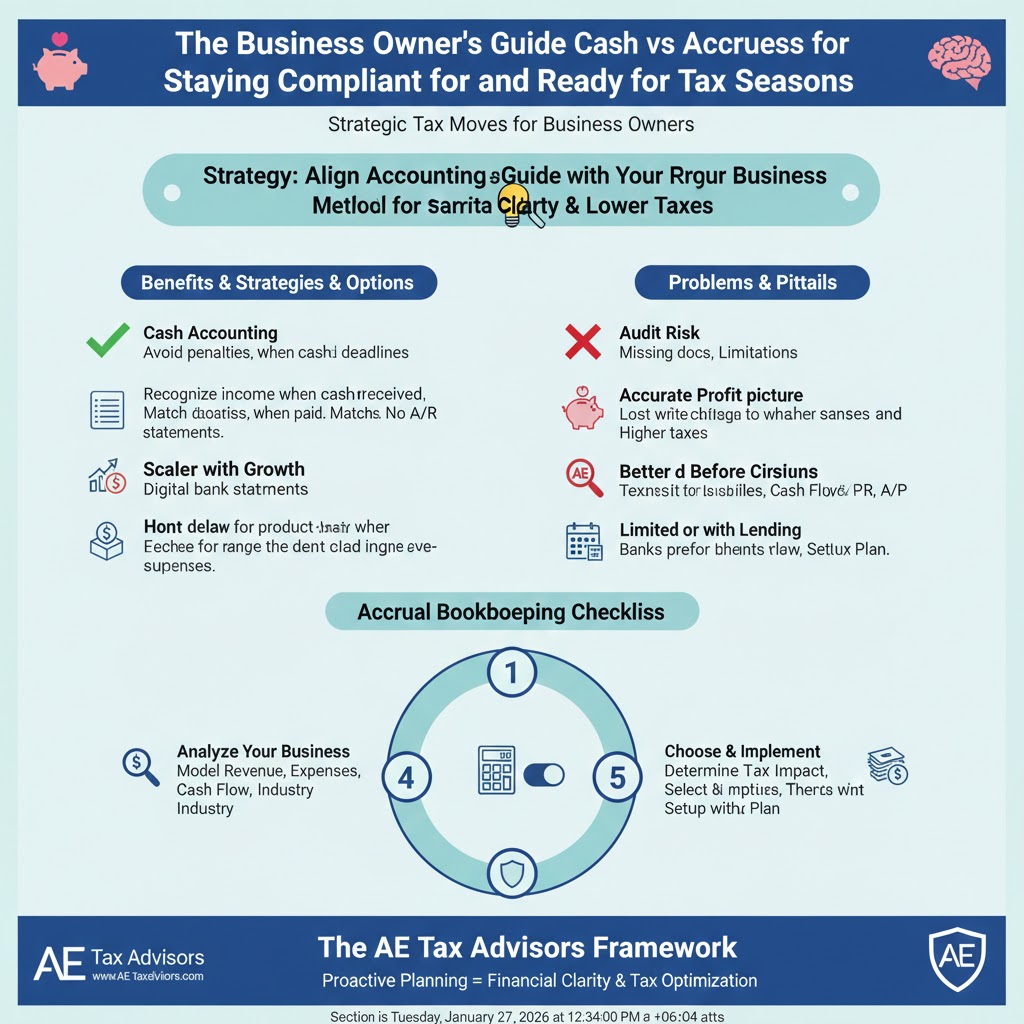
Cash accounting is the simplest method for business owners. You recognize income when money hits your bank account and record expenses when you actually pay them. There are no accounts receivable or accounts payable. Everything is tracked in real time based on cash movement.
Cash accounting works well for:
Solo business owners
Service based businesses
Small operations with limited invoices
Businesses that want straightforward tax reporting
The biggest advantage is simplicity. Your books follow your bank account. What you see is what you report. Many new businesses start with cash accounting because it is easy to maintain and integrates well with simple bookkeeping systems.
Pros and Cons of Cash Accounting
Benefits include:
Simple reporting
Easy reconciliation
Clear cash flow visibility
Fewer technical adjustments
Lower administrative burden
Limitations include:
Less accurate financial forecasting
No visibility into unpaid invoices
No tracking of future obligations
Harder to scale with complexity
Cash accounting can be great when you are small, but it may limit your strategic decisions as you grow.
What Is Accrual Accounting and Why Larger Businesses Use It
Accrual accounting records revenue when it is earned and expenses when they are incurred, even if money has not changed hands yet. This creates a more accurate picture of your business performance because income and expenses match the period when the activity occurred.
Accrual accounting works well for:
Growing businesses
Product based companies
Businesses with inventory
Companies that invoice customers
Businesses preparing for lending or investment
Accrual accounting requires more structure, which is why clean books are essential. If your bookkeeping is inconsistent, external reporting becomes unreliable.
Pros and Cons of Accrual Accounting
Benefits include:
Accurate profit measurement
Better financial forecasting
Clear invoicing visibility
Supports larger operations
Easier preparation for lending
Limitations include:
More complex
Requires more bookkeeping
Cash flow can appear misleading if not monitored
Needs consistent monthly reconciliation
Many businesses switch to accrual once revenue grows or financial reporting becomes more important.
How Your Accounting Method Affects Taxes
The IRS allows most small businesses to choose their method, and that choice impacts your tax liability. Cash accounting allows you to manage timing more easily because you control when revenue is recognized. Accrual accounting shows income when earned, which can create a larger tax bill during periods of rapid growth.
Tax implications:
Cash accounting can delay taxable income
Accrual accounting matches income to actual performance
Cash accounting allows strategic payment timing
Accrual accounting may increase administrative work
This is why tax planning requires clean bookkeeping. If you want deeper context on how clean books support tax strategies, refer to Why Clean Books Matter for High Income Business Owners.
Which Method Gives You Lower Taxes
There is no single method that always lowers taxes, but cash accounting offers more flexibility for small service based businesses. Accrual often becomes necessary for businesses with:
Inventory
Large contractor teams
Invoices that take weeks or months to collect
Purchase orders
Deferred revenue
AE Tax Advisors evaluates the structure of your income and expenses to determine which method leads to cleaner reporting and better tax outcomes.
How Your Method Impacts Your Bookkeeping System
Your accounting method determines how complex your monthly process needs to be. Cash accounting keeps everything simple, while accrual requires additional steps such as:
Tracking accounts receivable
Tracking accounts payable
Deferring income
Capitalizing expenses
Matching revenue to expenses
Using more detailed reports
If your monthly system is not dialed in, accrual accounting becomes frustrating. This is why we recommend reviewing Monthly Bookkeeping Checklist for Staying Compliant and Ready for Tax Season before choosing a method.
When You Should Switch from Cash to Accrual
A switch becomes beneficial when:
You want cleaner financial forecasting
Your CPA needs better reporting for tax planning
You are preparing for a loan or refinance
You have large invoices outstanding
You manage inventory
You want stronger long term clarity
Your business is scaling past early stage
If your year end becomes more confusing each year, that is usually a sign your business has outgrown cash reporting.
How AE Tax Advisors Helps You Choose the Right Method
Choosing an accounting method is not a one size decision. AE Tax Advisors evaluates your business model, revenue patterns, expense structure, and long term plans. We look at how clean your books are, how complex your operations are becoming, and which method supports your tax strategy.
We help you:
Analyze your financial patterns
Determine tax impact under each method
Build a bookkeeping system that supports your choice
Set up software correctly
Shift your books with minimal disruption
Integrate the method into your tax plan
Your accounting method should support your goals, not create confusion.
Understanding cash accrual accounting choose is essential for maximizing your tax savings as a real estate investor.
When it comes to cash accrual accounting choose, working with a specialized tax advisor makes all the difference.
Many investors overlook cash accrual accounting choose, but it can be one of the most impactful strategies in your tax plan.
At AE Tax Advisors, we help clients navigate cash accrual accounting choose to keep more of what they earn.
Cash accrual accounting choose is one of the most important concepts for real estate investors to understand. When properly implemented, cash accrual accounting choose can lead to significant tax savings that compound over time.
Many high-income earners miss out on cash accrual accounting choose opportunities simply because their CPA lacks the specialized knowledge. A proactive approach to cash accrual accounting choose can mean the difference between overpaying and optimizing your tax position.
At AE Tax Advisors, our team specializes in cash accrual accounting choose for real estate investors and W-2 professionals. We have helped hundreds of clients use cash accrual accounting choose to reduce their tax burden by $50,000 or more annually.
The key to successful cash accrual accounting choose implementation is working with an advisor who understands real estate taxation. Every cash accrual accounting choose decision should be part of a comprehensive, multi-year tax plan.
Final Thoughts
Cash accounting is simple and flexible. Accrual accounting is accurate and scalable. The right method depends on your business model, revenue flow, and long term plans. When your books are clean and updated consistently, either method becomes easier to manage. If your goal is lower taxes, better reporting, and long term clarity, choosing the right accounting method is a critical step.
Related services from AE Tax Advisors: depreciation review for rental properties and real estate professional status support.
For more information, refer to the IRS.