

 This guide covers business owners guide section and what it means for your tax situation.
Understanding The Business Owner’s Guide To in 2026
Every entrepreneur and investor knows that risk and reward are inseparable. But the IRS also uses that concept when deciding how much loss you can deduct from your business or investment activity. The Section 465 at-risk limitation rules ensure taxpayers can only deduct losses to the extent they actually have money or property at risk in the activity.
At AE Tax Advisors, we help business owners and real estate investors navigate the technical requirements of Section 465 to ensure compliance, maximize legitimate deductions, and prevent recapture surprises.
This article builds upon The Business Owner’s Guide to Section 751 Hot Assets and Ordinary Income Recharacterization, The Business Owner’s Guide to Section 704(b) Capital Accounts and Partner Allocations, and The Business Owner’s Guide to Section 469 Passive Activity Loss Rules and Material Participation.
What Is Section 465?
Section 465 limits the amount of loss you can claim from an activity to the amount you are “at risk.” In simple terms, you can only deduct what you personally stand to lose.
The at-risk rules apply to individuals, partnerships, S corporations, estates, and trusts. They are designed to prevent taxpayers from deducting artificial losses financed by nonrecourse debt or circular guarantees.
AE Tax Advisors builds entity-level models to measure each owner’s at-risk basis in accordance with IRS Publication 925 and Reg. §1.465-1 through §1.465-66.
Step 1: The Purpose of At-Risk Rules
Before Section 465, taxpayers could claim losses financed entirely with nonrecourse loans they weren’t personally liable for. Congress closed this loophole to align deductible losses with true financial exposure.
AE Tax Advisors ensures your loss deductions are grounded in real, documented capital at risk — whether through equity, recourse financing, or active participation.
Step 2: Activities Subject to Section 465
The at-risk rules apply to:
- All rental activities, including real estate.
- Business activities engaged in for profit.
- Holding company investments and leveraged equipment ventures.
Certain activities — like oil and gas drilling or film production — have special rules under Section 465(c).
AE Tax Advisors categorizes each entity activity and tests its exposure against the relevant subsection of the code.
Step 3: What Counts as “At Risk”?
Amounts considered at risk include:
- Cash contributions and the adjusted basis of property contributed to the activity.
- Amounts borrowed for which the taxpayer is personally liable (recourse debt).
- Amounts borrowed secured by property not used in the activity, where the taxpayer is personally liable for repayment.
What’s not at risk:
- Nonrecourse loans (unless qualified under Section 465(b)(6)).
- Stop-loss agreements or guarantees where repayment is protected.
- Capital protected by side agreements or other parties.
AE Tax Advisors reconciles at-risk basis with partnership capital accounts and debt allocations per Publication 541.
Step 4: Calculating the At-Risk Amount
Each year, at-risk basis is adjusted as follows:
- Increased by: additional capital contributions, recourse borrowing, and share of income.
- Decreased by: losses, withdrawals, and debt reductions.
AE Tax Advisors provides at-risk rollforward schedules annually to ensure consistency across tax years.
Step 5: Interaction With Other Limitations
Even if you pass the at-risk test, losses may still be limited by:
- Passive activity loss rules (Section 469).
- Basis limitations (Section 704(d) for partnerships or Section 1366(d) for S corps).
At-risk limitations are applied before passive activity limits, so correct sequencing is essential.
AE Tax Advisors layers these calculations to ensure compliance and maximize allowable deductions.
Step 6: Qualified Nonrecourse Financing
In real estate, nonrecourse loans can sometimes count as at-risk if they are qualified nonrecourse financing — meaning they are:
- Borrowed for real property activities.
- Secured only by the real property.
- From a qualified lender (bank, government, or regulated lender).
AE Tax Advisors confirms lender qualification and loan structure under Section 465(b)(6) to support inclusion in at-risk basis.
This ties directly to The Business Owner’s Guide to Real Estate Professional Status and Material Participation Tests.
Step 7: Partner and S Corporation Owner Rules
For partnerships:
- Each partner’s at-risk basis is calculated separately.
- Liabilities are allocated according to each partner’s risk exposure and guarantees.
For S corporations:
- Shareholders can only include debt they personally lend or guarantee.
AE Tax Advisors reconciles both partnership and S corp structures under Publication 541 and Publication 535.
Step 8: Loss Limitation in Practice
If a taxpayer’s loss exceeds their at-risk amount, the excess loss is suspended until additional risk basis is created or the activity generates income.
Example:
- You invest $100,000 and take on $50,000 of qualified debt.
- At-risk = $150,000.
- You report a $200,000 loss.
- Only $150,000 is deductible this year; the remaining $50,000 is carried forward.
AE Tax Advisors tracks suspended losses and basis restoration events to ensure timely recognition.
Step 9: At-Risk Recapture Rules
When your at-risk amount falls below zero due to withdrawals, debt relief, or asset sales, you must recapture previously allowed losses as income.
This prevents taxpayers from permanently claiming deductions they no longer truly stand to lose.
AE Tax Advisors performs annual risk-level testing to detect and report potential recapture events.
Step 10: Grouping Activities
Taxpayers may group activities under the at-risk rules if they constitute an economic unit.
AE Tax Advisors helps determine when grouping is beneficial — for example, combining multiple rental properties under one management structure to offset income and losses.
Step 11: Effect of Guarantees
Merely guaranteeing a partnership loan does not increase your at-risk basis unless the guarantee is enforceable and you are personally liable for repayment.
AE Tax Advisors reviews loan documentation to determine enforceability and ensure proper inclusion or exclusion of guarantees.
Step 12: Depreciation, Credits, and At-Risk Rules
Depreciation and credits (like energy or rehabilitation credits) are also limited by the at-risk amount. If disallowed, they carry forward until more basis is created.
AE Tax Advisors integrates depreciation and credit tracking within the same at-risk model for seamless compliance.
Step 13: Relationship With Cost Segregation
Accelerated depreciation from cost segregation increases early-year deductions but can also reduce the at-risk amount faster.
AE Tax Advisors balances aggressive depreciation with at-risk thresholds to prevent unintentional carryforwards.
Step 14: Reporting Requirements
Form 6198 is used to report at-risk limitations and compute allowable losses.
AE Tax Advisors prepares Form 6198 and integrates data from Forms 1065, 1120S, and Schedule E to ensure accurate reporting.
Step 15: Common Mistakes and IRS Audit Triggers
- Counting nonrecourse debt as fully at-risk without qualification.
- Ignoring personal guarantees that are not enforceable.
- Failing to carry forward suspended losses.
- Deducting losses after a capital withdrawal that drops at-risk below zero.
- Omitting Form 6198 when required.
AE Tax Advisors performs pre-filing diagnostics to catch these issues before they create audit exposure.
Step 16: Interaction With Section 465(e) Loss Recapture
If your at-risk amount becomes negative due to debt relief or restructuring, you must recapture prior losses as income under Section 465(e).
AE Tax Advisors identifies these recapture events early to help clients plan liquidity and avoid penalty assessments.
Step 17: Strategic At-Risk Planning
AE Tax Advisors helps clients:
- Structure financing to maximize qualified at-risk basis.
- Track recourse vs. nonrecourse liabilities.
- Avoid triggering recapture upon refinancing.
- Use guarantor entities or management companies to expand deductible loss limits safely.
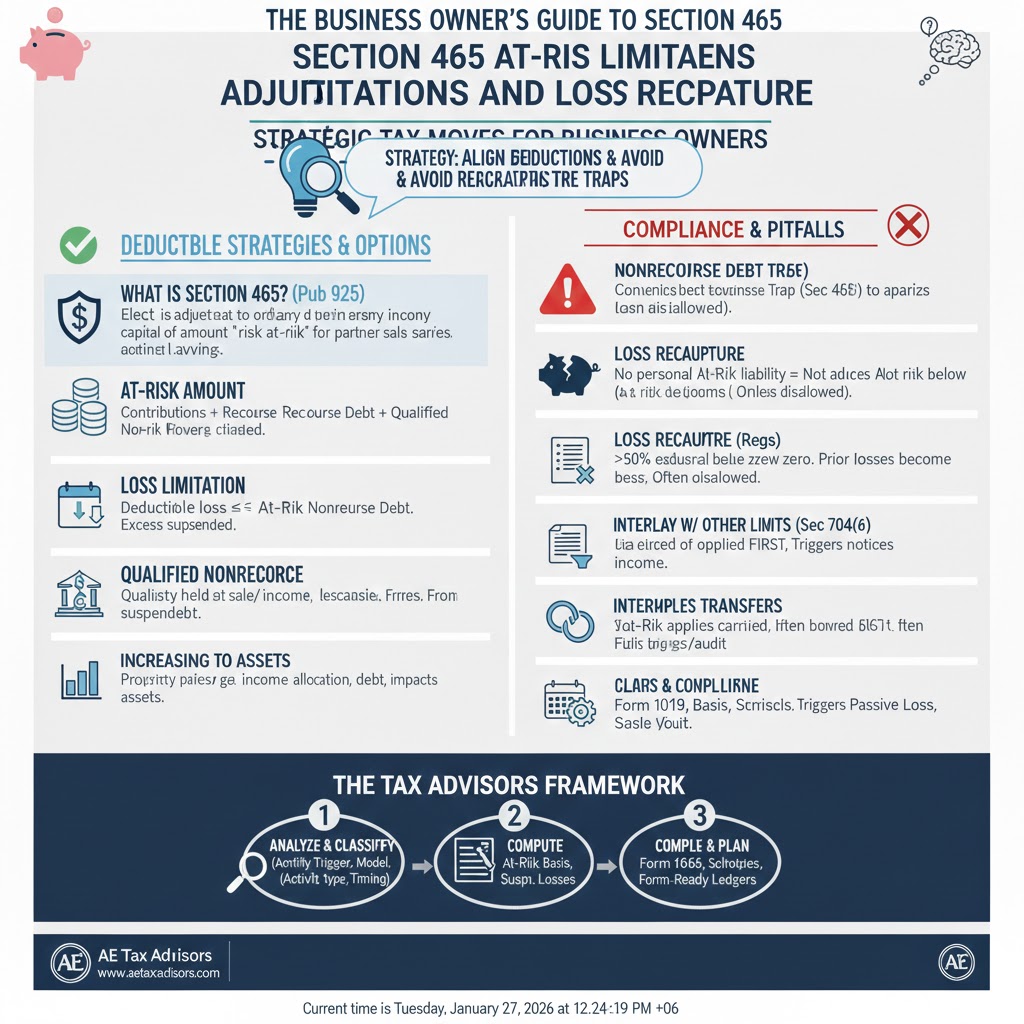
Step 18: AE Tax Advisors At-Risk Compliance Framework
- Identify at-risk activities under Section 465(c).
- Calculate each owner’s at-risk basis.
- Apply limitation and track suspended losses.
- Monitor for recapture or basis restoration events.
- Prepare Form 6198 and supporting schedules.
This framework follows IRS Publications 925, 541, and 535, ensuring full compliance and precise documentation.
Step 19: Example — Real Estate Investment At-Risk Calculation
A taxpayer invests $250,000 in cash and takes on $500,000 in qualified nonrecourse financing secured by the property.
At-risk amount = $750,000.
If the property generates a $900,000 loss due to depreciation and operating expenses:
- $750,000 is deductible this year.
- $150,000 is suspended and carried forward until additional risk is established or income offsets it.
AE Tax Advisors manages this analysis for each property and entity annually.
Conclusion: Deduct What You Truly Risk
Section 465 draws a clear line between real exposure and paper losses. By limiting deductions to true at-risk amounts, it ensures fairness and prevents abuse — but it also offers powerful opportunities for those who understand how to structure their activities properly.
At AE Tax Advisors, we design strategies to keep your losses deductible, your records compliant, and your exposure minimized. From recourse financing to qualified nonrecourse structuring, our team helps clients build legitimate at-risk basis — safely unlocking the full tax benefits of their investments.
Understanding business owners guide section is essential for maximizing your tax savings as a real estate investor.
When it comes to business owners guide section, working with a specialized tax advisor makes all the difference.
Many investors overlook business owners guide section, but it can be one of the most impactful strategies in your tax plan.
At AE Tax Advisors, we help clients navigate business owners guide section to keep more of what they earn.
Business owners guide section is one of the most important concepts for real estate investors to understand. When properly implemented, business owners guide section can lead to significant tax savings that compound over time.
Many high-income earners miss out on business owners guide section opportunities simply because their CPA lacks the specialized knowledge. A proactive approach to business owners guide section can mean the difference between overpaying and optimizing your tax position.
At AE Tax Advisors, our team specializes in business owners guide section for real estate investors and W-2 professionals. We have helped hundreds of clients use business owners guide section to reduce their tax burden by $50,000 or more annually.
The key to successful business owners guide section implementation is working with an advisor who understands real estate taxation. Every business owners guide section decision should be part of a comprehensive, multi-year tax plan.
If you are not actively using business owners guide section as part of your tax strategy, you are likely leaving money on the table. Contact AE Tax Advisors to learn how business owners guide section can work for your specific situation.
Understanding Business owners guide section
Business owners guide section is a critical component of any comprehensive tax strategy for real estate investors. At AE Tax Advisors, we help clients navigate business owners guide section to maximize their tax savings while maintaining full IRS compliance. Our proactive approach ensures you capture every available deduction and credit.
For more information, refer to the IRS.