

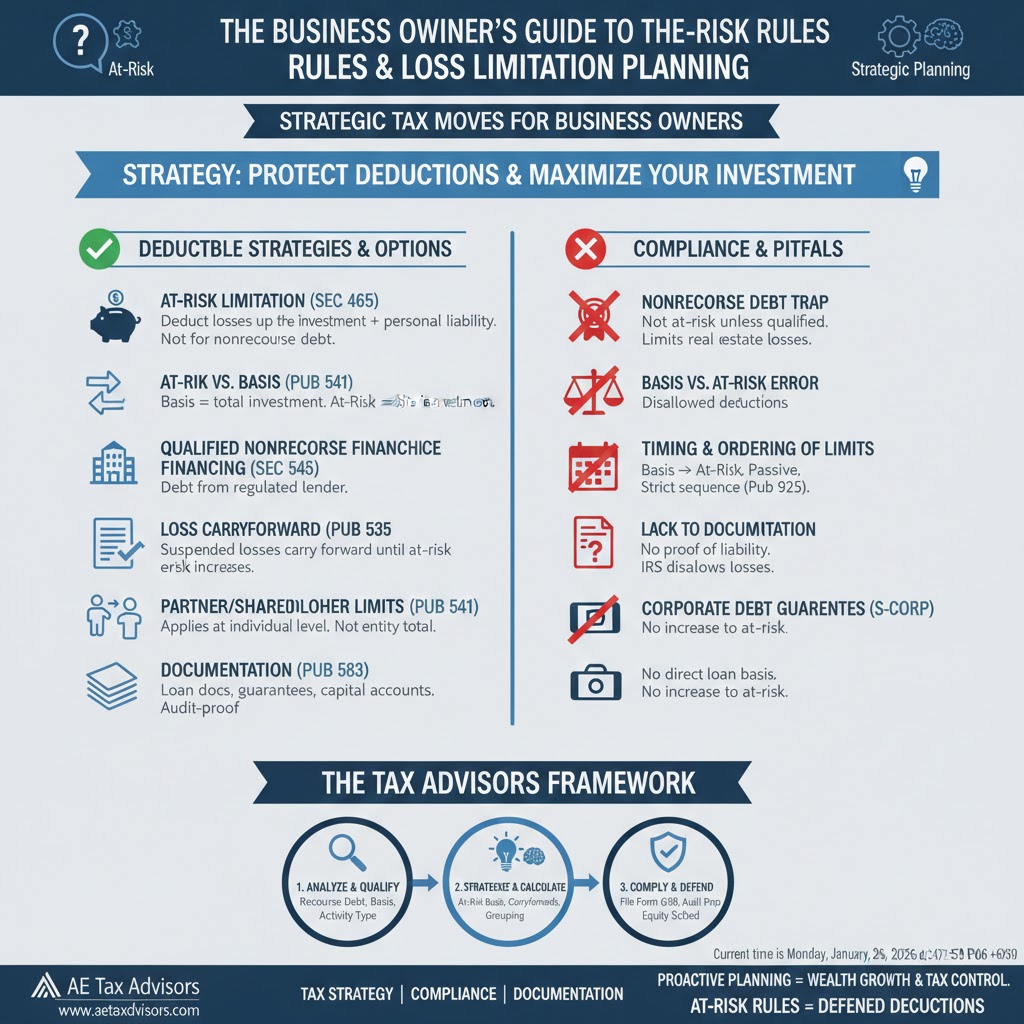
 This guide covers business owners guide at-risk and what it means for your tax situation.
Understanding The Business Owner’s Guide To in 2026
Business owners and investors often assume that if a business or investment shows a loss, it can automatically offset other income. But under IRS law, that isn’t always true. The at-risk rules limit how much loss you can deduct to the amount you’ve actually invested — the funds you truly have “at risk.”
At AE Tax Advisors, we help clients structure investments, financing, and entity ownership in compliance with IRS Publications 925, 535, and 541, ensuring that every claimed deduction is both legitimate and fully defensible.
This article builds upon The Business Owner’s Guide to Passive Loss Rules and Real Estate Professional Status, The Business Owner’s Blueprint: How to Build, Protect, and Multiply Wealth Through Entity Strategy, and The Family Office Formula.
What Are the At-Risk Rules?
The at-risk rules, introduced in the Tax Reform Act of 1976, were designed to prevent taxpayers from claiming losses exceeding the amount of money they could actually lose in a business or investment.
In short: you can only deduct losses up to the amount you have at risk — meaning actual cash invested, property contributed, or debt for which you are personally liable.
AE Tax Advisors calculates at-risk basis for every client-owned entity to determine which losses are deductible in the current year and which must be suspended or carried forward.
Step 1: The At-Risk Limitation Formula
Your at-risk amount typically includes:
- Cash and property you contributed to the activity.
- Amounts borrowed for use in the activity if you are personally liable (recourse debt).
- Income previously earned and left in the business.
It does not include:
- Nonrecourse loans (unless qualified).
- Borrowed funds for which you have no personal liability.
- Guarantees that have not been called upon.
AE Tax Advisors tracks these amounts annually in each client’s equity and basis schedule.
Step 2: At-Risk vs. Basis — The Key Difference
At-risk and basis are related but distinct concepts.
- Basis measures your total investment in the entity.
- At-risk measures how much of that investment is exposed to potential economic loss.
You may have basis in a partnership interest from nonrecourse debt, but it doesn’t count as at-risk unless you’re personally liable.
AE Tax Advisors reconciles both calculations to avoid overstating deductible losses or triggering partnership-level adjustments.
This connects directly to The Business Owner’s Guide to Passive Loss Rules and Real Estate Professional Status.
Step 3: Activities Subject to At-Risk Rules
According to IRS Publication 925, the at-risk rules apply to:
- Partnerships and LLCs.
- S-Corporations.
- Rental activities.
- Equipment leasing and other leveraged ventures.
- Any trade or business carried on for profit.
AE Tax Advisors ensures each client activity is properly classified and tracked, especially when multiple activities are grouped for tax purposes.
Step 4: How At-Risk Amounts Increase
You can increase your at-risk amount when you:
- Contribute additional cash or property.
- Earn income from the activity.
- Assume additional personal liability.
- Convert nonrecourse loans into qualified nonrecourse or recourse debt.
Example:
If you guarantee a business loan and the lender looks solely to you for repayment, that amount becomes “at risk.”
AE Tax Advisors advises clients on when personal guarantees may or may not be advisable, balancing tax benefits with liability exposure.
Step 5: How At-Risk Amounts Decrease
Your at-risk amount decreases when you:
- Withdraw cash or property.
- Deduct prior losses.
- Are relieved of debt or liability.
- Refinance or restructure into nonrecourse arrangements.
AE Tax Advisors tracks all changes to ensure proper annual carryover calculations and documentation under Publication 535.
Step 6: Qualified Nonrecourse Financing
For real estate activities, certain nonrecourse loans are treated as at-risk if they qualify under Section 465(b)(6).
Qualified nonrecourse financing means debt:
- Borrowed from a federally regulated lender or government agency.
- Secured by real property used in the activity.
- Not from a related party.
This exception is especially valuable for real estate investors who use property-secured financing.
AE Tax Advisors verifies loan documentation to determine whether debt qualifies under IRS standards.
This ties directly to The Complete Guide to Real Estate Depreciation for Business Owners.
Step 7: At-Risk Limits in Partnerships
For partnerships and LLCs, at-risk limitations are applied at the partner level. Each partner’s deductible losses are capped by their individual at-risk amount — not the total partnership loss.
AE Tax Advisors prepares partner-level schedules (K-1 supporting statements) showing how each partner’s at-risk basis is determined.
This connects directly to The Business Owner’s Guide to Depreciation and Cost Recovery.
Step 8: At-Risk Limits in S-Corporations
For S-Corporation shareholders, at-risk amounts are limited to the shareholder’s basis in stock and any direct loans made to the corporation.
You cannot include corporate-level debt unless you personally borrowed and lent the funds to the corporation.
AE Tax Advisors helps shareholders properly structure intercompany lending arrangements that build both basis and at-risk amounts.
This ties to The Business Owner’s Blueprint: How to Build, Protect, and Multiply Wealth Through Entity Strategy.
Step 9: Loss Carryforward Rules
When your losses exceed your at-risk amount, the excess is suspended and carried forward indefinitely until your at-risk amount increases.
Example:
- At-risk amount: $100,000.
- Loss: $150,000.
- $50,000 suspended and carried forward.
AE Tax Advisors maintains carryforward schedules and integrates them into multi-entity tax models for transparency and future planning.
Step 10: Ordering of Loss Limitations
When evaluating whether losses are deductible, the IRS applies three sequential limitations:
- Basis limitation — you must have basis in the activity.
- At-risk limitation — you must be at risk for the loss.
- Passive activity limitation — you must materially participate (if applicable).
AE Tax Advisors ensures losses are tested in this order to prevent errors that could trigger audit flags or IRS correspondence.
This connects directly to The Business Owner’s Guide to Passive Loss Rules and Real Estate Professional Status.
Step 11: Documentation Requirements
To substantiate at-risk calculations, maintain:
- Loan agreements and personal guarantees.
- Partnership and operating agreements.
- Capital contribution records.
- Annual K-1 basis and at-risk reconciliation statements.
AE Tax Advisors retains digital documentation for each client entity consistent with Publication 583 recordkeeping guidance.
Step 12: At-Risk and the Alternative Minimum Tax (AMT)
At-risk carryforward losses are not lost for AMT purposes, but timing differences can occur if deductions are suspended under regular tax but allowed under AMT.
AE Tax Advisors models both regular and AMT scenarios for complex partnership and real estate structures to ensure optimal timing.
Step 13: Advanced At-Risk Planning Techniques
To improve at-risk positions legally, AE Tax Advisors may recommend:
- Partner guarantees on loans to increase individual exposure.
- Capital contributions rather than debt infusions.
- Debt restructuring to convert nonrecourse to qualified nonrecourse financing.
- Grouping of activities to aggregate at-risk amounts across related ventures.
These strategies are carefully documented to meet the economic risk of loss test outlined in Reg. §1.465-1(b).
Step 14: Common Mistakes to Avoid
- Counting nonrecourse loans as at-risk without qualification.
- Ignoring debt conversions or refinancing impacts.
- Double-counting capital contributions or income credits.
- Failing to track partner-level liabilities in tiered partnerships.
- Claiming suspended losses prematurely.
AE Tax Advisors performs annual reviews of all at-risk schedules to prevent cumulative reporting errors and ensure compliance.
AE Tax Advisors At-Risk Planning Framework
- Calculate basis and at-risk for each entity.
- Separate recourse and nonrecourse financing.
- Apply qualified nonrecourse rules where available.
- Track increases, decreases, and suspended losses.
- Align with passive and material participation standards.
This framework aligns with IRS Publications 925, 535, and 541, ensuring accuracy, defensibility, and tax optimization.
Conclusion: Protect Deductions Without Crossing the Line
The at-risk rules aren’t designed to limit your success — they’re designed to align deductions with real economic exposure. When managed properly, they provide clarity, compliance, and the foundation for aggressive yet legitimate tax efficiency.
At AE Tax Advisors, we help clients design entity structures, lending arrangements, and investment strategies that stay fully within the IRS at-risk framework while capturing every allowable deduction. When it comes to risk, precision equals power — and every number must tell the same story on your tax return.
Understanding business owners guide at-risk is essential for maximizing your tax savings as a real estate investor.
When it comes to business owners guide at-risk, working with a specialized tax advisor makes all the difference.
Many investors overlook business owners guide at-risk, but it can be one of the most impactful strategies in your tax plan.
At AE Tax Advisors, we help clients navigate business owners guide at-risk to keep more of what they earn.
Business owners guide at-risk is one of the most important concepts for real estate investors to understand. When properly implemented, business owners guide at-risk can lead to significant tax savings that compound over time.
Many high-income earners miss out on business owners guide at-risk opportunities simply because their CPA lacks the specialized knowledge. A proactive approach to business owners guide at-risk can mean the difference between overpaying and optimizing your tax position.
At AE Tax Advisors, our team specializes in business owners guide at-risk for real estate investors and W-2 professionals. We have helped hundreds of clients use business owners guide at-risk to reduce their tax burden by $50,000 or more annually.
The key to successful business owners guide at-risk implementation is working with an advisor who understands real estate taxation. Every business owners guide at-risk decision should be part of a comprehensive, multi-year tax plan.
Understanding Business owners guide at-risk
Business owners guide at-risk is a critical component of any comprehensive tax strategy for real estate investors. At AE Tax Advisors, we help clients navigate business owners guide at-risk to maximize their tax savings while maintaining full IRS compliance. Our proactive approach ensures you capture every available deduction and credit.
For more information, refer to the IRS.