

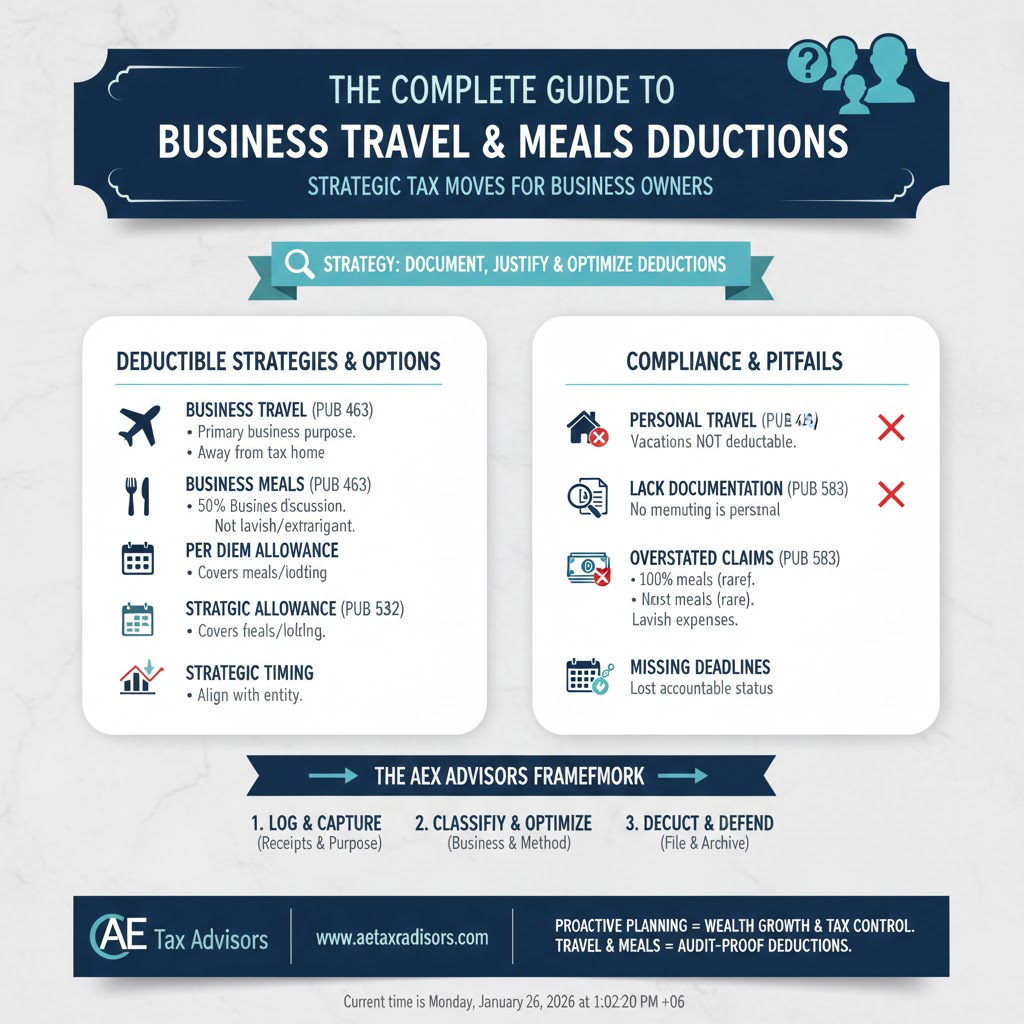
 This guide covers complete guide travel meals and what it means for your tax situation.
Understanding The Complete Guide To Travel, in 2026
Every business owner travels, eats, and entertains clients — but not every business owner deducts those expenses correctly. The IRS allows generous deductions for legitimate business travel and meals, but only if they’re properly documented and substantiated.
At AE Tax Advisors, we help business owners navigate these complex deduction rules under IRS Publications 463, 535, and 1542, ensuring that every allowable dollar is captured while staying 100% compliant.
This guide builds upon The Smart Way to Deduct Vehicle Expenses for Business, How to Set Up an Accountable Plan for Your Business, and The Ultimate Tax Checklist for Small Business Owners.
What Qualifies as Business Travel
Under Publication 463, travel expenses are deductible when they are ordinary, necessary, and directly related to business conducted away from your tax home — typically the city or area where your main business operations are located.
To qualify as business travel:
- The trip must be primarily for business, not personal.
- The destination must be outside your regular work area.
- The trip must require sleep or rest (not just day trips).
Common deductible categories include:
- Airfare, train, or bus tickets.
- Rental cars or rideshare costs.
- Hotels and lodging.
- Meals while traveling.
- Tips, baggage fees, and parking.
AE Tax Advisors reviews travel itineraries and expense logs to ensure each expense meets the “ordinary and necessary” standard outlined in Publication 535.
Step 1: Establish a Clear Business Purpose
Every deductible travel or meal expense must have a documented business purpose — a meeting, conference, client visit, or work-related event. Vague notes like “networking” or “client lunch” won’t suffice.
AE Tax Advisors recommends including:
- The who, what, when, where, and why for each expense.
- A brief summary of the business benefit gained.
- Supporting proof such as meeting invites or receipts.
This recordkeeping discipline connects directly with How to Build an Audit-Proof Recordkeeping System.
Step 2: Deducting Transportation and Lodging
Transportation expenses are fully deductible when they meet business criteria. This includes airfare, taxis, rideshares, and mileage (if using your own car).
Publication 463 allows you to choose the most reasonable and cost-effective travel option — first-class or luxury travel can be disallowed if deemed excessive.
Lodging costs are also fully deductible if required for overnight business stays. Keep itemized receipts showing the name, location, and dates of stay.
AE Tax Advisors advises clients to pay directly from business accounts to create clear audit trails.
Step 3: Deducting Meals
Business meals are typically 50% deductible under Publication 463. However, 100% deductions are allowed when meals are:
- Provided to employees at company events.
- Included in a travel per diem.
- Reimbursed under an accountable plan.
To qualify, meals must meet three tests:
- Ordinary and necessary to your business.
- Not lavish or extravagant under the circumstances.
- Incurred with a business associate (employee, client, or partner).
AE Tax Advisors helps businesses maintain digital logs recording the date, attendees, and purpose of each meal for compliance and deduction optimization.
This integrates with The Smart Way to Deduct Vehicle Expenses for Business and How to Legally Reimburse Yourself for Home Office Expenses.
Step 4: Using Per Diem Rates
Instead of tracking actual receipts, businesses can reimburse employees or owners using per diem rates — daily allowances set by the IRS for meals, lodging, and incidental expenses.
Under Publication 1542, per diem simplifies travel accounting by setting standard rates per location. The General Services Administration (GSA) updates these annually.
Example:
- GSA per diem for New York City: $297/day ($223 lodging + $74 meals).
- Instead of collecting receipts, you can reimburse this amount directly.
AE Tax Advisors helps clients establish compliant per diem policies under accountable plans to streamline reimbursements.
Step 5: Deducting Entertainment — What Still Qualifies
Since the 2018 tax law change, most entertainment expenses (like sporting events or concerts) are no longer deductible. However, certain related expenses may still qualify if they have a direct business connection.
Deductible scenarios include:
- Meals before or after a business meeting.
- Events included in employee incentive programs.
- Reimbursed client expenses included in income.
AE Tax Advisors reviews entertainment-related expenses line by line to determine which qualify under Publication 535.
Step 6: Combine Travel and Personal Days Correctly
You can still deduct business-related travel even if you include personal days — as long as the primary purpose of the trip is business.
Example:
- Fly to Los Angeles for a three-day client meeting, then stay two extra days for leisure.
- You can deduct airfare, lodging for the business days, and 50% of meals during those business days.
AE Tax Advisors calculates allocations using daily rate breakdowns to ensure deductions align with Publication 463 requirements.
Step 7: Keep Excellent Records
For every trip, maintain:
- Receipts and invoices for airfare, lodging, meals, and transport.
- Mileage logs (if applicable).
- Travel itineraries or agendas proving business purpose.
- Meeting confirmations or notes.
Publication 583 establishes record retention standards. AE Tax Advisors recommends keeping digital records for at least seven years.
This practice complements How to Build an Audit-Proof Recordkeeping System.
Step 8: Reimburse Owners and Employees Through Accountable Plans
When employees or owners pay out of pocket for business travel, reimbursements under an accountable plan remain tax-free if:
- Expenses have a business purpose.
- Receipts are submitted within 60 days.
- Excess funds are returned promptly.
Publication 463 provides the framework. AE Tax Advisors drafts written accountable plan policies to ensure compliance and streamline reimbursements.
This ties directly to How to Set Up an Accountable Plan for Your Business.
Step 9: Common Mistakes to Avoid
- No business purpose recorded. Always document “who, what, and why.”
- Missing receipts. Every expense must be supported by proof.
- Mixing personal and business funds. Keep all travel paid from business accounts.
- Overstating deductions. Meals over 50% or nonqualifying entertainment are frequent audit issues.
- Improper per diem application. Use correct location rates and timeframes.
AE Tax Advisors performs quarterly reviews of client expense reports to catch these errors early.
Step 10: Coordinate with Entity-Level Planning
The deductibility of travel and meals depends partly on your entity type:
- S-Corporations: Must reimburse owners through accountable plans.
- C-Corporations: Deduct directly from corporate income.
- Partnerships: Report reimbursements or guaranteed payments appropriately.
AE Tax Advisors aligns these deductions with your entity’s tax treatment for consistency and compliance.
This approach integrates with The Business Owner’s Blueprint and The Family Office Formula.
AE Tax Advisors Travel and Meals Deduction Framework
- Determine if the trip meets “ordinary and necessary” business standards.
- Document purpose, attendees, and receipts.
- Use per diem or actual expense method.
- Apply 50% or 100% deduction rules appropriately.
- Reimburse under an accountable plan when applicable.
- Maintain all records digitally for audit readiness.
This process aligns with IRS Publications 463, 535, and 1542, ensuring compliance while maximizing deductions.
Conclusion: Turn Every Legitimate Trip Into Tax-Efficient Growth
Travel and meals are part of doing business — and when documented correctly, they can also be powerful tax tools. With clear policies, accurate records, and proper structuring, you can enjoy the benefits of mobility and connection without losing deductions to technical errors.
At AE Tax Advisors, we help business owners apply these rules strategically, combining travel and meal deductions with entity-level planning, reimbursement systems, and long-term compliance frameworks. Every mile, meal, and meeting can strengthen your bottom line when managed the right way.
Understanding complete guide travel meals is essential for maximizing your tax savings as a real estate investor.
When it comes to complete guide travel meals, working with a specialized tax advisor makes all the difference.
Many investors overlook complete guide travel meals, but it can be one of the most impactful strategies in your tax plan.
At AE Tax Advisors, we help clients navigate complete guide travel meals to keep more of what they earn.
Complete guide travel meals is one of the most important concepts for real estate investors to understand. When properly implemented, complete guide travel meals can lead to significant tax savings that compound over time.
Many high-income earners miss out on complete guide travel meals opportunities simply because their CPA lacks the specialized knowledge. A proactive approach to complete guide travel meals can mean the difference between overpaying and optimizing your tax position.
At AE Tax Advisors, our team specializes in complete guide travel meals for real estate investors and W-2 professionals. We have helped hundreds of clients use complete guide travel meals to reduce their tax burden by $50,000 or more annually.
The key to successful complete guide travel meals implementation is working with an advisor who understands real estate taxation. Every complete guide travel meals decision should be part of a comprehensive, multi-year tax plan.
Understanding Complete guide travel meals
Related services from AE Tax Advisors: entity structuring for rental portfolios and 1031 exchange coordination.
Complete guide travel meals is a critical component of any comprehensive tax strategy for real estate investors. At AE Tax Advisors, we help clients navigate complete guide travel meals to maximize their tax savings while maintaining full IRS compliance. Our proactive approach ensures you capture every available deduction and credit.
For official IRS guidance, visit the IRS Newsroom.