
Understanding Tax Planning For High Net in 2026
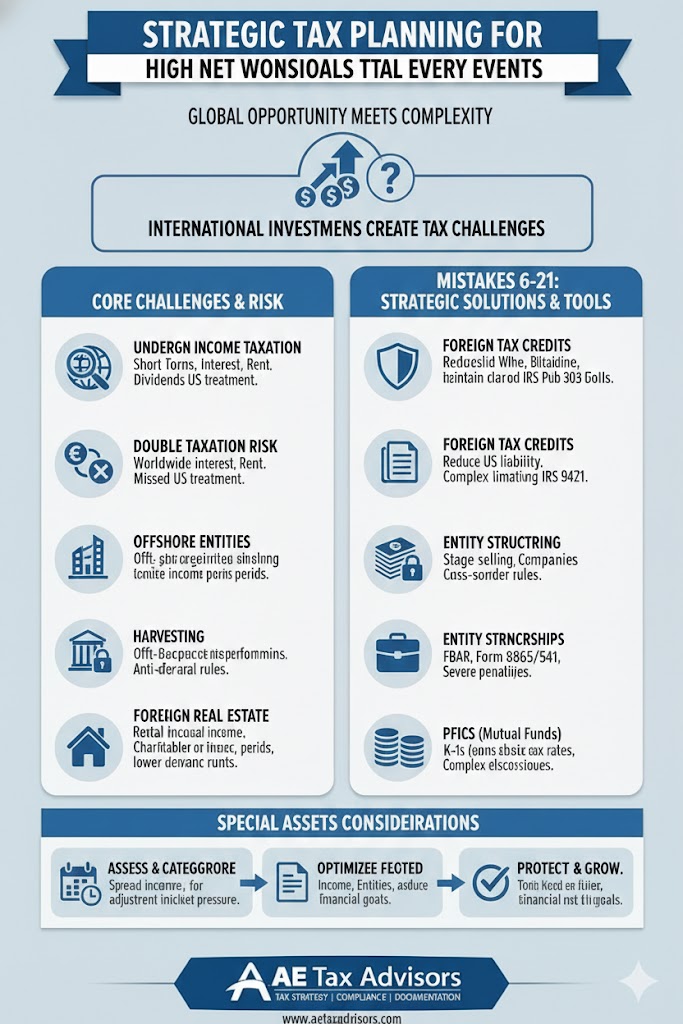
High net worth individuals increasingly diversify their portfolios by investing overseas, whether through foreign real estate, international partnerships, private funds, foreign corporations, or global markets. While international exposure builds opportunity and growth, it also introduces one of the most complicated tax environments an investor can face. Every country has its own tax rules, and the United States taxes its citizens on worldwide income. Without a coordinated global tax plan, international investments can trigger unexpected taxes, duplicate reporting obligations, compliance penalties, and reduced net returns. Effective planning turns global investing into a tax efficient component of long term wealth strategy.
The first challenge for wealthy global investors is understanding how foreign income is taxed. Dividends, interest, rental income, capital gains, and business profits from foreign sources each have their own tax treatment in the United States. Some may be eligible for foreign tax credits, while others require special elections or reporting. Without accurate categorization, high net worth individuals risk paying taxes twice on the same income or missing credits that would significantly reduce liability.
Foreign tax credits are one of the most valuable tools available. These credits allow taxpayers to reduce their US tax liability by the amount of taxes paid to a foreign country, but only when used correctly. The rules governing these credits are complex. They must be matched to the type of income, limited by specific thresholds, and allocated properly across countries. High net worth individuals with multiple international holdings need coordinated planning to ensure each foreign tax credit is maximized without violating IRS limitations.
Foreign corporations create another layer of complexity. High net worth individuals who own shares in foreign corporations may face controlled foreign corporation rules, Subpart F income, global intangible low taxed income calculations, and other anti deferral provisions. These rules are designed to prevent taxpayers from sheltering income offshore. Proper planning helps ensure that foreign business income is taxed appropriately while avoiding punitive treatment.
Passive foreign investment companies, commonly known as PFICs, are among the most challenging international tax structures for wealthy investors. Many foreign mutual funds, hedge funds, and pooled investment vehicles fall under PFIC rules. Without proper elections, PFIC income can be taxed at punitive rates with interest charges applied retroactively. High net worth individuals must evaluate their international funds carefully and make timely elections to avoid PFIC penalties. This level of oversight is essential for anyone with diversified international exposure.
Foreign real estate offers unique tax opportunities and obligations. Rental income, depreciation rules, local taxes, and property sale gains must all be coordinated across jurisdictions. Some countries impose withholding taxes or special property transfer taxes. US taxpayers must report rental income from foreign properties, track foreign depreciation schedules, and account for exchange rate variations. A coordinated plan ensures that foreign real estate remains a profitable and tax efficient part of the overall portfolio.
International partnerships and joint ventures often issue foreign K1 equivalents that contain tax attributes different from US partnerships. These investments may require additional disclosures, including Forms 8865 or 5471, depending on ownership level. High net worth investors must maintain accurate records of capital contributions, income allocation, and foreign tax credits associated with these partnerships. Proper planning ensures compliance while minimizing exposure.
Currency fluctuations add another consideration. Gains or losses arising from currency changes may be taxable depending on the type of investment. Investors with large international exposure must plan for currency impact both on returns and on tax obligations, ensuring that exchange movements do not create unwanted tax surprises.
International estate and gift tax planning becomes critical for wealthy families. Some countries impose their own inheritance taxes or place restrictions on property transfers. US citizens holding foreign assets must coordinate their US estate plan with the laws of the foreign jurisdiction to avoid unintended consequences. Trusts, holding companies, and strategic ownership structures play a major role in preserving international wealth for the next generation.
Reporting compliance is one of the most important parts of international tax planning. High net worth individuals may need to file FBARs, Form 8938, Form 5471, Form 8621, or other international information returns. These filings carry severe penalties if missed. A proactive system ensures that every asset is tracked, documented, and reported properly.
The most successful international tax strategies are integrated across countries, investment classes, entities, and long term goals. AE Tax Advisors helps high net worth clients build global tax systems that reduce exposure, protect income, and keep international investing compliant and efficient.
Understanding tax planning strategy is essential for maximizing your tax savings as a real estate investor.
When it comes to tax planning strategy, working with a specialized tax advisor makes all the difference.
Many investors overlook tax planning strategy, but it can be one of the most impactful strategies in your tax plan.
At AE Tax Advisors, we help clients navigate tax planning strategy to keep more of what they earn.
Tax planning strategy is one of the most important concepts for real estate investors to understand. When properly implemented, tax planning strategy can lead to significant tax savings that compound over time.
Many high-income earners miss out on tax planning strategy opportunities simply because their CPA lacks the specialized knowledge. A proactive approach to tax planning strategy can mean the difference between overpaying and optimizing your tax position.
At AE Tax Advisors, our team specializes in tax planning strategy for real estate investors and W-2 professionals. We have helped hundreds of clients use tax planning strategy to reduce their tax burden by $50,000 or more annually.
Understanding Tax planning
Related services from AE Tax Advisors: long-term rental tax planning and depreciation review for rental properties.
Tax planning is a critical component of any comprehensive tax strategy for real estate investors. At AE Tax Advisors, we help clients navigate tax planning to maximize their tax savings while maintaining full IRS compliance. Our proactive approach ensures you capture every available deduction and credit.
For more information, refer to the IRS.