
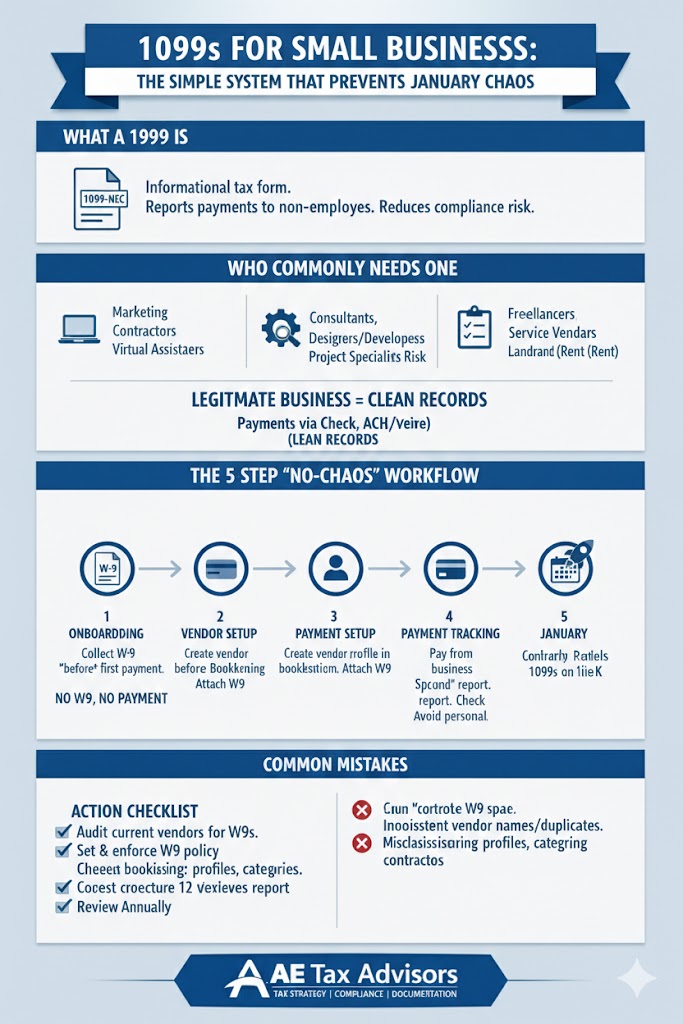
 This guide covers 1099s small businesses simple and what it means for your tax situation.
Understanding 1099s For Small Businesses: The in 2026
If you have ever tried to file 1099s in January without a plan, you know how it goes.
You scramble to figure out who you paid.
You realize you never collected W9s.
Some contractors ignore you.
Your bookkeeping vendor names are inconsistent.
Deadlines show up fast.
None of this is complicated. It is just preventable.
1099 compliance becomes easy when you build a simple system at the beginning of the year instead of treating it like an emergency in January.
This guide explains what 1099s are, who commonly needs them, what documents matter, and a practical process you can implement so 1099 season becomes routine.
What a 1099 Is
A 1099 is an informational tax form. It reports certain types of payments your business made to a non employee during the year.
The IRS uses these forms to match income. When you file 1099s correctly, you reduce compliance risk and you keep your records clean.
Many businesses think of 1099s as a burden. A better way to think of them is:
1099s are part of running a legitimate business with clean records.
Who You Might Need To Issue a 1099 To
The details can vary by situation, but the contractors that commonly trigger 1099 review include:
Marketing contractors
Virtual assistants
Bookkeepers
Consultants
Designers and developers
Project based specialists
Freelancers of all types
Certain service vendors depending on how they are structured and paid
Payments that often matter include payments made by check, ACH, wire, or cash. Payments made through certain third party networks can have different reporting mechanics, which is why you want a system to track how payments were made, not just to whom.
Do Not Guess Who Needs One
The biggest mistake is guessing.
You should review vendor details, payment methods, and totals before deciding whether a 1099 is required. Some vendors are corporations and may not require a 1099 in certain cases. Some payment networks handle reporting differently.
That is why the process is:
Collect W9s
Track payments cleanly
Run a year end vendor report
Then decide what is required
The W9: The Document That Solves Everything
A W9 is the form that gives you what you need to prepare a 1099 properly.
It provides:
Legal name
Business name if different
Tax classification
Address
Taxpayer identification number
If you collect a W9 upfront, you avoid the January scramble.
The best policy is simple.
No W9, no payment.
If you do not want to be strict, at least do this:
No W9 means the vendor is flagged and paid only after W9 is received unless there is an emergency.
Most businesses regret being casual here.
Bookkeeping Cleanup That Makes 1099s Easy
Most 1099 problems are bookkeeping problems.
Here are the fixes that make 1099 reporting easy.
- Use consistent vendor names
Do not use “Mike,” “Mike contractor,” and “Mike LLC” randomly. Pick one vendor profile. - Track vendor type
Mark whether a vendor is a contractor and store their W9 in your bookkeeping or document system. - Categorize contractor spend correctly
Contractor payments should not get buried in random categories. - Track payment method
Knowing whether you paid by check, ACH, or a third party processor matters for reporting. - Reconcile monthly
If you reconcile monthly, year end reports are accurate. If you do not, you chase errors in January.
A Practical 1099 Workflow
Here is a system that works for most small businesses.
Step 1: Onboarding
When you hire a contractor, collect W9 before the first payment.
Step 2: Vendor setup
Create a vendor profile in bookkeeping with consistent naming. Attach the W9.
Step 3: Payment tracking
Pay contractors from one business account whenever possible. Avoid paying contractors from personal accounts.
Step 4: Monthly review
Once per month, run a contractor spend report and make sure vendor names and categories are correct.
Step 5: Year end review
In early January, run your final contractor report, confirm totals, and file required 1099s.
This turns 1099 season into a final step, not a desperate cleanup.
Common Mistakes
These are the errors that cause January chaos.
Collecting W9s after you already paid
Paying contractors through personal accounts
Inconsistent vendor naming and duplicate vendors
Misclassifying contractors as “supplies” or “miscellaneous”
Using cash with no records
Waiting until late January to start collecting information
Forgetting to confirm vendor address or tax ID accuracy
Most mistakes come from lack of a process, not from complexity.
Action Checklist
- Make W9 collection part of your contractor onboarding
- Set a policy: no W9, no payment, or at least no W9 means flagged
- Create clean vendor profiles in bookkeeping with consistent names
- Track contractor payments from one business account
- Review contractor spend monthly
- Confirm payment methods and vendor classifications
- Run a year end 1099 readiness report in December or early January
- File on time and store forms with your tax records
Conclusion
1099 reporting does not have to be painful.
If you collect W9s upfront and keep bookkeeping clean, 1099 season becomes a routine administrative step instead of a stressful event.
AE Tax Advisors helps business owners build contractor onboarding systems, clean up bookkeeping for 1099 reporting, and coordinate year end compliance so you avoid penalties and reduce stress.
If you want help setting up a simple 1099 workflow for your business, we can help you build a process your team can run every year without chaos.
Understanding 1099s small businesses simple is essential for maximizing your tax savings as a real estate investor.
When it comes to 1099s small businesses simple, working with a specialized tax advisor makes all the difference.
Many investors overlook 1099s small businesses simple, but it can be one of the most impactful strategies in your tax plan.
At AE Tax Advisors, we help clients navigate 1099s small businesses simple to keep more of what they earn.
1099s small businesses simple is one of the most important concepts for real estate investors to understand. When properly implemented, 1099s small businesses simple can lead to significant tax savings that compound over time.
Many high-income earners miss out on 1099s small businesses simple opportunities simply because their CPA lacks the specialized knowledge. A proactive approach to 1099s small businesses simple can mean the difference between overpaying and optimizing your tax position.
Understanding 1099s small businesses simple
Related services from AE Tax Advisors: cost segregation studies and discover how AE Tax Advisors can help.
1099s small businesses simple is a critical component of any comprehensive tax strategy for real estate investors. At AE Tax Advisors, we help clients navigate 1099s small businesses simple to maximize their tax savings while maintaining full IRS compliance. Our proactive approach ensures you capture every available deduction and credit.
For more information, refer to the IRS.